Turn Glass into Steel:
Fortify the Skeleton.
A diagnosis of low bone density or osteoporosis changes how you view the world. Suddenly, a simple rug becomes a hazard, and picking up your grandchild feels terrifying. The instinct is to sit down, rest, and stop moving to protect yourself. This is the worst thing you can do. Bones are living tissue that rapidly weaken when ignored, and calcium pills alone cannot save them. We offer physician-monitored osteoporosis physical therapy. By utilizing safe, clinically prescribed load-bearing protocols and advanced fall-prevention strategies, we help you build an impenetrable muscular armor around your skeleton, preventing devastating fractures and restoring your independence.
The Law of Structural Demand
<h3>Why Resting is Destroying Your Skeleton</h3>
Recent health statistics from 2025 reveal an alarming reality: 6 out of 10 Filipino adults are currently at risk of osteopenia or full-blown osteoporosis. The immediate reaction to this diagnosis is paralyzing fear. You begin to treat your body like it is made of delicate glass (malutong ang buto). You stop walking on uneven surfaces, you avoid carrying groceries, and you resign yourself to sitting in a chair to stay safe. However, human biology operates on a strict "use it or lose it" principle known as Wolff’s Law. Bones do not absorb calcium just because you swallow a vitamin; they absorb calcium and lay down new, dense tissue only when they are mechanically challenged by physical stress. When you stop moving to "protect" yourself, your brain assumes you no longer need a strong skeleton and actively accelerates bone loss.
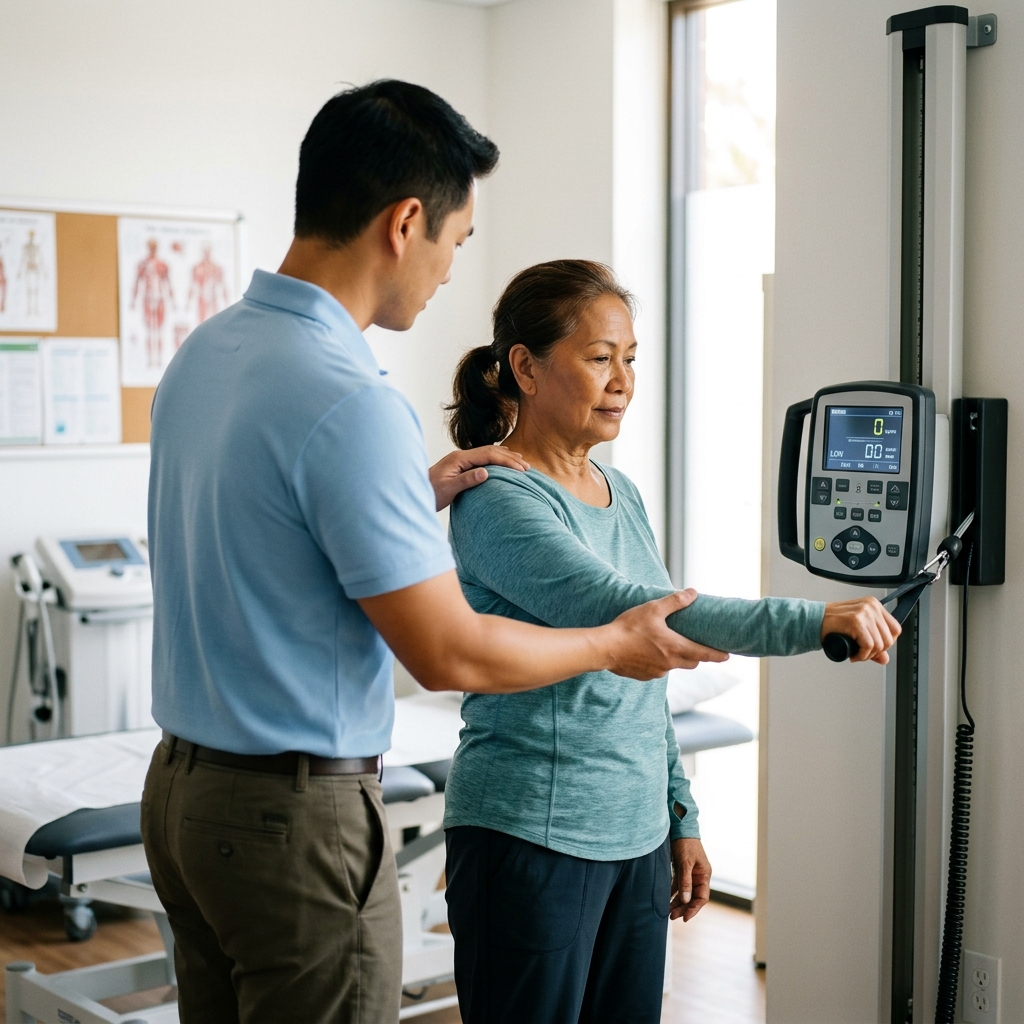
To make your bones stronger, you must safely load them. But lifting weights with compromised bones requires millimeter-level medical precision. You cannot entrust a fragile spine to a standard commercial gym trainer. Our clinical protocols are designed to transition your skeletal mindset from fragile to anti-fragile. We act as the architectural engineers of your body, applying perfectly dosed, physician-monitored mechanical stress to your hips and spine to naturally stimulate bone growth without ever crossing the threshold into danger.
<strong>Practitioner's Insight:</strong> When treating local patients for severe osteoporosis in our Vigan City clinic, my absolute first clinical objective is to eliminate the terror of falling. We call it "Iwas Tumba" (Fall Prevention). An osteoporotic bone rarely breaks on its own; it breaks because the surrounding muscles were too weak to catch the patient when they stumbled. Before we even focus on increasing your bone density, we aggressively rebuild your muscular scaffolding and your neurological balance. Once we have built that protective armor around your fragile bones, we can safely introduce the load-bearing physical therapy required to fortify the skeleton from the inside out.
Comprehensive Skeletal Preservation
Moving from Fragility to Empowerment
In our clinical experience in Ilocos Sur, many patients do not seek help until after they have broken a hip and endured traumatic surgery. Bone health is about absolute prevention. Our clinic provides the safest possible environment to rebuild your strength.
Who Needs a Clinical Bone Health Assessment?
Ideal indications
You are a woman over the age of 50 (or post-menopausal) and want to proactively prevent your bones from deteriorating.
You have recently been diagnosed with Osteopenia or Osteoporosis via a bone density test (DEXA scan) and realize that calcium pills are not enough.
You or your elderly parents are experiencing frequent stumbling, dizziness, or a profound fear of falling in the bathroom or on stairs.
You suffer from a stooped posture and dull, aching pain in your mid-back (masakit ang buto buto), which may indicate silent vertebral compression fractures.
You want to lift weights to strengthen your bones (pampatibay ng buto) but are absolutely terrified of injuring yourself at a commercial gym.
Clinical precautions
You have suffered an acute, unhealed fracture within the last few weeks. We must wait for primary orthopedic healing (callus formation) before initiating load-bearing physical therapy.
You suffer from severe, uncontrolled vertigo that has not been medically stabilized, making weight-bearing balance exercises an immediate hazard.
Why You Need a Physiatrist, Not a Gym Trainer
The 'Rest and Pills' Approach
Taking basic calcium supplements and avoiding all physical activity to 'stay safe.'
Standard Commercial Gyms
Hiring a general fitness trainer to guide you through standard gym machines or yoga classes.
Clinical Physiatric Rehabilitation
A Board-Certified Physiatrist reviews your bone density scans and prescribes a millimeter-precise, zero-flexion, high-load physical therapy program.
Clinical Science & Technical Details
For our medical colleagues and highly analytical patients, we provide these transparent technical details on the pathophysiology and interventional protocols.
Explore the Clinical Science: Wolff’s Law and Mechanotransduction
The core foundation of our osteoporosis rehabilitation program is anchored in the physiological principle of Mechanotransduction. When bone tissue (specifically the osteocytes) experiences mechanical deformation (strain) from muscular contractions and weight-bearing forces, a cascade of biochemical signals is triggered.
These signals actively inhibit osteoclasts (the cells that break down bone) and forcefully stimulate osteoblasts (the cells that build new bone matrix). Passive activities like swimming or cycling, while excellent for cardiovascular health, provide zero osteogenic (bone-building) stimulus because they do not subject the axial skeleton to gravitational loading. Our targeted physical therapy protocols utilize specific ground-reaction forces and high-intensity, low-velocity resistance training to generate the exact threshold of micro-strain required to force the bone to adapt, thicken, and increase its mineral density, effectively halting the progression of osteopenia.
Detailed Diagnostic Pathways: Understanding Your DEXA T-Score
At Tera Care, we do not guess the structural integrity of your bones. Treatment intensity is strictly guided by the results of your Dual-Energy X-ray Absorptiometry (DEXA) scan.
Dr. Rabara meticulously reviews your T-scores. A T-score between -1.0 and -2.5 indicates Osteopenia (low bone mass), where our goal is aggressive reversal and fortification. A T-score of -2.5 or lower confirms Osteoporosis. In these cases, particularly if there is a history of fragility fractures (which automatically elevates the patient to a 'Very High Fracture Risk' category according to the 2025 Clinical Practice Guidelines), our physical therapy protocols are heavily modified. We strictly avoid spinal flexion (bending forward) and aggressive twisting motions, focusing entirely on isometric spinal stabilization, hip abductor strengthening, and pharmacological coordination with your endocrinologist or rheumatologist.
Inside the Procedure: The Absolute Contraindication of Spinal Flexion
The most critical aspect of osteoporotic physical therapy is knowing what not to do. The anterior portion (the front) of the vertebral body is composed of highly porous trabecular bone, which deteriorates rapidly in osteoporosis.
When an osteoporotic patient performs spinal flexion under load (e.g., doing a traditional sit-up, touching their toes, or using a seated crunch machine at a gym), immense compressive force is localized on the anterior aspect of the weakened vertebrae. This is the primary mechanism of injury for anterior wedge compression fractures. Dr. Rabara’s clinical protocols strictly utilize 'Hip Hinging' mechanics and isometric core stabilization (like modified planks and anti-rotation press-outs). We teach the patient how to lock the spine in a rigid, neutral position and pivot entirely from the ball-and-socket hip joint, allowing them to lift heavy loads and stimulate bone growth without ever exposing the spine to sheer stress.
Comprehensive Bone Health & Osteoporosis Guides
Explore our library of physician-led resources to understand bone density, demystify supplements, and learn how to safely build skeletal strength in the Philippines.
How to Make Bones Stronger: Calcium, Vitamin D & Osteoporosis Diet
Demystify bone nutrition. Why calcium pills alone won't work and how physical therapy 'activates' your supplements.
Osteoporosis Symptoms & Causes: Why Bone Pain Isn't Normal
The 'silent' nature of bone loss. Differentiating between joint pain and bone pain from micro-fractures.
Bone Density Test & DEXA Scans: Osteopenia vs. Osteoporosis Explained
Understand your T-score, bone density scan costs in the Philippines, and PhilHealth coverage realities.
Weight Bearing Exercises & Physical Therapy for Osteoporosis
Wolff's Law in action. Safe, zero-flexion protocols to build bone mass without risking spinal fractures.
Osteoporosis Treatment Guidelines: Can You Reverse Bone Loss Naturally?
The latest clinical guidelines. Can osteopenia be reversed? A look at pharmacotherapy and mechanical loading.
Osteoporosis Doctor in Vigan: Fall Prevention & Bone Health Clinic
Meet your local specialist for geriatric structural rehab. Why 'Iwas Tumba' is your best fracture protection.
Masakit ang Buto-Buto? Sintomas ng Osteoporosis at Mahinang Buto
Validate your pain in Taglish. Understanding brittle bones (malutong na buto) and when to get tested.
Gamot at Vitamins Para sa Osteoporosis: Paano Tumibay ang Buto?
Milk isn't enough. Why pampatibay ng buto requires medical guidance and actual physical movement.
Iwas Tumba: Doctor at Physical Therapy Para sa Buto sa Vigan
Preventing 'bali sa balakang'. Detail our safe ehersisyo para sa matanda and balance training program.
Your Armor Against Fractures
Step 1: The Architectural Audit (DEXA & Gait Review)
We begin with a deep medical analysis. Dr. Rabara will review your bone density scan to pinpoint exactly where your skeleton is the weakest (typically the femoral neck of the hip or the lumbar spine). We then conduct a rigorous Fall Risk Assessment, analyzing your gait (how you walk), your visual tracking, and your baseline leg strength.
Step 2: Neurological Balance & Fall Prevention
Before we load the bones, we must stabilize the body. We call this "Iwas Tumba" training. We utilize specialized clinical equipment to retrain your nervous system. You will practice safely reacting to loss of balance in a harnessed or highly controlled environment, ensuring that if you ever trip on a rug at home, your reflexes will instantly catch you before you hit the ground.
Step 3: Targeted, Safe Mechanical Loading
This is where bone density is built. Using precise clinical resistance equipment, we apply safe, calculated pressure to your bones. We focus heavily on strengthening the hip abductors and the spinal erectors. By forcing your muscles to pull fiercely against your bones in a completely safe, perfectly aligned position, we biologically trigger your body to lay down new, dense bone tissue.
Step 4: Medical Management & Postural Correction
Osteoporosis causes the spine to collapse forward. We aggressively train your upper back to pull your shoulders back, opening your chest and protecting your vertebrae from compression. Concurrently, Dr. Rabara can collaborate with your primary doctor regarding the advanced medical management of osteoporosis, ensuring your pharmacological treatments (like Bisphosphonates or Denosumab) are perfectly aligned with your physical therapy.