Stop Guessing.
Revolutionize Your Diagnostic Path.
Don't wait weeks for answers. Musculoskeletal (MSK) Ultrasound provides real-time, high-resolution imaging of your joints and tendons—allowing for an immediate, moving diagnosis.
What is Diagnostic Musculoskeletal (MSK) Ultrasound?
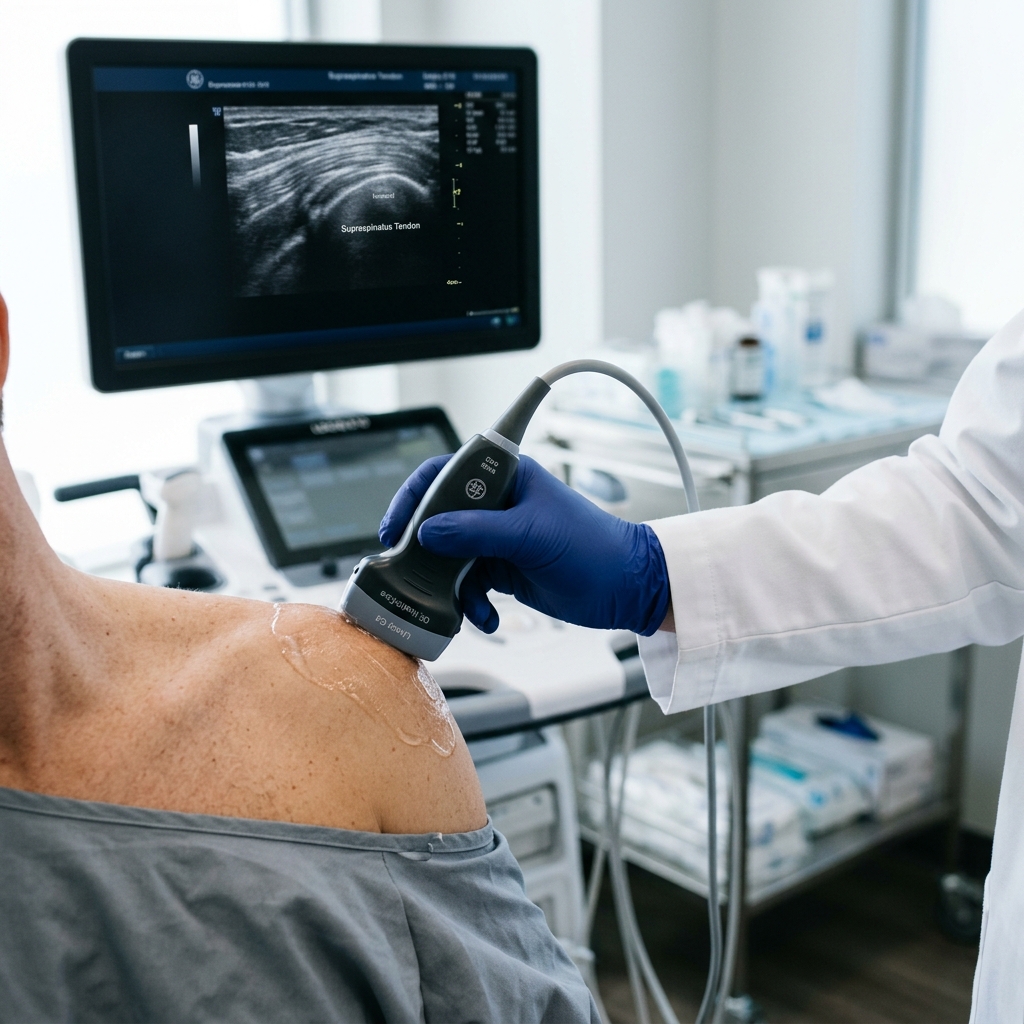
For decades, patients with joint or tendon pain were sent for X-rays (which cannot see soft tissue) or expensive MRIs (which require lying perfectly still). Musculoskeletal (MSK) Ultrasound revolutionizes the diagnostic process. Utilizing high-frequency sound waves, this advanced imaging technology creates high-resolution, real-time pictures of your muscles, tendons, ligaments, nerves, and joints entirely without the use of harmful radiation.
The greatest clinical advantage of MSK Ultrasound is that it is a dynamic study. Pain rarely happens when you are lying perfectly still; it happens when you move. Unlike an MRI, an ultrasound allows Dr. Rabara to actively move your joint while scanning the tissue. We can actually watch the tendon glide, observe the ligament stretch, and pinpoint exactly when and where the impingement or inflammation occurs.
What Conditions Can MSK Ultrasound Detect?
Is MSK Ultrasound
the Right Test for You?
Musculoskeletal Sonography is the gold standard for dynamic tissue assessment.
Ideal indications
Suspected rotator cuff or Achilles tendon tears.
Lumps or bumps that need soft-tissue differentiation.
Nerve entrapments like Carpal Tunnel Syndrome.
Pain that only occurs during specific joint movements.
Clinical precautions
Suspected deep joint pathology (e.g., meniscus tears deep in the knee or spinal disc herniations).
Evaluation of internal bone structure or marrow abnormalities.
The Realities of
Diagnostic Ultrasound
Because it relies on sound waves rather than radiation, there are virtually zero medical risks. However, there are important clinical realities:
Highly Operator Dependent
Accuracy depends entirely on the physician holding the probe. As a trained Physiatrist, Dr. Rabara possesses the specialized skill to accurately interpret these scans.
Penetration Limits
Ultrasound waves cannot see through dense bone. If you have a deep meniscus tear or a slipped disc deep in the spine, an MRI will likely still be necessary.
How Does Ultrasound
compare to Other Scans?
High-Resolution Soft Tissue Imaging Without Radiation
Traditional X-Ray
Evaluating bone fractures and late-stage joint arthritis.
Blind to soft tissues; exposes body to ionizing radiation.
Diagnostic MSK Ultrasound
Real-time imaging of soft-tissue tears, active inflammation, and fluid.
Cannot penetrate through deep bone to see deep joint structures.
MRI Imaging
Deep joint evaluation, spinal discs, and complex bone abnormalities.
Static, highly expensive, claustrophobic, and often long wait times.
Advanced Scanning
Technology
What to Expect During Your Real-Time Scan
Real-Time Visualization: The Tech Behind the Probe
Musculoskeletal ultrasound relies on the principle of acoustic impedance to visualize tissue architecture. Normal tendons exhibit a highly organized, hyperechoic "fibrillar pattern" when viewed longitudinally—often described as a series of parallel linear echoes representing collagen fascicles.
A critical technical concept in MSK ultrasound is Anisotropy. Because of the linear arrangement of tendon fibers, if the ultrasound beam is not perfectly perpendicular to the tissue, the tendon will artifactually appear dark, potentially mimicking a tear. This is why specialized training in ultrasound physics and beam angle optimization is mandatory.
Dynamic Testing: The Biomechanical Advantage Over MRI
The single greatest clinical advantage of MSK Ultrasound is its dynamic capability. Traditional MRI and CT scans are "static"—they take a snapshot while the patient is perfectly still.
During your evaluation, Dr. Rabara can actively move your joint while the probe is on the skin, allowing us to watch the tendon glide beneath the bone in real-time. We can pinpoint exactly where the 'catch' or 'impingement' happens.
Diagnostic Advantages of High-Frequency Sound Waves
Unlike X-rays or CT scans, which utilize ionizing radiation, MSK ultrasound is based on the Piezoelectric Effect. The transducer probe contains specialized crystals that vibrate, producing sound waves.
Because there is no radiation, ultrasound is exceptionally safe for repeated use, monitoring healing progress over time, and for use in pediatric or pregnant patients.
MSK Ultrasound Diagnostic Guides
Explore how real-time, dynamic imaging pinpoint muscle, tendon, and joint injuries without radiation.
Shoulder Pain Causes: Ultrasound vs. MRI for Rotator Cuff Tears
Explain why chronic shoulder pain often doesn't show up on X-rays. compare MSK Ultrasound directly to MRI.
Swollen Joints & Knee Popping: Why You Need an MSK Ultrasound
Address the mystery of swollen and clicking knees using dynamic fluid detection.
Morning Heel Pain? Diagnosing Plantar Fasciitis & Achilles Tears
Differentiate a simple sprain from a torn ligament using diagnostic imaging.
Tendonitis vs. Bursitis: Symptoms & Accurate Ultrasound Diagnosis
Clarify the anatomical difference between tendonitis and bursitis in real-time.
X-Ray vs. Ultrasound for Pain: Finding Hidden Torn Ligaments
The 'Dynamic Truth' framework. Explain why X-rays only see bone while ultrasound sees everything else.
MSK Ultrasound Cost in the Philippines (Joint Diagnostics in Vigan)
Total financial transparency. Detail the cost of joint imaging in Vigan.
Pilay o Napunit na Muscle? Bakit Mas Maganda ang Ultrasound sa X-Ray
Dispel the 'X-ray fixes everything' myth for severe pilay (sprains).
Namamagang Tuhod: Lunas at Ultrasound Para sa Tubig at Napunit na Litid
Focus strictly on knee mechanics and tubig (effusion) detection.
Magkano ang Ultrasound sa Joints, Balikat, at Kamay? (Klinika sa Vigan)
Direct purchasing guidance for local patients in Northern Luzon.
The 3-Step Clinical Process
Targeted Physical Examination
We begin with a focused musculoskeletal exam to identify the specific area of pain and isolate the biomechanical dysfunction.
Real-Time Dynamic Scanning
Applying a water-based gel, Dr. Rabara glides the high-frequency probe over the affected area while you move the joint.
Immediate Diagnosis & Strategy
We explain the findings on the screen immediately and map out your recovery plan during the very same visit.