Stop Guessing.
Map the Source of Your Pain.
Don't let numbness, tingling, or radiating pain go undiagnosed. Our precision diagnostic suite provides the objective data needed to map your nerve health and build a targeted recovery plan.
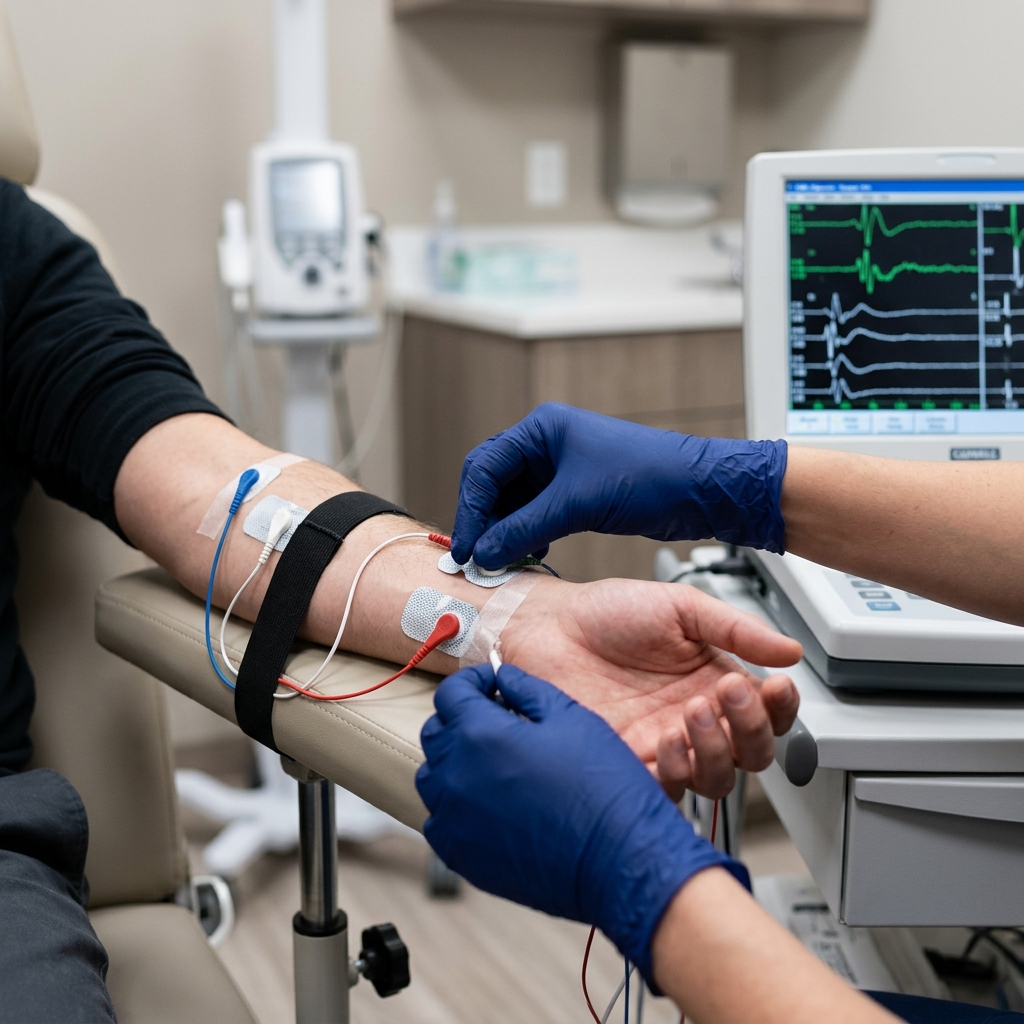
What is Precision EMG-NCV Diagnostic Testing?
When you experience shooting pain, muscle weakness, or a persistent 'pins and needles' sensation, the problem often originates deep within your nervous system. Standard physical exams and X-rays cannot see how your nerves are functioning. Precision Electromyography (EMG) and Nerve Conduction Velocity (NCV) testing are the clinical gold standards for evaluating the true physiological health of your peripheral nerves and muscles.
This diagnostic procedure is actually two separate, complementary tests. The NCV (Nerve Conduction Velocity) test utilizes mild electrical impulses applied to the skin to measure exactly how fast and how well your body's electrical signals are traveling along your nerve pathways. The EMG (Electromyography) portion involves inserting a microscopic, sterile pin directly into specific muscles to record their electrical activity, both at rest and during contraction. Together, these tests allow Dr. Rabara to map the exact location and severity of nerve compression, axonal damage, or demyelination.
What Conditions Does an EMG-NCV Diagnose?
Is an EMG-NCV
Right for You?
Early detection of nerve compression is critical. Prolonged nerve entrapment can lead to irreversible axonal damage and permanent muscle atrophy.
Ideal indications
Frequent dropping of objects or noticeable loss in grip strength.
Awakening with numb, tingling, or 'asleep' extremities.
Electric-like pain radiating down the cervical or lumbar spine.
Requirement for objective data before considering spinal surgery.
Clinical precautions
Active bleeding disorders or use of heavy anticoagulants (Precautions).
Cardiac pacemakers or implanted medical devices (Must disclose).
Active skin infections at proposed diagnostic insertion sites.
The Realities of
Nerve Testing
We prioritize your clinical comfort, but it is important to set honest expectations about the procedure:
Honest Feedback
The NCV portion feels like mild electrical shocks. The EMG involves a tiny sterile needle. Most find it entirely worth the accuracy.
No Downtime
There is absolutely no sedation. You can immediately return to work, drive, or exercise after the test.
Expert Interpretation
The accuracy depends on the physician's skill. Dr. Rabara interprets complex waveforms in real-time.
MRI vs.
EMG-NCV Testing
The MRI (The Picture)
Like a high-resolution photo of wires in a house. It shows if a wire looks pinched, but not if electricity is flowing.
The EMG (The Electricity)
Acts as an electrician's multimeter. It provides objective data to prove whether that compression is causing damage.
In-Depth Clinical Science
Technical documentation for medical colleagues regarding electrodiagnostic pathophysiology.
Explore the Clinical Science: Wallerian Degeneration & Axonogenesis
Electrodiagnostics (EDX) allows us to quantify nerve health. When an axon is severely compressed, it undergoes Wallerian Degeneration distal to the injury site.
We identify spontaneous activity (fibrillation potentials, positive sharp waves) indicating 'denervation', allowing us to predict recovery vs permanent loss.
Detailed Diagnostic Pathways: Cervical & Lumbar Radiculopathy
We utilize the 'H-Reflex' and 'F-Wave' latencies to evaluate the proximal nerve segments closer to the spine, inaccessible by standard NCV.
This allows us to differentiate between localized entrapment (like Carpal Tunnel) and spinal root compression (Radiculopathy).
Precision Nerve Diagnostic Guides
Expert resources on identifying the exact source of numbness, tingling, and chronic nerve pain.
Numbness in Hands & Carpal Tunnel Syndrome: Do You Need an EMG?
Differentiate between sleeping on an arm awkwardly and actual, progressive nerve entrapment.
Pinched Nerve & Sciatica Pain: Why an MRI Isn't Always Enough
An MRI takes a picture of the spine's structure, but an EMG tests the actual live electrical current.
Tingling & Burning Feet: Diagnosing Diabetic Peripheral Neuropathy
Address the systemic nerve damage caused by diabetes or circulatory issues.
What is an EMG-NCV Test? Finding the Cause of Muscle Weakness
Break down the two distinct parts of the procedure: NCV vs. EMG.
Does an EMG Test Hurt? Preparation & What to Expect
Tackle the 'fear of the needle and shock' directly. Validate and normalize the procedure.
EMG-NCV Test Cost in the Philippines (Nerve Clinic in Vigan)
Total financial transparency. Detail the cost of precision diagnostics in the Ilocos Region.
Manhid at Tusok-Tusok sa Kamay at Paa? Test Para sa Nerve Damage
Relatable symptom checking for chronic manhid and tusok-tusok.
Naipit na Ugat sa Likod: Para Saan ang EMG Test?
Translate radiculopathy into ipit na ugat for local patient understanding.
Magkano ang EMG NCV Test sa Pilipinas? (Klinika sa Vigan)
Actionable purchasing guidance for local patients in Vigan.
The 3-Step Testing Process
The Nerve Conduction Study (NCV)
We place surface electrodes on your skin and deliver brief, mild electrical impulses to map nerve speed and signal strength.
The Electromyography (EMG)
A micro-needle electrode is gently inserted into specific muscles to record internal electrical activity and detect muscle denervation.
The Clinical Diagnosis
Dr. Rabara analyzes the complex waveforms immediately to provide you with a precise, actionable diagnosis of your nerve health.