
- — Back pain, sliding or a rounded posture in a wheelchair should prompt a fit and function review before buying a new cushion or posture gadget.
- — A custom molded wheelchair seat may help a defined positioning problem, but it should be assessed and trialled as part of the complete chair system.
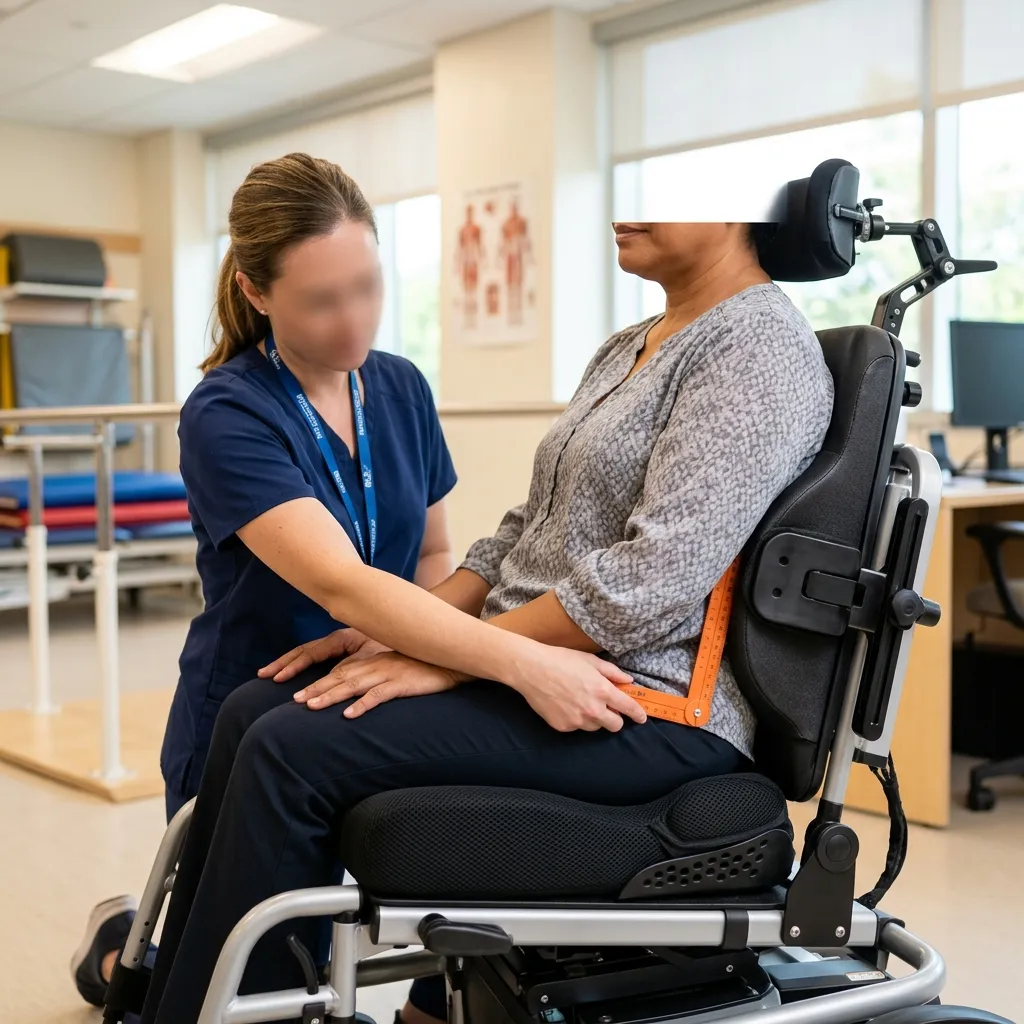
- — A wheelchair seating assessment reviews the person, pelvis, trunk, skin, sensation, movement, transfers, environment and daily goals—not just seat width.
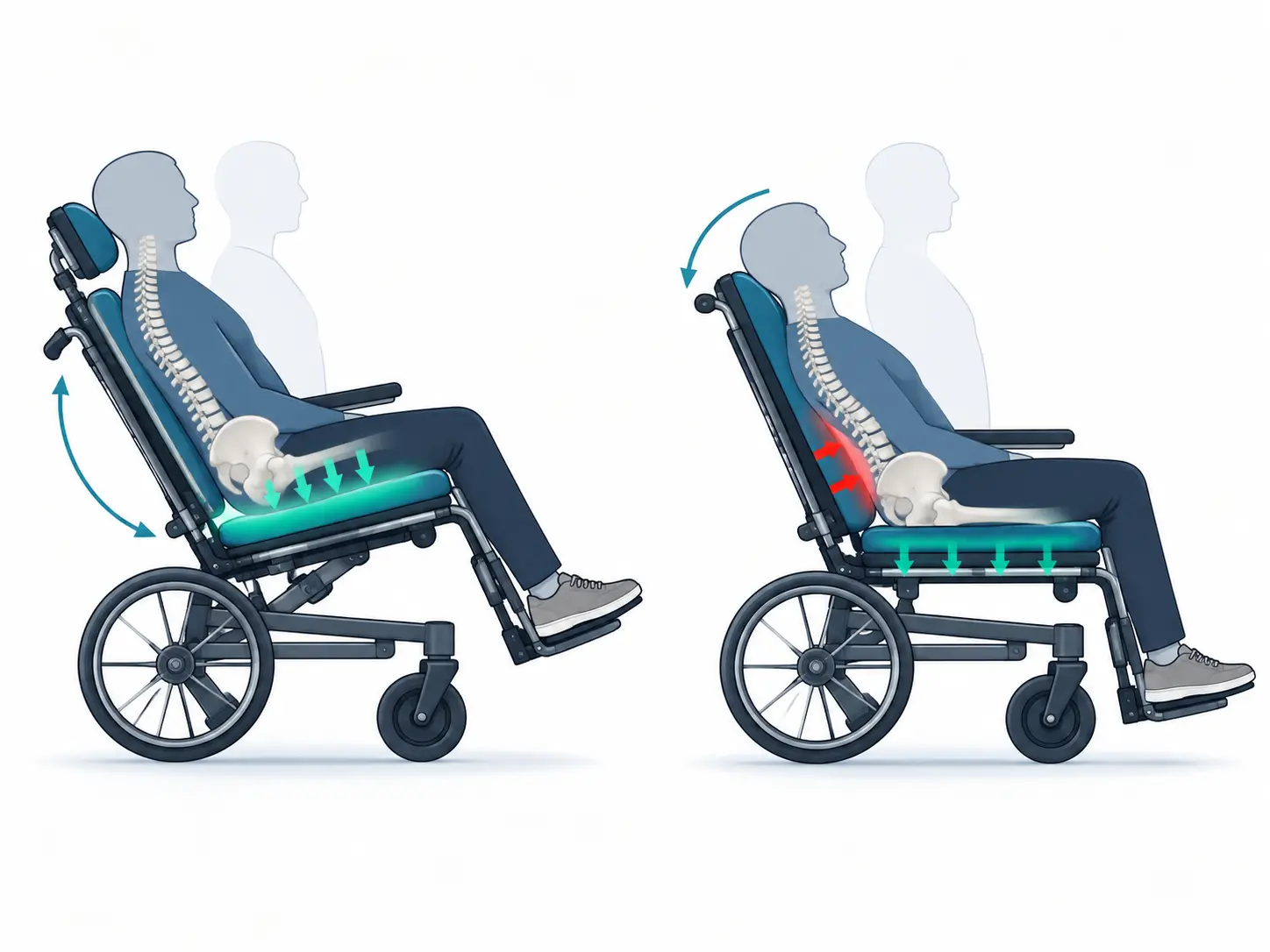
- — Tilt, recline and pressure-relief features are not universal prescriptions. Use them only after a trained clinician has shown the person and caregiver how to use them safely.
If sitting in a wheelchair leaves you with back pain, sliding, leaning or a rounded posture, the useful first question is not “Which ergonomic cushion should I buy?” It is “What changed in the person, the chair or the daily routine?” Wheelchair fit, sitting duration, wheelchair skills and cognitive status can all influence seated posture, and poor fit can be associated with pain and pressure injuries (PMID: 32657850; PMID: 37471445).
Wheelchair seating and positioning: start with the whole person?
Ergonomic wheelchair seating is not simply adding more padding. It is the process of matching the person’s posture, movement, skin and participation needs with the complete chair system. That includes the seat base, cushion, back support, foot support, arm support, frame, controls and any tilt or recline features.
A seating decision should also include the environment. A chair that works in a clinic may be difficult to turn in the home, load into a vehicle, push on a slope or manage during a transfer. Ask who will use the brakes and controls, who will check the skin, who will charge or repair the equipment, and what the person wants to do while seated.
Research does not support presenting one “posture correction” product as suitable for every wheelchair user. An umbrella review identified many personal and clinical pressure-injury risk factors, including age, obesity, spinal cord injury, diabetes, immobility, sensory problems, respiratory or perfusion impairments and low activity (PMID: 39772943). The practical implication is an individualized screen, not a promise that one cushion removes risk.
In my clinic, I look for the person’s goal first—eating at a table, reaching a control, travelling, transferring or tolerating a longer activity—then test whether the seating system helps that goal without creating a new risk.
Back pain from wheelchair sitting: what to check first?
Back pain can feel dull, sharp, stiff, heavy, burning, catching, grinding, radiating or tingling, or spread into another area. Those words describe the experience, not the cause. Pain may relate to the pelvis sliding forward, a back support that does not match the person, prolonged sitting, an awkward transfer, propulsion demands, muscle fatigue, a new neurological problem or a separate condition.
Wheelchair-related musculoskeletal pain is common in the published review literature: one systematic review and meta-analysis reported pooled pain prevalence of 50% (95% CI 33–67%) and found shoulder pain was the most common pain syndrome at 44% (95% CI 36–52%). These figures are not a Philippine estimate and do not predict an individual patient’s outcome (PMID: 34387846).
Start with a short pattern record rather than tightening straps or buying a support at random:
- When does the pain start, and how long has the person been sitting?
- Does the pelvis slide, rotate or feel uneven? Does the trunk lean or does the head move forward?
- Where is the pain—back, neck, shoulder, hip, tailbone or legs—and does numbness or weakness occur?
- What changed recently: the cushion, chair, clothing, weight, activity, medication, transfers, route or caregiver routine?
- Does the person have reliable sensation and the ability to shift position or ask for help?
Good fit can support function, but it should not be presented as a guaranteed cure for back pain. A study of older wheelchair users found that posture was associated with fit and sitting duration and that poor posture was associated with pain; it was observational, so it cannot prove that one adjustment will resolve symptoms (PMID: 32657850).
Custom molded wheelchair seat: when a trial may help?
A custom molded wheelchair seat or contoured seating system may be considered when a person needs more specific support than a flat cushion can provide. The reason might be pelvic instability, a flexible asymmetry, difficulty maintaining trunk position, a pressure-risk pattern, or a need to coordinate seating with function. The reason should be documented before the equipment is ordered.
“Custom” does not automatically mean “better” or “more comfortable.” A rigid contour can reduce movement, change pressure, affect transfers or make it harder to use the wheels. It may also be the wrong match if the person’s posture is changing quickly. A clinician should trial the complete system, observe the person in the tasks that matter, check skin and sensation, and plan how the system will be reviewed.
Evidence for adaptive seating is population-specific and limited. A systematic review in children with cerebral palsy reported possible improvements in sitting ability and postural control but called for better trials; that evidence should not be generalized to every adult wheelchair user (PMID: 37747975).
Pressure mapping can be one part of a seating trial. In a small randomized feasibility study of at-risk older nursing-home wheelchair users, the intervention included a seating evaluation with pressure mapping and a subsequent seating prescription, with weekly skin and pressure-ulcer-risk assessments (PMID: 11905977). That is evidence for a careful process, not a universal product ranking.
Wheelchair seating assessment: what happens in clinic?
A wheelchair seating assessment begins with the person’s goals and the problems that need solving. In a physician-led rehabilitation review, the clinician may examine:
- Pelvic position, trunk alignment, head position and whether the posture is flexible or fixed.
- Hip, knee and ankle range, muscle tone, strength, balance, sensation and fatigue.
- Skin history, pressure risk, current redness or wounds, and how the person performs pressure relief.
- Transfers, propulsion, reach, controls, communication, vision and the caregiver’s ability to help.
- Home doorways, bathroom access, vehicle loading, outdoor surfaces, ramps and the person’s daily activities.
Bring the chair, cushion and supports if possible. Bring photos or notes about the home route, the times when the person slides or hurts, the current sitting routine, skin changes, transfer problems and any previous prescriptions. The more realistic the trial, the less likely the decision is to rely on a product label alone.
| Observation | Example record | What it helps the clinician understand |
|---|---|---|
| Sitting duration | Minutes seated before sliding or pain | How fatigue and routine may affect posture. |
| Pain response | 0–10 rating and body location | Whether symptoms change with position or activity. |
| Skin finding | Area, colour and minutes to settle | Whether the skin needs prompt review. |
| Body and chair measurements | Seat width and depth in cm | Whether fit and support need checking. |
| Pressure mapping, if used | Recorded interface pressure in mmHg | One trial measure, interpreted with posture and skin findings. |

During a trial, the clinician may compare a neutral sitting position with a support or feature and observe reach, breathing, communication, comfort, movement, transfers and skin risk. The goal is not to force a person into a visually straight position. The goal is a supported position that is safe, usable and consistent with the person’s goals.
How to fix wheelchair posture: safer daily steps
Until an assessment is available, keep changes simple and reversible:
- Check the setup: confirm the brakes, cushion orientation, foot support and back support are positioned as taught. Do not add a strap or wedge just to stop sliding.
- Change the task, not only the posture: shorten a sitting task, change the surface or ask for help with a transfer if fatigue is causing the person to collapse.
- Check the skin: inspect the areas at risk according to the rehabilitation team’s plan, especially when sensation, communication or cognition is reduced.
- Record the response: note what position or activity changed the pain, sliding, fatigue or skin finding, and how long the effect lasted.
- Ask before replacing: use a seating assessment before changing to a molded seat, different cushion, belt, back support or powered positioning feature.
Pressure-relief movement matters, but there is no safe universal timer for every person. A review in spinal cord injury found that prompts and alarms can increase in-seat movement, while also noting that the devices studied were not designed for long-term use (PMID: 28603664). Ask the clinical team to teach the person’s movement or powered-positioning plan.
Tilt and recline also need separate teaching. A systematic review found that posterior tilt can reduce interface pressure under the pelvis in studied populations, but most studies examined immediate effects and did not establish a universal home angle, duration or pain protocol (PMID: 18042602). Do not leave someone in a position they cannot correct or return from safely.
When wheelchair pain or skin changes need medical review
Arrange a prompt seating or medical review for repeated sliding, new or worsening back, neck, shoulder or hip pain, persistent redness or discoloration, blistering, broken skin, drainage, new numbness, repeated near-falls, inability to maintain posture, unsafe transfers, or a chair that no longer fits after a change in strength, tone, sensation, weight or routine. Pain can be absent when sensation is reduced, so a reassuring verbal report does not replace a skin check.
Seek emergency care for sudden facial droop, new one-sided weakness or numbness, new speech or vision difficulty, sudden severe headache, collapse or sudden confusion. Seek urgent medical assessment for new bladder or bowel control problems, rapidly progressive weakness, fever, significant trauma or severe unexplained pain. Do not wait for a cushion delivery or a routine seating appointment.
Clarify the seating problem before buying equipment
A TeraCare rehabilitation assessment can review posture, pain, skin risk, transfers and the person’s daily environment before a cushion or chair is changed.
This page is educational and does not diagnose an individual or prescribe a wheelchair, cushion, molded seat, tilt angle or pressure-relief schedule. Equipment decisions should be made with a qualified rehabilitation professional who can assess the person in the relevant chair and environment.
Why “ergonomic” is not a complete prescription
A chair can look supportive and still be wrong for the person, the route or the caregiver.
Fit is personal
Pelvic position, trunk control, sensation, pain, tone, skin risk and movement ability change what support is safe.
The system matters
Cushion, back support, foot support, frame, controls and transfer space work together; changing one part can change the whole result.
Follow-up is clinical care
A new pain pattern, sliding, redness, fatigue or change in function can mean the seating system needs reassessment.
References & Clinical Evidence
- [1] Sprigle S. Measure It: Proper Wheelchair Fit Is Key to Ensuring Function while Protecting Skin Integrity. Adv Skin Wound Care. PMID: 37471445. https://pubmed.ncbi.nlm.nih.gov/37471445/
- [2] Wheelchair Seated Posture and Health Outcomes of Older Veterans in Community Living Centers. PMID: 32657850. https://pubmed.ncbi.nlm.nih.gov/32657850/
- [3] Liampas A, et al. Musculoskeletal Pain Due to Wheelchair Use: A Systematic Review and Meta-Analysis. J Clin Med. PMID: 34387846. https://pubmed.ncbi.nlm.nih.gov/34387846/
- [4] Paquin C, et al. Personal risk factors for pressure injuries among wheelchair users: an umbrella review of new insights in 2024. PMID: 39772943. https://pubmed.ncbi.nlm.nih.gov/39772943/
- [5] Vos-Draper T, Morrow M. Seating-Related Pressure Injury Prevention in Spinal Cord Injury. PMID: 28603664. https://pubmed.ncbi.nlm.nih.gov/28603664/
- [6] Michael SM, et al. Tilted seat position for non-ambulant individuals with neurological and neuromuscular impairment. PMID: 18042602. https://pubmed.ncbi.nlm.nih.gov/18042602/
- [7] Acharya S, et al. Effect of Adaptive Seating Systems on Postural Control and Activity Performance. PMID: 37747975. https://pubmed.ncbi.nlm.nih.gov/37747975/
- [8] Geyer MJ, et al. A randomized control trial to evaluate pressure-reducing seat cushions for elderly wheelchair users. PMID: 11905977. https://pubmed.ncbi.nlm.nih.gov/11905977/
* Clinical references are provided to support the medical claims made in this article. TeraCare adheres to evidence-based practices in physical medicine and rehabilitation.

Dr. Ben Rabara
Dr. Ben Rabara is a Board-Certified Physiatrist specializing in Physical Medicine and Rehabilitation. He focuses on non-surgical, precision treatments for musculoskeletal conditions, utilizing advanced diagnostics like MSK Ultrasound.
Medical Disclaimer: The information provided in this article is for educational purposes only and does not substitute for professional medical advice, diagnosis, or treatment. Always consult a qualified physician for your specific health conditions.