Reclaim Your Mobility. Solve Your Low Back
Pain..
Most back pain is mechanical, not surgical. We use advanced spinal decompression and electromagnetic healing to solve the root cause of your pain without drugs or operations.
Symptom
Archetypes
Identify the specific mechanical presentations that warrant specialist intervention.
Evidence
Science.
Low back pain is rarely caused by a single event; it is usually the result of cumulative mechanical stress on the lumbar spine. This stress can lead to 'Micro-instability' where the small joints (facets) and discs of your spine are no longer perfectly aligned, causing inflammation and protective muscle guarding.
At Tera Care, we classify low back pain not just as 'pain', but as a biomechanical failure. Dr. Rabara utilizes precise clinical mapping to determine if your pain is 'Discogenic' (coming from the disc), 'Facet-mediated' (coming from the joints), or 'Myofascial' (coming from the muscles). Only by identifying the exact generator can we apply the correct non-surgical solution.
Deep Clinical Insights
For our medical colleagues and highly analytical patients, we provide these transparent technical details on the pathophysiology and interventional protocols.
The Kinetic Chain: Why Your Feet Might Cause Your Back Pain
The human body operates as a kinetic chain. If you have flat feet (overpronation) or poor ankle mobility, your knees and hips must rotate internally to compensate. This rotation forces the pelvis into an 'Anterior Tilt', which sharply increases the shear force on your L4-L5 and L5-S1 lumbar discs.
Dr. Rabara's assessment looks beyond just the spine. By evaluating your gait and foot mechanics, we can determine if custom orthotics or specific hip mobility exercises are the 'missing link' in solving your chronic back pain.
Understanding 'Centralization' vs. 'Peripheralization'
In spinal rehabilitation, we look for a phenomenon called 'Centralization'. This is when pain moves from your legs or buttocks back toward the center of your spine. This is a highly positive clinical sign that your treatment (like decompression) is working.
Conversely, if pain is moving further down your leg ('Peripheralization'), it indicates increasing nerve pressure. Our goal is to 'Centralize' your pain and then resolve it entirely.
Your Targeted Recovery Pathway
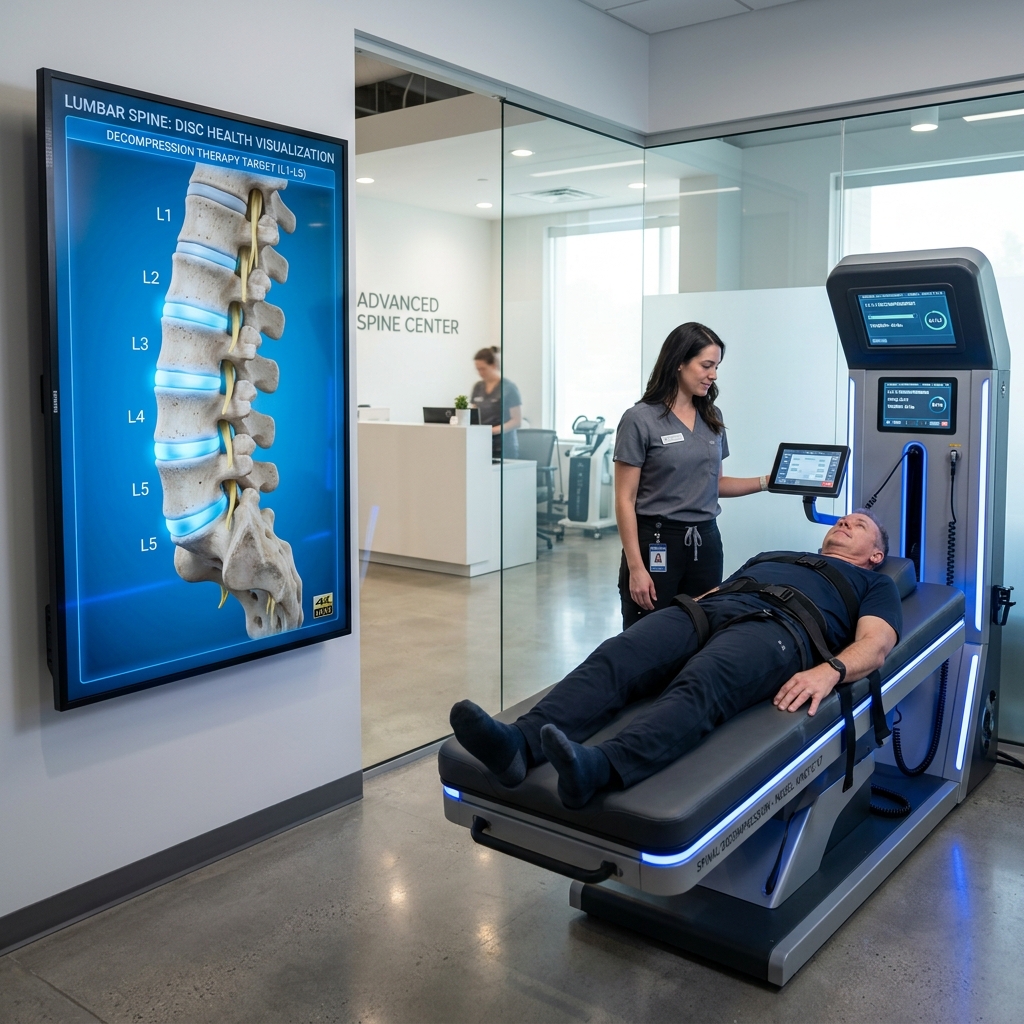
Spinal Decompression
targeted mechanical traction to offload herniated discs and pinch nerves.
SIS Electromagnetic Therapy
High-intensity electromagnetic pulses to instantly block pain signals and stimulate healing.
Physiatrist-Led PT
Guided rehabilitation to correct biomechanical imbalances and strengthen the core.
Clinical
Curiosity
Addressing your scientific concerns regarding recovery and protocols.
Do I need an MRI for my back pain?
How long until I see relief?
Is bed rest good for my back?
Back Pain Recovery Resources
Expert articles on maintaining a healthy spine and preventing future flare-ups.