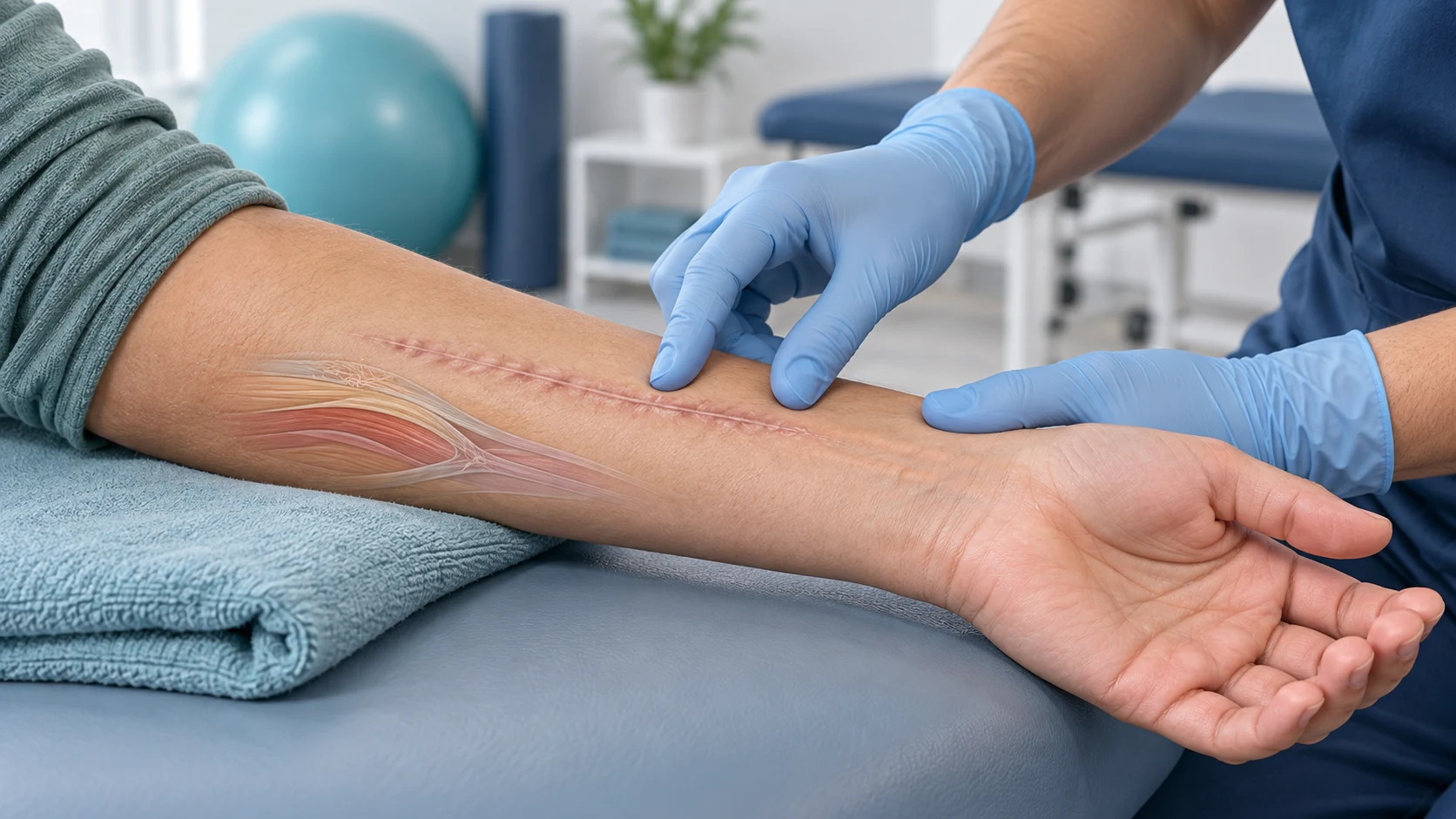
- — “Break up scar tissue” usually means improving a tethered, sensitive, or movement-limiting area, not physically erasing a solid lump.
- — A healed scar may benefit from carefully graded mobility work, desensitization, range-of-motion practice, and strengthening when the diagnosis fits.
- — Massage research shows possible benefits but highly variable methods, doses, and outcomes. No universal pressure or schedule is established.
- — IASTM or Graston may be an adjunct, but mixed low-certainty evidence does not support treating bruising or redness as proof of successful release.
- — Open wounds, infection signs, new neurologic symptoms, rapidly worsening swelling, or declining function require assessment before deeper manual work.
People rarely ask about scar tissue because they want a cosmetic explanation. They say a scar feels stuck, tight, or pulled in. Some notice a sharp pull when they reach, lift, walk, or stretch. Others feel stinging or burning when clothing touches the area, while the scar itself looks quiet. Those descriptions matter because the skin, fascia, muscle, joint, and nerve may not be moving together.
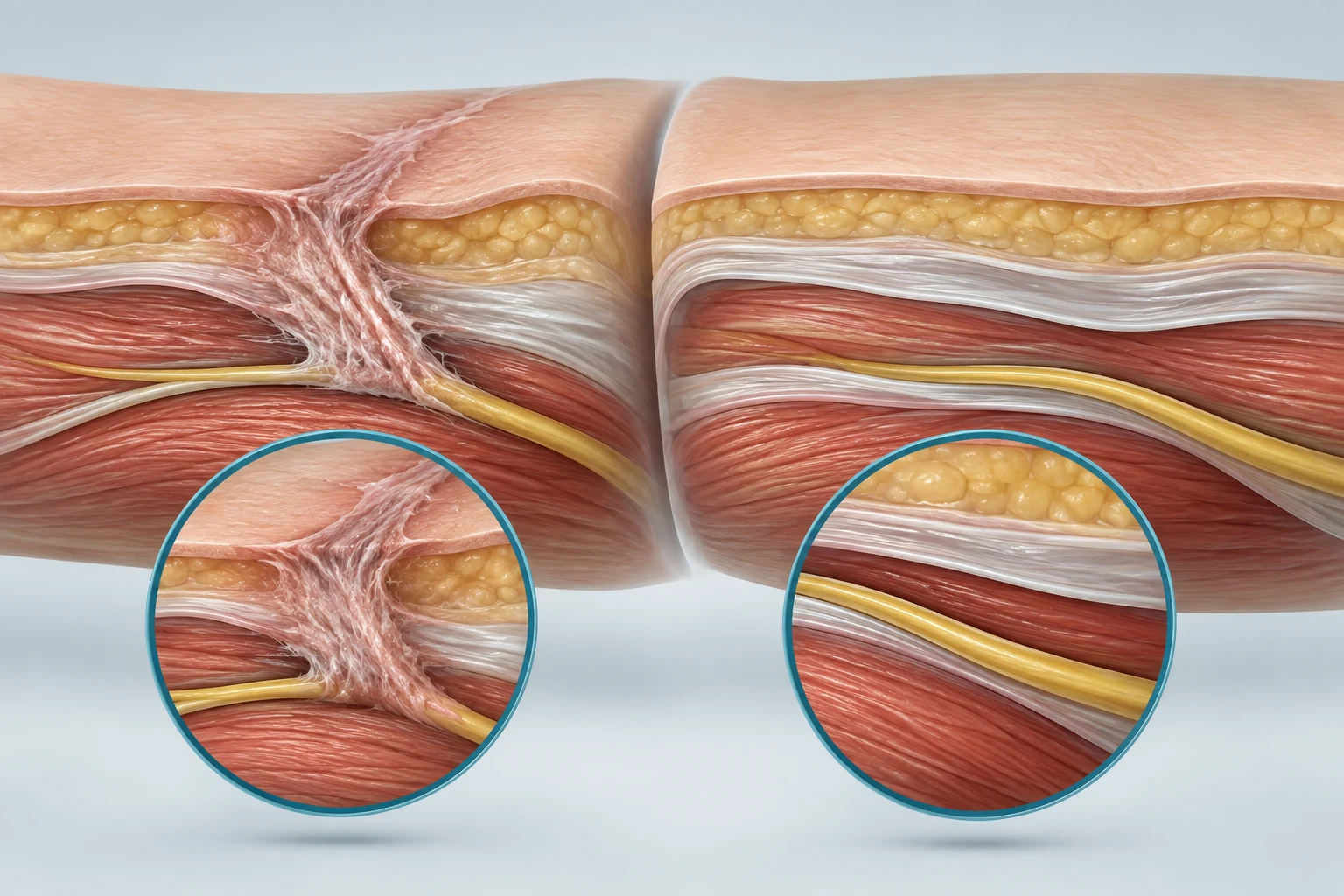
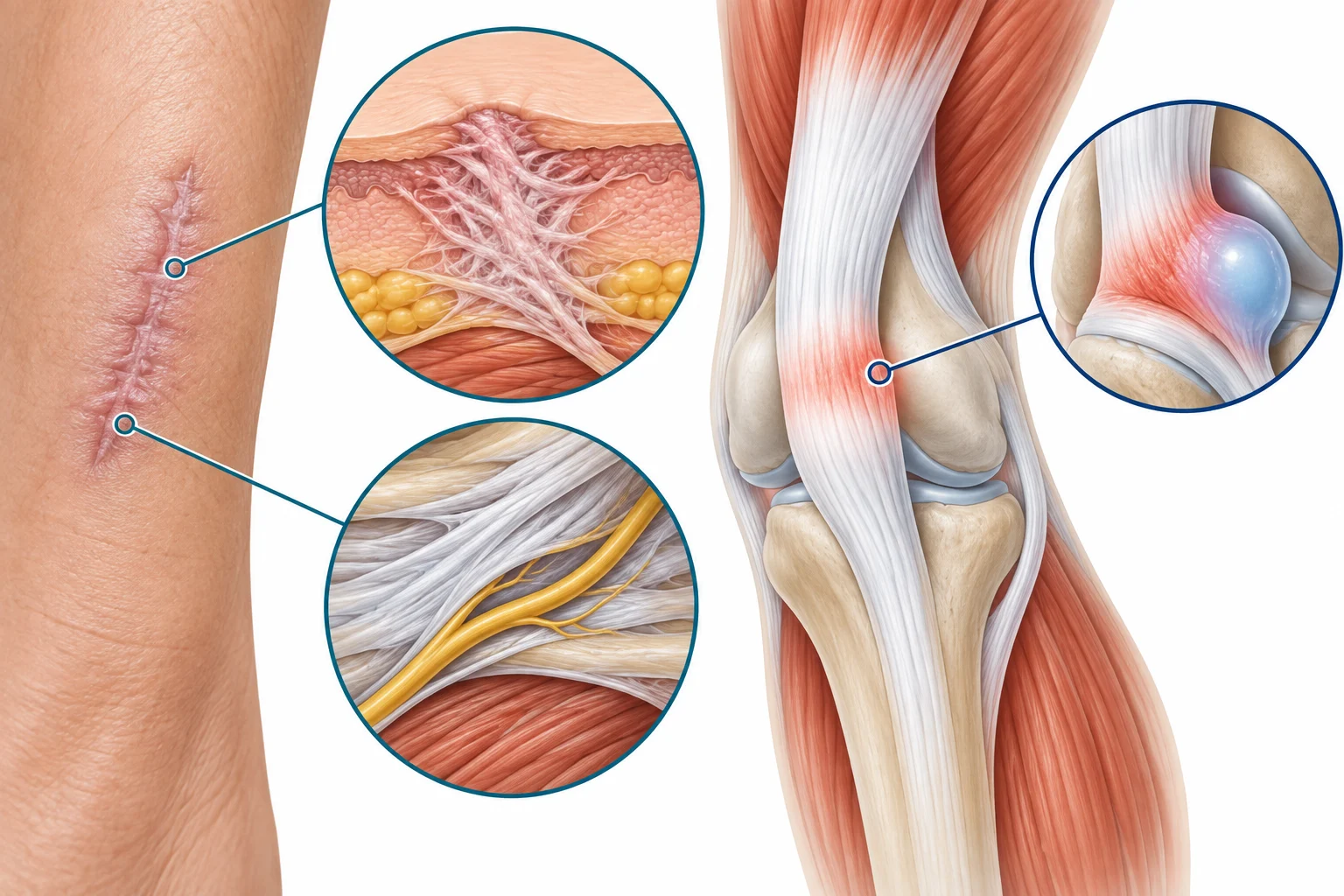
Scar tissue is normal collagen that forms during healing; an adhesion is a loss of normal glide between tissue layers that can contribute to pulling, sensitivity, or restricted movement. “Break up” is a patient-friendly phrase, not a promise that a clinician can physically erase every adhesion with massage or a tool. My goal is to identify the structure limiting function and restore useful movement without irritating healing tissue.
How to break up scar tissue safely after an injury or surgery?
Scar-tissue care works best when I match the technique to wound maturity, tissue irritability, and the movement you want back. I first check whether the scar is closed and stable, then measure the restricted task. Gentle mobility, desensitization, range-of-motion work, and strengthening often matter more than applying the strongest pressure available.
A healed surface can still sit over sensitive nerves, a tendon repair, a joint capsule, or a deeper plane that is not ready for aggressive contact. I do not treat the word “adhesion” as a diagnosis by itself. I ask when the pulling began, whether movement or touch reproduces it, and whether weakness, numbness, swelling, or fever changes the risk.
What changes the plan before scar work?
- Wound state: open, draining, separating, hot, or increasingly red skin needs medical review before massage.
- Functional target: reaching, walking, gripping, sitting, or returning to work gives us a measurable endpoint.
- Symptoms: burning, spreading tingling, progressive weakness, or disproportionate pain can point beyond superficial scar stiffness.
What is scar tissue physical therapy trying to change?
Scar tissue physical therapy tries to improve the way skin, fascia, muscle, tendon, joint, and nerve-related sensitivity work together. The endpoint is not a softer-looking scar alone. I look for smoother movement, less touch sensitivity, better joint motion, stronger loading, and more confidence with the activity that the scar has been interrupting.
A 2020 systematic review found that physical scar management was associated with improvements in pain, pruritus, pigmentation, pliability, surface area, and thickness in adults, but the studies were heterogeneous and had important risk-of-bias limits (Deflorin et al., 2020; PMID: 32589450). That finding supports a measured rehabilitation plan. It does not prove that a particular massage technique releases a deep muscle adhesion.
Can physical therapy break up scar tissue without damaging healing tissue?
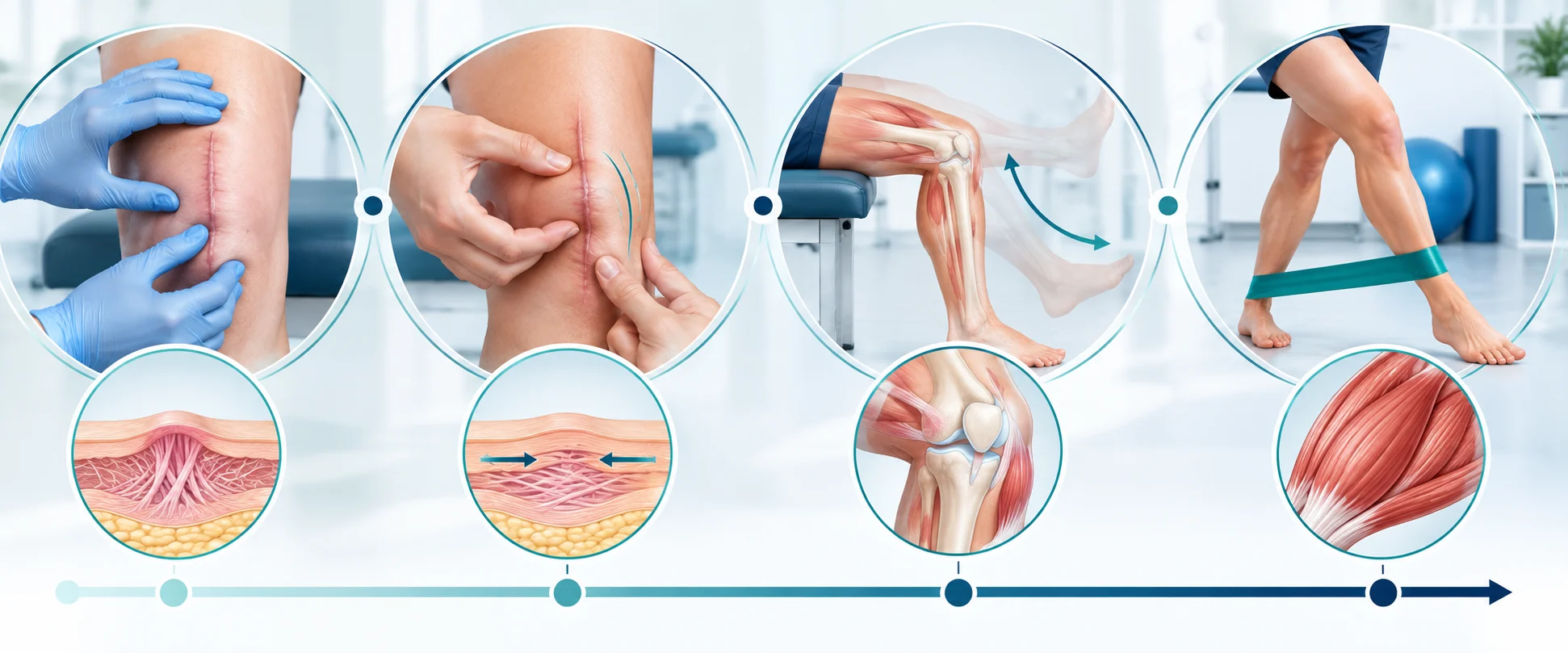
Physical therapy can improve function around a scar without trying to tear tissue apart. I usually progress from low-irritability movement and touch exposure to active range of motion, resistance, and task practice when the area settles between sessions. I reduce or stop the plan when symptoms remain worse the next morning, swelling increases, skin changes appear, or nerve symptoms spread.
The body adapts to a load it can tolerate. Gentle movement can help a person regain confidence and coordination; progressive resistance can rebuild the force capacity that protects the area during work or sport. The progression criterion is not “more pain means more release.” It is a stable response with better movement or function over time.
How to break up scar tissue without surgery?
Nonsurgical scar care combines diagnosis, graded movement, scar mobility when appropriate, desensitization, strengthening, and activity changes. I choose the smallest intervention that can answer a useful clinical question: does the person move more easily, tolerate touch better, or complete a relevant task? A treatment that creates a bruise without functional improvement does not answer that question.
The options may include gentle crosswise or circular contact over a closed scar, guided range-of-motion practice, nerve desensitization, progressive loading, and a short trial of manual or instrument-assisted work. A scar-focused plan also considers the joint above and below, the muscle that crosses the area, and the task that keeps provoking the restriction. The 2025 scoping review found many physical approaches but substantial variation in dose, location, scar size, study quality, and control groups (Di Serio et al., 2025; PMID: 40943680).
What should active rehabilitation do before deeper manual work?
Active rehabilitation should establish a safe movement baseline before deeper manual work adds more stimulus. I measure a simple task, use a low-load motion that the tissue can tolerate, and progress only when the response remains settled. This sequence helps separate a temporary change in sensation from a real improvement in capacity.
For someone returning to lifting, that may mean restoring comfortable reach first, then adding controlled load, then practicing the actual work pattern. For someone with a limb scar, it may mean touch desensitization before stronger contact. The plan changes when the scar crosses a joint, a tendon repair is healing, or the symptom pattern suggests nerve irritation rather than a surface restriction.
Can massage break up scar tissue or only improve mobility?
Massage may improve comfort, movement, or scar pliability, but I do not describe it as a guaranteed way to break apart every adhesion. A 2022 scoping review found possible benefits for pain, movement, and scar characteristics, while also finding 45 different outcome measures, varied protocols, and confounding from additional rehabilitation (Scott et al., 2022; PMID: 35227556).
That uncertainty changes how I use massage. I may use light, focused contact to improve tolerance for movement or to assess whether a superficial layer glides differently. I do not increase force simply because a person feels a hard spot. A painful “lump” may represent a sensitive nerve, tendon, joint, muscle guarding, or a problem that needs assessment rather than deeper pressure.
The clinical distinction that changes the decision
A short-term feeling of looseness is useful information, but it is not proof that the underlying adhesion disappeared. I judge the result by movement, load tolerance, and symptom behavior after the session.
Why does scar massage evidence vary from study to study?
Scar massage evidence varies because studies enroll different scars, use different techniques, and measure different outcomes. Reported protocols range from a single session to three treatments each day for six months, so the literature does not establish one correct frequency or pressure (Scott et al., 2022; PMID: 35227556). A practice survey likewise found no established effective dosage or method (Scott et al., 2024; PMID: 38434186).
Typical internet advice often treats the skin scar and a deep postoperative adhesion as the same problem. They are not always the same. A superficial scar may need gentle mobility and skin desensitization; a deeper restriction may involve the joint, tendon, nerve, lymphatic tissue, or a surgical repair. That is why a clinician should define the target before recommending “deep” work.
Can physical therapy break up scar tissue when movement is restricted?
Physical therapy can help movement restriction when the plan addresses the actual driver, which may include scar glide, joint stiffness, weakness, sensitivity, or altered motor control. I use manual work only when it supports that plan. Exercise and stretching were the strongest recurring options in the narrow axillary-web-syndrome literature, while manual therapy and scar massage appeared less consistent (González-Rubino et al., 2023; PMID: 37043039).
Which approach fits the restriction?
The correct choice depends on tissue state, diagnosis, and the function you want to regain.
Scar mobility plus active rehabilitation
Best for a closed scar with mild tethering, sensitivity, stiffness, or a measurable movement goal. It links gentle contact to range of motion, strength, and task practice.
Progress can feel slower than a dramatic hands-on session and requires repeated home practice and follow-up.
Deeper manual or instrument work
A clinician-selected, time-limited adjunct when the tissue is healed and the person can describe a clear movement or symptom goal.
IASTM evidence is mixed and often low certainty. Bruising, force, or a strong sensation does not prove a deep adhesion changed.
Surgical release discussion
A confirmed structural restriction that persists despite appropriate nonoperative care or creates a specific functional problem.
Surgery introduces a new healing process and may create new scar tissue. It should follow diagnosis, risk review, and a realistic rehabilitation plan.
Which symptoms can mimic a scar adhesion?
Several problems can feel like a scar is “stuck.” I check the pattern rather than assuming the scar is the source. The following clues do not diagnose a condition on their own, but they explain why forceful massage may be the wrong first step:
- Burning, electric, or spreading tingling: nerve sensitivity or entrapment may matter more than skin glide.
- Pain with resisted loading: a tendon or muscle problem may need graded strengthening rather than deeper rubbing.
- True joint block or loss of motion: capsular stiffness, swelling, or a joint problem may limit movement.
- Warmth, drainage, or expanding redness: infection or inflammation needs medical assessment, not scar massage.
How to massage scar tissue after surgery safely?
Massage a surgical scar only after the incision has closed and the operating team or treating clinician has cleared the activity. I start with the least irritating contact that matches the goal, monitor the skin during and after the session, and avoid treating through increasing heat, drainage, separation, or escalating pain. Surgical timing varies too much for one internet schedule to be safe for everyone.
Once a closed scar is appropriate for contact, a clinician may teach short, gentle movements in several directions and pair them with the motion the scar is limiting. The dose should be judged by the next-day response, not by how much pressure a person can tolerate. A small burn-injury trial used 30-minute massage twice weekly for five weeks on a closed scar and reported symptom improvements, but that 20-person study does not establish a universal postoperative prescription (Field et al., 2000; PMID: 10850898).
When should scar massage stop and a clinician assess the area?
Stop massage when the skin breaks down, pain escalates, swelling increases, or the area becomes hot, increasingly red, or draining. Stop and arrange prompt assessment for new weakness, progressive numbness, spreading burning, unexpected bleeding, fever, or a marked change in function. These signs can point beyond ordinary scar sensitivity and should not be covered up with stronger pressure.
What can you safely monitor?
- Before: note the movement, touch, or task that feels restricted.
- During: keep contact tolerable and stop if the sensation becomes sharp, burning, electric, or progressively painful.
- After: check whether swelling, warmth, skin color, or function is worse later that day or the next morning.
When is scar tissue physical therapy more useful than deeper massage?
Scar tissue physical therapy is more useful when the main problem involves lost range, weakness, touch sensitivity, fear of movement, or a task that remains limited after the skin settles. I combine examination with a graded plan so the person can see whether function changes. Deeper massage has less value when the diagnosis is unclear or the treatment repeatedly provokes a flare.
Evidence supports a cautious translation rather than a fixed recipe. Scar-management reviews suggest possible symptom and pliability benefits, while IASTM reviews disagree and often rate certainty as very low (Deflorin et al., 2020; PMID: 32589450; Nazari et al., 2023; PMID: 35611579). In Vigan and nearby Ilocos communities, travel time, work, family transport, and the cost of repeated visits can limit ideal supervised care. I therefore prioritize a clear home plan, a small number of meaningful measures, and follow-up that changes the plan when the response is poor rather than repeating passive treatment by habit.
Need help choosing the next step?
A PM&R assessment can separate scar restriction from nerve, tendon, joint, or wound problems before deeper treatment is considered.
What does a physiatry assessment check before adhesion release?
A physiatry assessment checks the scar and the movement system around it before choosing a technique. I review the surgery or injury, wound course, medicines, symptom behavior, work demands, and the task that feels blocked. I then compare skin glide, joint motion, strength, sensation, reflexes when relevant, and the response to a controlled movement or load.
Imaging or another test may help when the examination suggests a tendon injury, joint pathology, retained material, nerve problem, infection, or a deeper structural restriction. A scan does not replace the functional examination. The useful result is a working explanation that tells us what to protect, what to move, what to strengthen, and when to escalate.
What results should you expect from scar-focused rehabilitation?
Scar-focused rehabilitation should aim for a practical change: less pulling during a task, improved joint motion, better touch tolerance, stronger loading, or safer return to work and exercise. Some people notice symptom relief before strength returns; others need gradual loading before movement feels dependable. I explain the expected direction, then reassess instead of promising a fixed timeline.
The answer to “how to break up scar tissue” is therefore more specific than “push harder.” Protect an unready wound, identify the structure producing the restriction, use gentle mobility when appropriate, and build the movement capacity that lets the change last. If the scar is worsening, the limb is becoming weak or numb, or function is declining, assessment is safer than another round of self-massage.
Scar-tissue treatment realities
The useful endpoint is function, not how dramatic the treatment looks.
A soft scar can still restrict movement
The skin may look settled while deeper layers remain sensitive, tethered, or poorly coordinated with the joint and muscle underneath.
Redness is not a treatment score
A visible mark shows a skin response to contact. It does not prove that a deep adhesion changed or that the diagnosis was correct.
Active rehabilitation carries the plan
Manual work may help a person tolerate movement, but range of motion, strength, nerve health, and daily function determine whether the plan is working.
References & Clinical Evidence
- [1] Scott HC, Stockdale C, Robinson A, Robinson LS, Brown T. Is massage an effective intervention in the management of post-operative scarring? A scoping review. J Hand Ther. 2022;35(2):186-199. doi:10.1016/j.jht.2022.01.004. PMID:35227556.
- [2] Lippi L, de Sire A, Losco L, et al. Axillary Web Syndrome in Breast Cancer Women: What Is the Optimal Rehabilitation Strategy after Surgery? A Systematic Review. J Clin Med. 2022;11(13):3836. doi:10.3390/jcm11133839. PMID:35807124.
- [3] Di Serio S, Congiu M, Minnucci S, Scalise V, Mourad F. Current Physical Therapy for Skin Scar Management: A Scoping Review. J Clin Med. 2025;14(17):5920. doi:10.3390/jcm14175920. PMID:40943680.
- [4] Deflorin C, Hohenauer E, Stoop R, et al. Physical Management of Scar Tissue: A Systematic Review and Meta-Analysis. J Altern Complement Med. 2020;26(10):854-865. doi:10.1089/acm.2020.0109. PMID:32589450.
- [5] Nazari G, Bobos P, Lu SZ, et al. Effectiveness of instrument-assisted soft tissue mobilization for the management of upper body, lower body, and spinal conditions: an updated systematic review with meta-analyses. Disabil Rehabil. 2023;45(10):1608-1618. doi:10.1080/09638288.2022.2070288. PMID:35611579.
- [6] Nazari G, Bobos P, MacDermid JC, Birmingham T. The effectiveness of instrument-assisted soft tissue mobilization in athletes and individuals with musculoskeletal conditions: a systematic review. Arch Phys Med Rehabil. 2019;100(9):1726-1751. doi:10.1016/j.apmr.2019.01.017. PMID:30797743.
- [7] Moras G, et al. The effectiveness of instrument-assisted soft tissue mobilization on range of motion: a meta-analysis. PMID:38654270.
- [8] González-Rubino JB, Vinolo-Gil MJ, Martín-Valero R. Effectiveness of physical therapy in axillary web syndrome after breast cancer: a systematic review and meta-analysis. Support Care Cancer. 2023;31(5):257. doi:10.1007/s00520-023-07666-x. PMID:37043039.
- [9] Field T, Peck M. Postburn itching, pain, and psychological symptoms are reduced with massage therapy. J Burn Care Rehabil. 2000;21(3):189-193. PMID:10850898.
* Clinical references are provided to support the medical claims made in this article. TeraCare adheres to evidence-based practices in physical medicine and rehabilitation.

Dr. Ben Rabara
Dr. Ben Rabara is a Board-Certified Physiatrist specializing in Physical Medicine and Rehabilitation. He focuses on non-surgical, precision treatments for musculoskeletal conditions, utilizing advanced diagnostics like MSK Ultrasound.
Medical Disclaimer: The information provided in this article is for educational purposes only and does not substitute for professional medical advice, diagnosis, or treatment. Always consult a qualified physician for your specific health conditions.