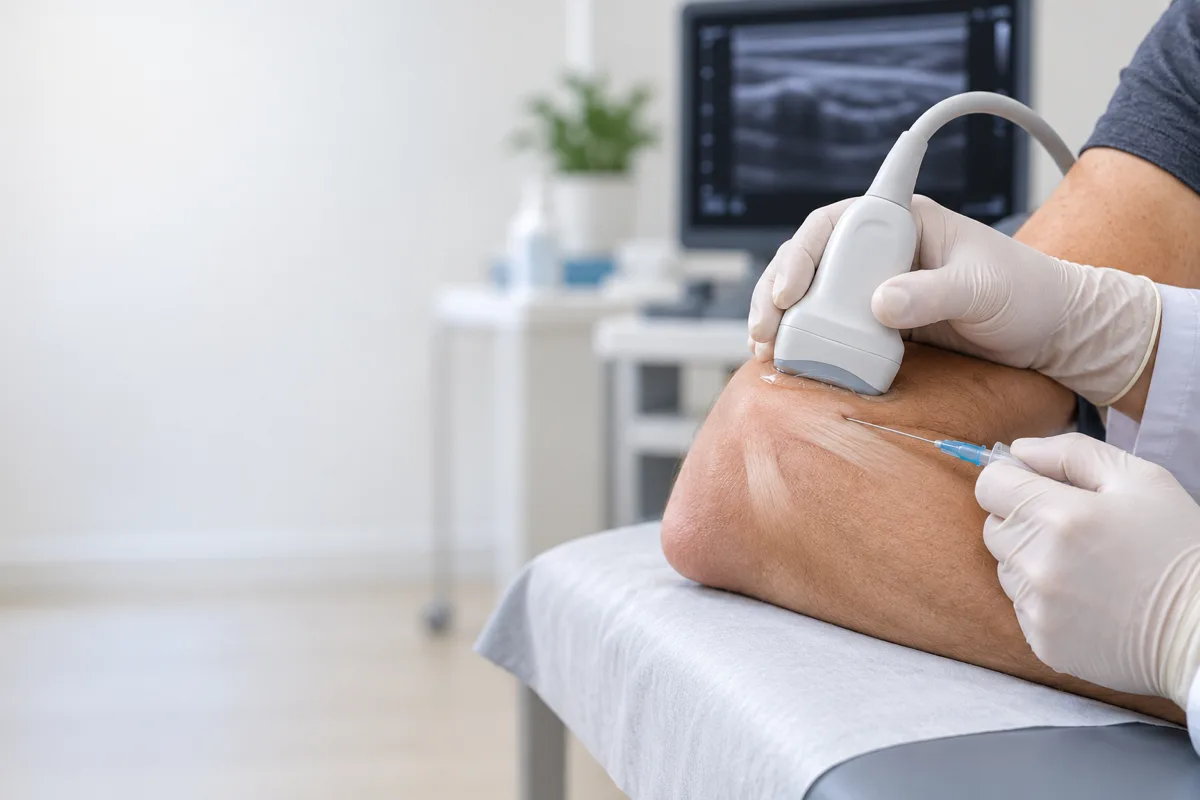
- — Needle tenotomy is an image-guided option that may be discussed for selected tendon problems. It is not a guaranteed cure and is not suitable for every source of elbow or knee pain.
- — Tennis elbow and jumper’s knee affect different tendons and different daily loads. A careful examination should confirm that the painful structure fits the proposed treatment.
- — Rehabilitation and graded loading remain important before and after any procedure. There is no single safe exercise schedule for every person or every tendon.
- — New weakness, a major injury, fever or a hot swollen area, progressive numbness, or severe unrelenting pain needs prompt medical assessment.
Needle tenotomy may be discussed when a clinician believes a particular tendon is contributing to persistent pain and the target can be assessed safely with imaging. It is not a universal cure for tennis elbow or jumper’s knee. The decision should follow a clinical examination, a review of competing causes, a realistic discussion of uncertainty, and a plan for rehabilitation before and after the procedure.
Tennis elbow usually refers to pain around the outside of the elbow involving the common extensor tendon. Jumper’s knee usually refers to patellar tendinopathy near the kneecap. They are not the same tendon, and a loading plan or procedure used for one should not automatically be copied for the other. Reviews describe tennis elbow as common and often self-limiting, while persistent symptoms can be difficult to manage and may need the diagnosis revisited (Johns and Shridhar; PMID: 33123709; Ahmed et al.; PMID: 35031850).
What is needle tenotomy for tennis elbow?
Needle tenotomy is a broad name for a clinician-performed technique that uses a needle to treat a selected area of tendon tissue, usually with imaging to identify the target and nearby structures. Different clinics may use different names, devices, needle paths, anaesthesia, and aftercare. Ask the clinician to describe the exact technique rather than relying on the label alone.
The proposed aim and exact technique should be explained before treatment. A patient-friendly consent discussion should say what structure is targeted, what benefit is expected, how it will be measured, what the alternatives are, and what happens if the pain remains. A procedure should not be presented as proof that a tendon is “cleaned out” or guaranteed to return to normal.
The common extensor tendon sits near several structures that can also produce outer-elbow pain. A clinician may consider radial nerve irritation, cervical radiculopathy, joint disease, referred pain, ligament problems, or a partial tear. A review of lateral epicondylitis specifically highlights the importance of diagnosis and ruling out other causes of lateral elbow pain (Lenoir et al.; PMID: 31543413).
In my clinic, I look for the exact pattern rather than treating a label: is the pain sharp or dull, burning or aching, stiff or catching, and does it radiate, tingle, click, grind, or cause numbness? Patients may use any of these words for very different problems. Burning, tingling, finger numbness, or a painful grinding or catching sensation should prompt a wider examination instead of being assumed to be tendon pain.
- Where is the pain, and can you point to it with one finger?
- Which load reproduces it: gripping, wrist extension, squatting, jumping, landing, or something else?
- Is there swelling, weakness, numbness, fever, locking, or a recent injury?
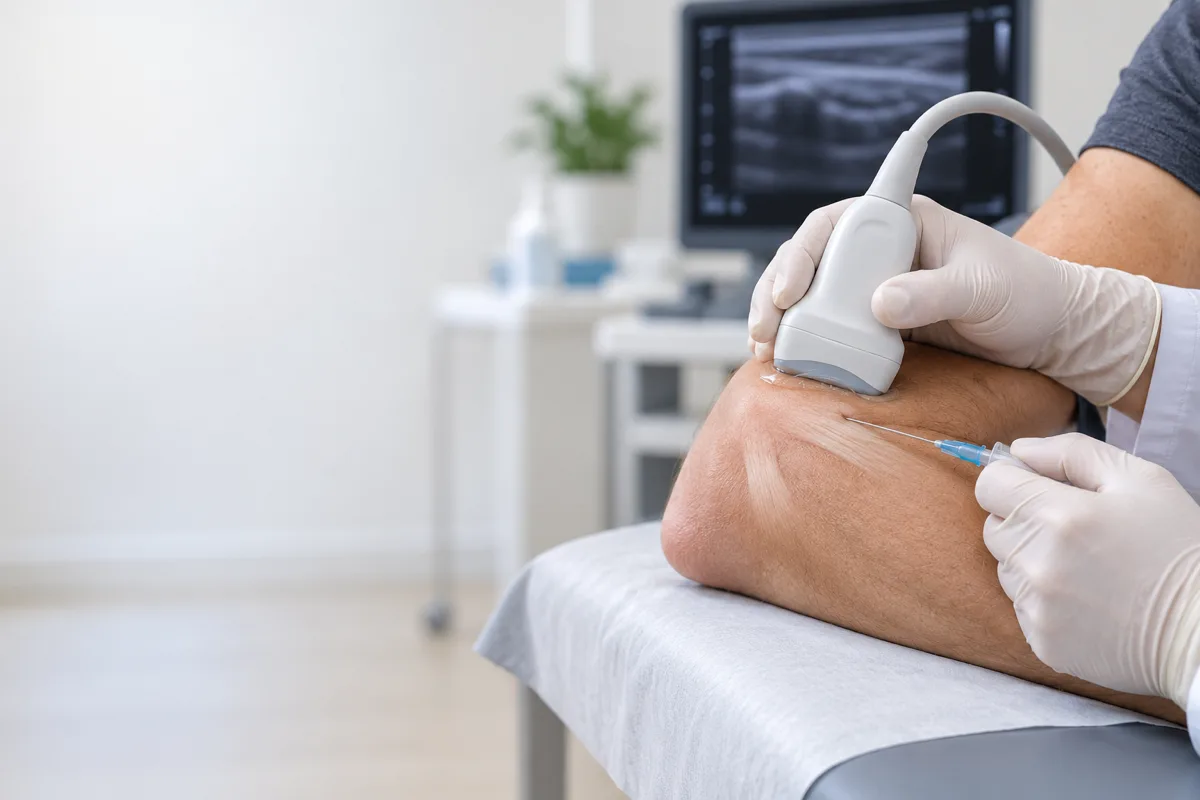
How is tennis elbow treatment chosen?
Tennis elbow treatment starts with the story and examination: where the pain is, which grips or wrist movements provoke it, what has changed at work or in sport, whether strength is reduced, and whether the neck or nerves are involved. Imaging can be useful when it answers a specific question, but a scan should not replace the examination. The condition is often associated with repetitive gripping or wrist extension, yet it can affect people in many occupations and activities (Ma et al.; PMID: 32454922; Pathan and Sharath; PMID: 38021828).
Many people start with education, activity adjustment, and progressive rehabilitation. A systematic review found that manual therapy and eccentric strength training had beneficial effects in the included physiotherapy literature, while a later meta-analysis found that eccentric exercise can improve pain and strength in lateral elbow tendinopathy but also warned that exercise parameters were heterogeneous (Landesa-Piñeiro and Leirós-Rodríguez; PMID: 34397403; Zhou et al.; PMID: 34501416). These findings do not create one fixed prescription for every patient.
The evidence also has limits that matter when making a decision. One eccentric-exercise meta-analysis included 6 studies and 429 participants, while a separate review describes tennis elbow as affecting roughly 4–7 people per 1,000 and notes that symptoms are self-limiting in about 90% of cases. In practical rehabilitation, a clinician may adjust the plan over time rather than promising a result in 1 session. These numbers describe the cited study populations and review estimates; they are not a personal forecast and do not prove that a needle procedure is needed (Zhou et al.; PMID: 34501416; Johns and Shridhar; PMID: 33123709).
Needle tenotomy may be considered only when the diagnosis, target, goals, alternatives, and likely recovery plan are clear. It should not be used to avoid checking a new injury, marked weakness, neurological symptoms, infection, or a pain pattern that does not behave like a tendon problem.
What does jumper’s knee have to do with tendon loading?
Jumper’s knee is a plain-language name commonly used for patellar tendinopathy. The patellar tendon transfers force from the quadriceps through the kneecap to the shin, so jumping, landing, running, deep squatting, and rapid increases in training can challenge it. Pain at the front of the knee can also come from the patellofemoral joint, fat pad, bursa, meniscus, hip, spine, or a nerve. A clinical assessment should establish whether the patellar tendon is truly the main target.
The same principle applies as at the elbow: a tendon must be loaded in a way that gradually restores useful capacity. Complete rest may reduce symptoms for a short period but can leave a person less prepared for the load they need to resume. Conversely, jumping straight back to intense training can keep symptoms irritable. The safest progression depends on pain behaviour, strength, movement, training history, and the clinician’s findings.
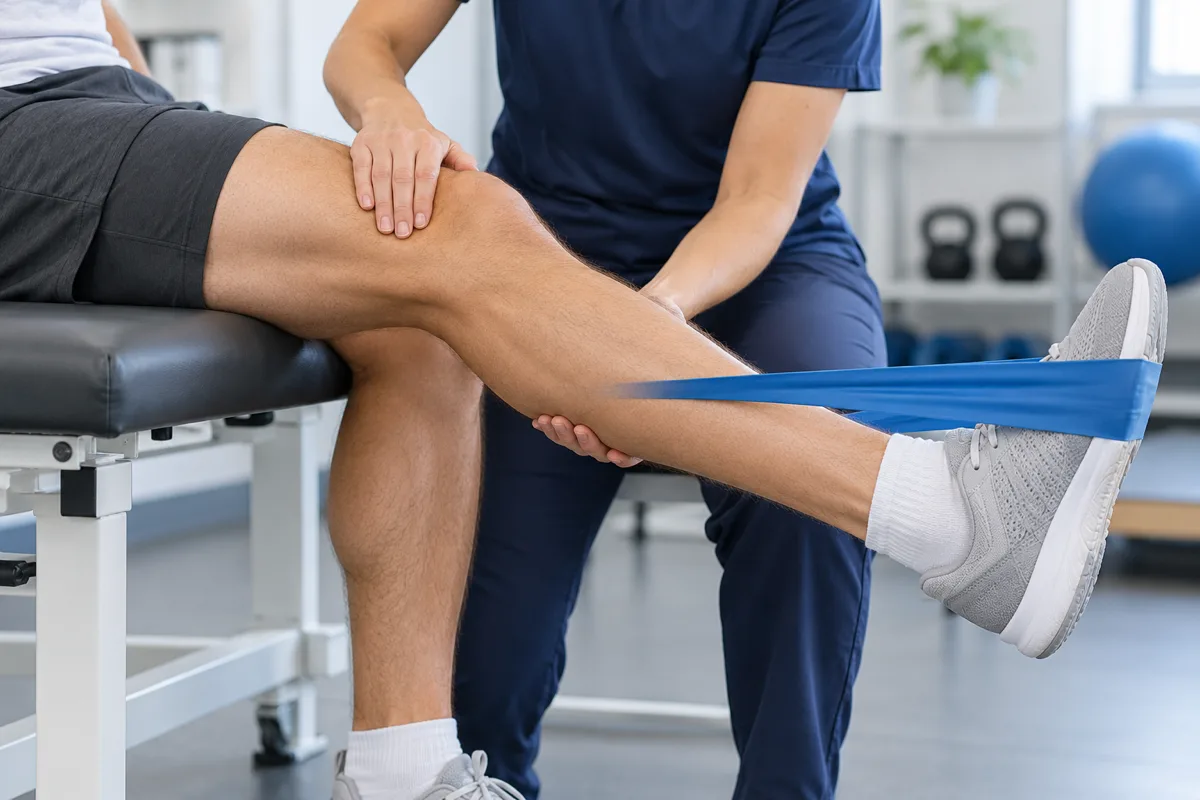
You do not have to play tennis to develop tennis elbow, and you do not have to be an elite jumper to develop jumper’s knee. Repeated gripping, lifting, racquet use, manual work, running, jumping, or a sudden change in training can all change tendon load. The name describes a common pattern, not a requirement that you play the sport in the title.
What is exercise after needle tenotomy for tennis elbow like?
Exercise after needle tenotomy should be prescribed by the treating clinician or rehabilitation team. The early phase may include protection of the treated area and movement that is allowed by the procedure instructions. Later stages may build strength and load tolerance, then reconnect that capacity to work, lifting, racquet use, running, jumping, or other goals. The exact timing is not interchangeable between an elbow tendon and the patellar tendon.
Ask for written instructions that answer five questions: what can I do today, what should I avoid, what symptoms are expected, when can I progress, and who should I contact if the recovery changes? A useful plan also explains how the next-day response will be judged. Increasing pain, new weakness, spreading redness, fever, or loss of function should not be dismissed as a normal healing response.
Do not use a generic online exercise schedule as a substitute for aftercare. The needle path, tendon condition, pain sensitivity, medicines, work demands, and procedure details may all change the appropriate progression. A procedure without a recovery plan is an incomplete treatment decision.
Who may not be a good candidate for needle tenotomy?
Suitability is less about finding the longest-lasting pain and more about finding a clear, treatable target. A clinician may pause when the diagnosis is uncertain, the pain is mainly coming from a joint, spine, or nerve, there is a major untreated injury, an active infection, a significant bleeding risk, or the person cannot follow the required aftercare. Medicines such as anticoagulants and health conditions such as diabetes or immune problems need to be discussed rather than hidden.
Ask how the clinician will protect nearby nerves, vessels, joints, and healthy tendon; what discomfort is expected; how infection or bleeding would be recognised; and what the plan is if the procedure does not help. The answer should be specific to the proposed tendon and technique. “Minimally invasive” does not mean risk-free.
How should you compare a procedure with rehabilitation?
Compare options by the problem they are meant to treat, the quality and limits of the evidence, the time and cost involved, possible harms, and the recovery work still required. Progressive rehabilitation may be slower but can address strength and load tolerance. A needle procedure may be considered for a selected target but does not remove the need for recovery. Injection, shockwave, observation, or surgery may have different indications and uncertainties.
| Option | What it may aim to do | Question to ask |
|---|---|---|
| Education and graded loading | Build usable strength and tolerance | How will the starting load and progression be chosen? |
| Needle tenotomy | Treat a selected tendon target under imaging | What evidence and fallback plan apply to this tendon? |
| Injection or other modality | Address a selected pain or tendon-related problem | What problem is it targeting and what are the risks? |
| Surgery | Address selected structural problems | Has the diagnosis and non-operative pathway been reviewed? |
When should elbow or knee tendon pain be assessed?
Arrange a review when pain affects sleep, work, walking, lifting, or sport; when weakness is new or progressive; when the diagnosis is uncertain; or when a reasonable rehabilitation plan has not helped. A clinical history and examination are usually central to diagnosing lateral epicondylitis, and the differential includes nerve, cervical, bone, joint, and inflammatory causes (Johns and Shridhar; PMID: 33123709).
Seek urgent assessment for a major injury with deformity or inability to use the limb, fever or a hot red swollen area, rapidly worsening pain, new marked numbness or weakness, chest pain, shortness of breath, or symptoms that make you acutely unwell. Do not assume these warning signs are ordinary tendon inflammation.
If you are considering care in Vigan or nearby, ask which clinician will assess you, whether ultrasound guidance is available when needed, which treatments are actually offered, what alternatives exist, and what follow-up is included. Availability and fees can change, so confirm them directly with the clinic rather than relying on an old post.
What should you ask before deciding?
- What structure is the likely source of my pain, and what other causes were considered?
- What is the exact needle technique, and what evidence applies to my tendon and goal?
- What are the reasonable alternatives, including rehabilitation without a procedure?
- What should I do during the first days and weeks, and how will progression be decided?
- What complications should make me call, and who provides follow-up?
- What is the plan if pain or function does not improve?
A thoughtful procedure decision is not a promise that pain will disappear. It is a shared plan based on a defensible diagnosis, honest evidence limits, safe aftercare, and a way to measure whether function is actually improving.
Read our percutaneous needle tenotomy and barbotage guide for the broader role of image-guided tendon procedures, and our chronic tendon pain guide for diagnosis and loading principles.
Tendon Procedure Realities
The useful question is not only whether a needle procedure exists, but whether the diagnosis and recovery plan make sense for you.
A scan is not the whole diagnosis
Tendon changes may be present without being the only source of pain. The history, examination, strength, movement, nearby nerves and joints, and imaging need to fit together.
The tendon still needs a loading plan
A procedure does not replace rehabilitation. The treated tendon has to regain useful tolerance for work, walking, lifting, running, or sport at a pace that matches its response.
Results are not guaranteed
Evidence differs by tendon, technique, comparison treatment, and patient group. A responsible consultation includes uncertainty, alternatives, possible harms, and a fallback plan.
References & Clinical Evidence
- [1] Landesa-Piñeiro L, Leirós-Rodríguez R. Physiotherapy treatment of lateral epicondylitis: A systematic review. 2022. PMID: 34397403.
- [2] Lenoir H, Mares O, Carlier Y. Management of lateral epicondylitis. 2019. PMID: 31543413.
- [3] Johns N, Shridhar V. Lateral epicondylitis: Current concepts. 2020. PMID: 33123709.
- [4] Ahmed AF, Rayyan R, Zikria BA, Salameh M. Lateral epicondylitis of the elbow: an up-to-date review of management. 2023. PMID: 35031850.
- [5] Pathan AF, Sharath HV. A Review of Physiotherapy Techniques Used in the Treatment of Tennis Elbow. 2023. PMID: 38021828.
- [6] Zhou Y, et al. The Beneficial Effects of Eccentric Exercise in the Management of Lateral Elbow Tendinopathy: A Systematic Review and Meta-Analysis. 2021. PMID: 34501416.
- [7] Ma KL, Wang HQ. Management of Lateral Epicondylitis: A Narrative Literature Review. 2020. PMID: 32454922.
* Clinical references are provided to support the medical claims made in this article. TeraCare adheres to evidence-based practices in physical medicine and rehabilitation.

Dr. Ben Rabara
Dr. Ben Rabara is a Board-Certified Physiatrist specializing in Physical Medicine and Rehabilitation. He focuses on non-surgical, precision treatments for musculoskeletal conditions, utilizing advanced diagnostics like MSK Ultrasound.
Medical Disclaimer: The information provided in this article is for educational purposes only and does not substitute for professional medical advice, diagnosis, or treatment. Always consult a qualified physician for your specific health conditions.