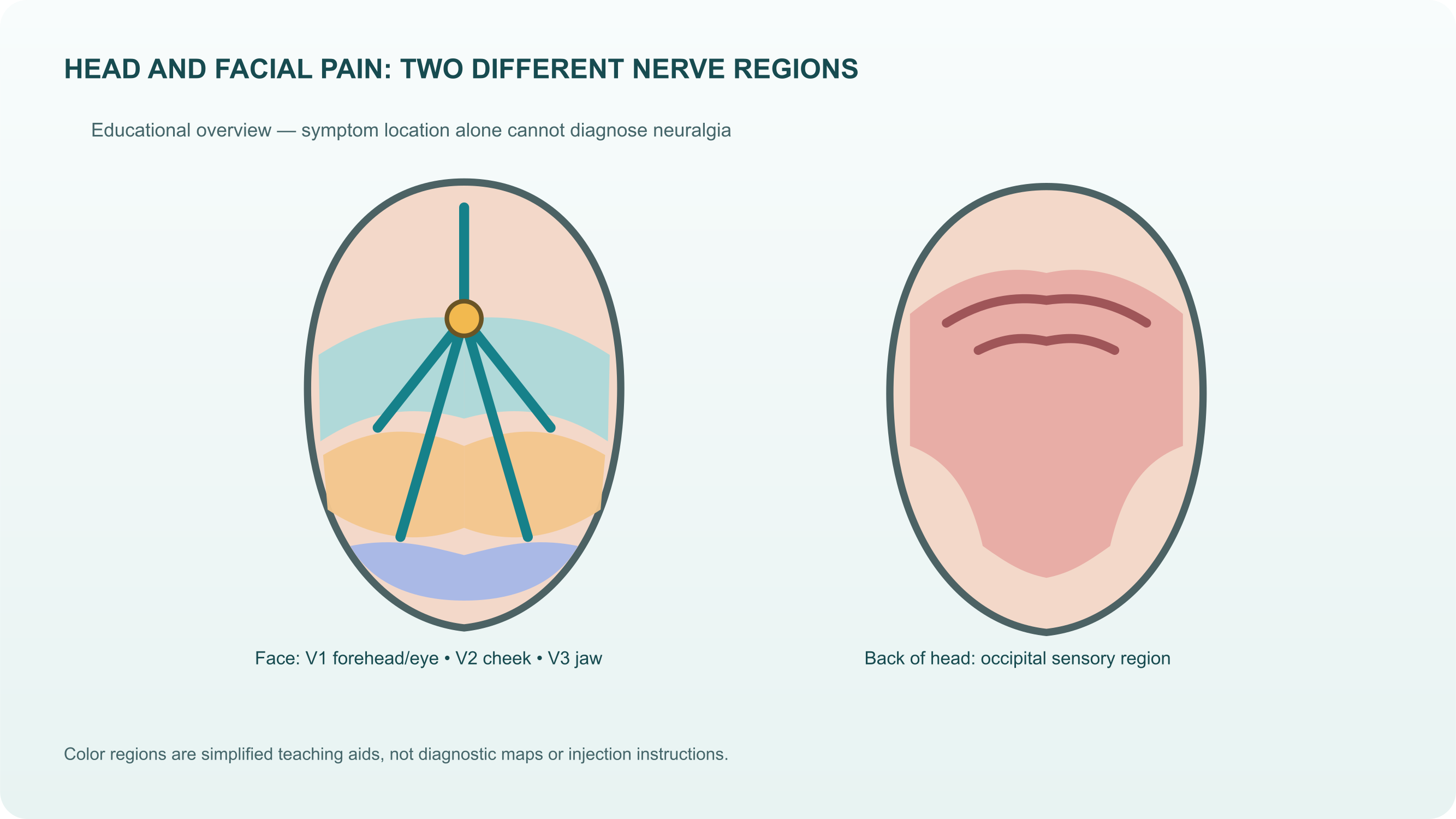
- — Electric-shock facial pain and pain that starts at the back of the skull can involve different nerves and different diagnoses. A symptom checklist cannot confirm which one is present.
- — Occipital neuralgia treatment may include a clinician-led assessment and, for selected patients, an occipital nerve block. A block is not a cure and does not replace a diagnosis or follow-up plan.
- — Trigeminal neuralgia treatment is usually planned around the pain pattern, examination, and possible secondary causes. The reviewed evidence does not support a universal treatment or a guaranteed result.
- — Sudden severe headache, new weakness or numbness, facial droop, confusion, fainting, seizure, vision loss, fever with neck stiffness, or rapidly worsening symptoms need urgent assessment.
Pain described as “nakukuryente,” a lightning shock, a burning scalp, or a sharp pain behind the eye can be frightening because it may be severe while leaving no visible injury. Trigeminal and occipital neuralgia are not the same condition: one concerns facial sensory territories, while the other is considered when pain involves nerves at the back of the head. Similar symptoms can also come from dental, jaw, migraine, neck, nerve-root, or other neurological problems.
This page explains how I separate the two patterns, where an occipital nerve block or trigeminal nerve block may fit, and why the injection should not be treated as a shortcut to a diagnosis. The evidence used here is limited: the key PubMed records are abstract-only, and they do not establish a universal injection technique, dose, duration of relief, price, or success rate. The goal is a safer conversation about the next clinical question.
What Does Occipital Neuralgia Treatment Involve?
Occipital neuralgia treatment starts by checking whether the pain pattern is compatible with irritation of an occipital nerve and whether another explanation is more urgent or more likely. I ask where the pain begins, whether it travels over the scalp or toward the eye, whether the scalp or neck is sensitive, which movements or positions change it, and whether there are neurological symptoms. The examination should not be replaced by the label “neuralgia.”
When the working diagnosis remains uncertain, the plan may be observation, medication review, rehabilitation, further diagnostic work, referral, or a selected procedure. An occipital nerve block may be considered when the proposed target matches the symptoms and the clinician has a clear question to answer. The purpose might be temporary symptom control, information about the targeted region, or enough comfort to continue a broader plan. A block does not repair every possible cause of pain.
I also discuss what would count as a useful result before an injection is scheduled. Relief should be described in terms that matter to the patient, such as being able to sleep, turn the head, tolerate scalp contact, or complete a work task. A change in pain alone is not proof that the diagnosis is complete. The result needs to be recorded alongside the examination and function.
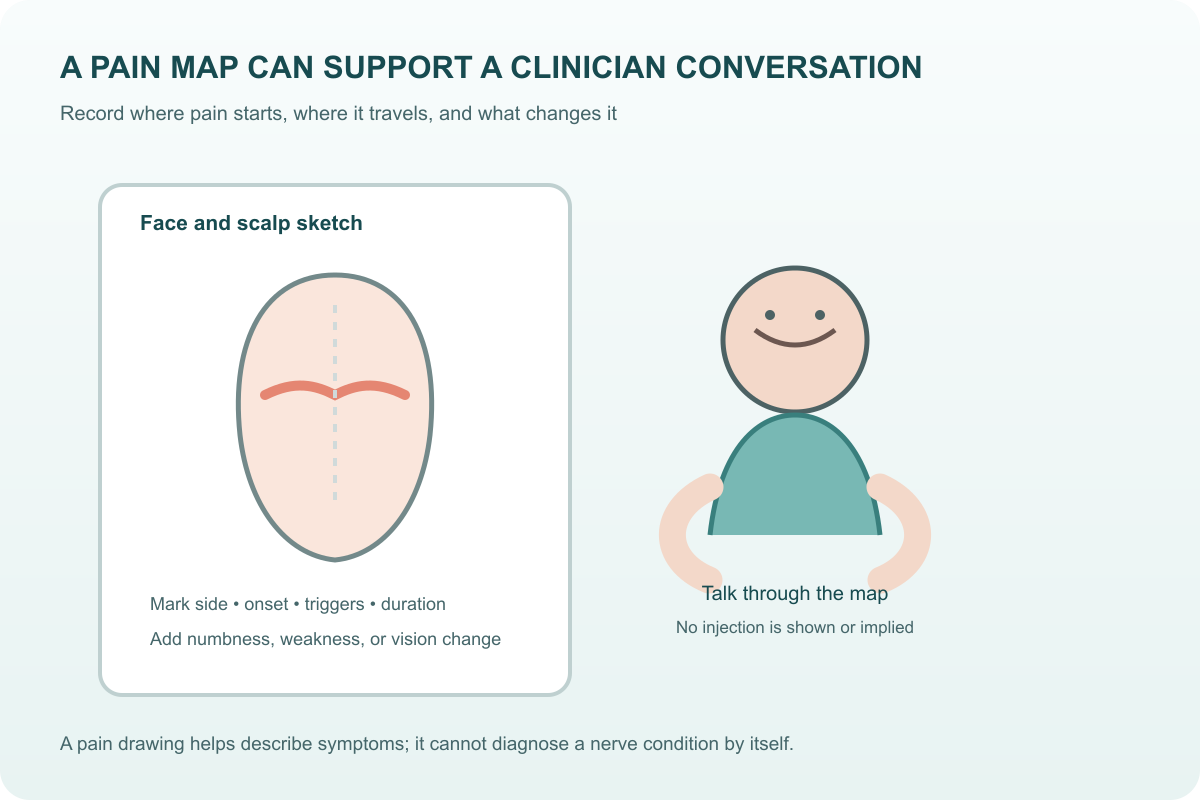
The distinction between the two patterns is practical. Facial pain provoked by brushing the teeth or touching a particular facial area raises a different question from pain that begins in the upper neck or skull base and travels over the scalp. Neither pattern is a permission slip to self-inject, repeat dental procedures, or wait through worsening neurological symptoms. The clinical aim is to match the pain map with the neurological examination and decide whether a block would answer a useful question.
What Are Trigeminal Neuralgia Symptoms?
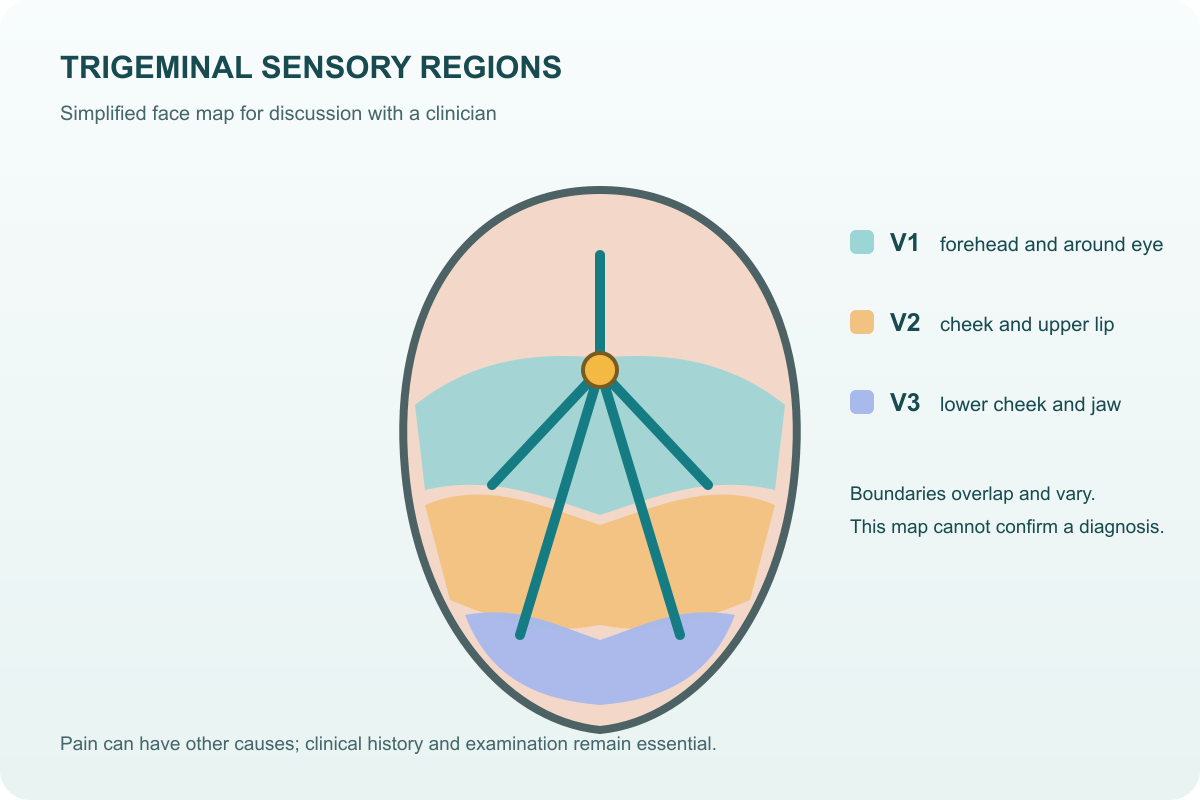
Trigeminal neuralgia symptoms commonly involve sudden, paroxysmal facial pain that may feel electric or shock-like and may be triggered by mechanical or environmental stimuli. The pain can be felt in a cheek, jaw, lip, nose, forehead, or other facial territory, but the location alone is not enough to diagnose it. A dental problem, jaw disorder, migraine, skin condition, nerve-root problem, or another neurological disorder can overlap with the description.
The reviewed abstract describes diagnosis as clinical and notes that imaging such as magnetic resonance imaging may be used to look for a secondary cause (Villegas Díaz et al., 2024; PMID: 39800569). This does not mean every person needs the same scan or that a normal scan dismisses the pain. It means the decision should be based on the history, examination, risk pattern, and the question the test is meant to answer.
Dental confusion is common in patient descriptions of facial shocks: someone may first notice pain while eating, talking, brushing, shaving, or touching the face and reasonably suspect a tooth. That experience deserves respect, but it should not lead to repeated dental treatment without reconsidering the pain pattern. Keep a record of triggers, exact location, attack pattern, numbness, weakness, visual symptoms, and what changed after any dental or medical treatment.
When Is an Occipital Nerve Block Considered?
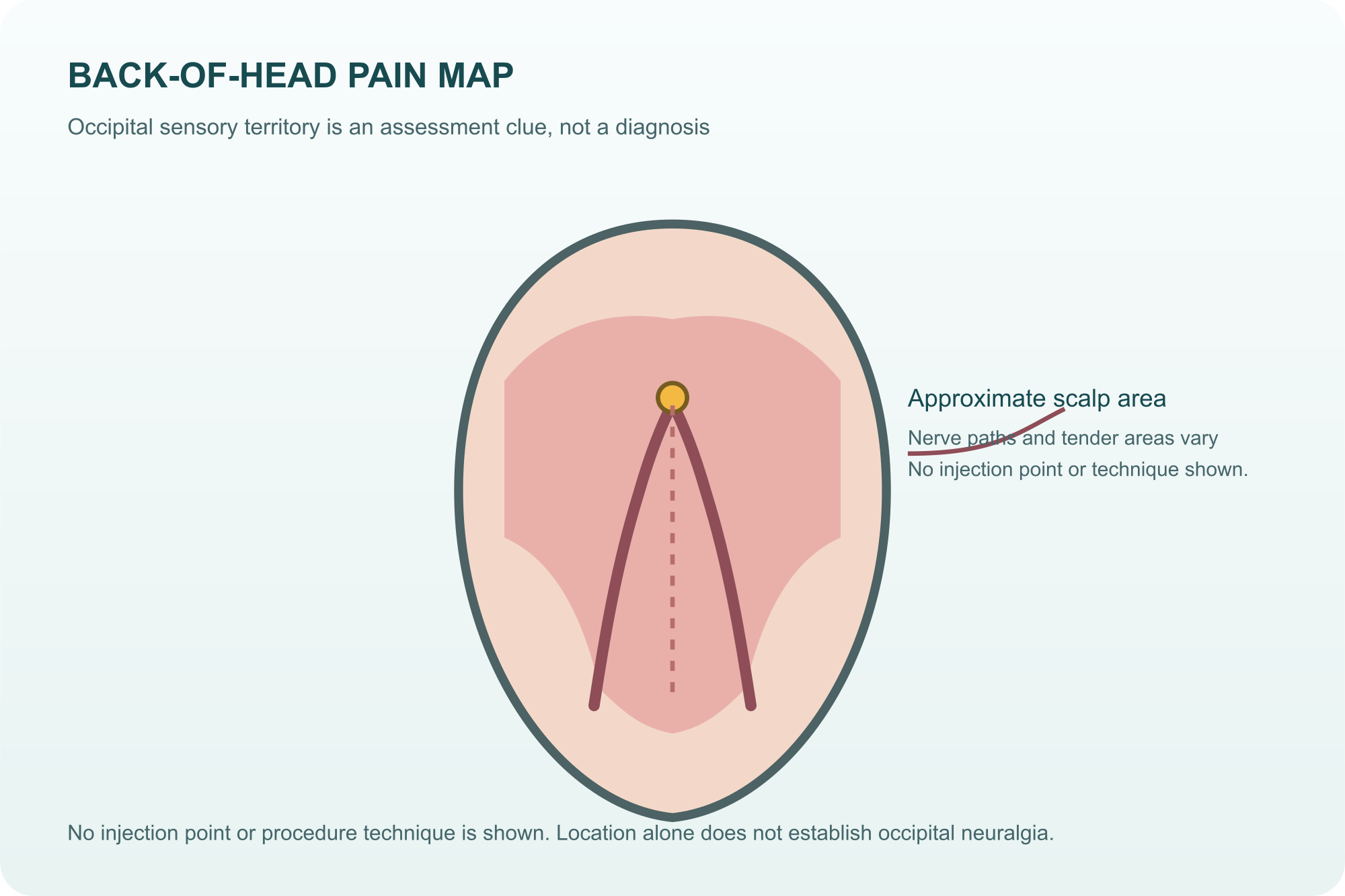
An occipital nerve block is considered only after the clinician has identified a plausible occipital target and checked whether an injection is safe and useful for the patient’s goal. It is not a general treatment for every headache, neck ache, scalp sensation, or pain behind the eye. The examination should also consider migraine-like features, neck sources, medication effects, skin or ear problems, and urgent neurological warning signs.
Before proceeding, I would want the patient to understand the proposed target, the purpose of the injection, what medication may be used, what alternatives exist, and how the result will be judged. The discussion should include relevant medicines, allergies, bleeding risk, infection, pregnancy or other health factors when relevant, and what to do if new weakness, worsening pain, fever, or another concerning symptom appears. Ultrasound guidance may help a clinician identify anatomy when appropriate, but it does not make an injection risk-free.
A short response can be disappointing, but it is still better treated as information to interpret than as an automatic reason to repeat the procedure. A case series of refractory occipital neuralgia described patients who had already tried occipital nerve blocks and other treatments before referral for decompression surgery. The authors also stated that selection criteria for surgery were not well defined (Austen et al., 2023; PMID: 38090265). That is a reason for specialist judgment, not a promise that surgery or repeated blocks are the next step.
Clarify the pain pattern before choosing an injection
A focused assessment can help separate facial, scalp, neck, dental, and neurological possibilities before a nerve-block decision.
What Is a Trigeminal Nerve Block?
A trigeminal nerve block is a targeted procedure near a selected branch or structure associated with the trigeminal nerve. The phrase can describe different levels of treatment. A superficial peripheral branch approach is not interchangeable with a deeper hospital-based ganglion or neurosurgical procedure, and each has different questions, risks, equipment, and referral requirements.
The first question is not “Which block is strongest?” It is “What pain pattern and clinical finding make this target reasonable?” If the pain is not clearly in the proposed nerve territory, if there is progressive numbness or weakness, or if the symptoms suggest another condition, an injection may be the wrong first move. The patient should be told whether the block is intended as a diagnostic aid, a temporary treatment, or part of a larger plan.
The injection cannot guarantee that facial pain will stop, cannot establish that the trigeminal nerve is the only pain generator, and should not delay urgent assessment. The evidence record for this draft does not support a numeric success rate or a promised duration of relief for a trigeminal nerve block. Those details should be discussed only when the exact procedure and indication have been reviewed.
A patient can ask whether the proposed block is peripheral or deep, whether imaging or another specialist is needed first, and what symptom would make the clinician stop. It is also reasonable to ask how temporary numbness, altered sensation, or weakness would affect eating, speaking, walking, driving, or work. These are not minor details: they define whether the treatment can be carried out safely and whether the result will be interpretable.
What Is an Occipital Nerve Block?
In plain language, an occipital nerve block is an injection placed near an occipital nerve at the back of the head. The clinician chooses the target from the pain map and examination rather than from the word “headache” alone. The patient remains part of the safety process: report blood-thinning medicines, allergies, infection, previous reactions, pregnancy, and any new neurological symptom before the procedure.
A block may make a selected area feel different for a time, but that sensation should not be mistaken for healing. The practical question is whether the result changes the patient’s function and helps clarify the next step. If there is no meaningful response, the clinician should revisit the diagnosis and source of pain rather than assuming that a stronger or repeated injection is automatically better.
Before travelling for a procedure, confirm whether the visit is for assessment, injection, or both; whether a companion is advisable; which medicines should be disclosed; and which warning signs require urgent help afterward. A patient should leave with a written plan for monitoring the response and a clear route back to the clinician. The plan should still make sense if the pain returns, changes location, or begins to include numbness or weakness.
The safest expectation is limited and specific: a nerve block may be one tool in a broader plan for a carefully selected patient. It does not remove the need to assess the neck, jaw, teeth, skin, medication use, sleep, and neurological findings when those factors may contribute. The parent guide on peripheral nerve blocks and pain management explains the wider role and limits of targeted blocks.
What Treatments Are Used for Trigeminal Neuralgia?
Trigeminal neuralgia treatment is chosen after the pain pattern and possible secondary causes have been assessed. The reviewed abstract describes pharmacological treatment as first-line, while noting that no treatment modality with 100% efficacy is established (Villegas Díaz et al., 2024; PMID: 39800569). That evidence does not tell us which medicine is right for a particular person, how it should be monitored locally, or when a procedure is appropriate.
A careful plan weighs pain control against alertness, balance, work demands, other medicines, kidney or liver conditions, pregnancy considerations, allergies, and the need for follow-up. Do not start, stop, or change a prescription based on this article. If medicine is not tolerated or does not control the pain, the next step may be a more detailed neurological review, imaging for a specific question, or referral for a procedure. A nerve block is one possible discussion, not a default replacement for medication.
Surgery belongs to a specialist conversation when symptoms remain disabling or treatment options are limited. The occipital case-series evidence in this run illustrates why a selected refractory pathway cannot be copied as a universal protocol: the patients had specialist assessment and previous treatments, and the authors acknowledged uncertainty around selection criteria. Ask what diagnosis is being treated, what benefit is realistic, what harms are possible, and what happens if the planned treatment does not help.
For patients preparing for a consultation, the most useful information is often simple: draw the pain on a face and scalp diagram, note whether touch or movement triggers it, record numbness or weakness, list medicines and supplements, and bring previous reports. If the problem may involve a nerve elsewhere in the body, the EMG and nerve-diagnostic service guide explains how a clinician may decide whether electrodiagnostic testing is relevant; it is not a substitute for a head-pain assessment.
When Is Head or Facial Pain an Urgent Problem?
Seek emergency assessment for sudden severe or unusual head pain, new weakness or numbness, facial droop, confusion, fainting, seizure, new vision loss, fever with neck stiffness, repeated vomiting, or rapidly worsening symptoms. These warning signs can indicate a problem that should not wait for a routine consultation or nerve-block appointment. If you feel acutely unsafe or very unwell, use local emergency services or go to the nearest emergency department.
Arrange prompt clinical review when pain is steadily changing, is associated with new persistent numbness, affects eating or speaking, follows significant trauma, or is repeatedly being treated as a tooth or muscle problem without a clear explanation. Bring the medication list and previous reports. In Vigan or elsewhere in the Philippines, confirm current clinic availability, fees, and referral requirements directly; this article does not claim a price, insurance benefit, or guaranteed local procedure availability.
Do not use a nerve-block appointment to postpone emergency care. If symptoms are mild but recurring, write down what happened before, during, and after each episode instead of relying on memory. Note triggers, location, duration, associated nausea or visual change, sleep disruption, and whether the pain affected speaking, chewing, walking, or balance. That record can help a clinician decide whether the next step is a pain assessment, dental review, neurological work-up, rehabilitation plan, or a targeted procedure.
Head and facial pain can be severe, invisible, and difficult to name. The useful next step is not to prove that a symptom matches an online checklist. It is to identify the safest working diagnosis, define what a proposed nerve block is meant to answer, and agree on what would change the plan. The pain rehabilitation overview provides broader context for combining assessment, symptom management, and function-focused care.
Head and Facial Pain Realities
A targeted injection can be part of a plan, but the target and the diagnosis must be clear first.
A familiar pain word is not a diagnosis
“Kuryente,” “zaps,” burning, pressure, scalp tenderness, tooth pain, and pain behind the eye describe experiences. They do not by themselves identify trigeminal neuralgia, occipital neuralgia, migraine, dental pain, or another condition.
A temporary response is still limited information
Pain may change after a targeted procedure, but that result does not prove that the nerve is the only source or that the underlying problem has been repaired. The response needs to be matched with examination and function.
Refractory care is not a universal sequence
A small occipital-neuralgia case series described patients who had already tried blocks and other treatments before surgery, but that pathway should not be turned into a rule for every patient. Surgical selection remains a specialist decision.
References & Clinical Evidence
- [1] Villegas Díaz D, Guerrero Alvarado G, López Medina A, Gómez Clavel JF, et al. Trigeminal neuralgia: therapeutic strategies to restore quality of life. J Oral Facial Pain Headache. 2024. PMID: 39800569.
- [2] Austen WG Jr, Remy K, Packowski K, Hazewinkel MH, et al. Refractory occipital neuralgia treatment with nerve decompression surgery: a case series. Front Neurol. 2023. PMID: 38090265.
* Clinical references are provided to support the medical claims made in this article. TeraCare adheres to evidence-based practices in physical medicine and rehabilitation.

Dr. Ben Rabara
Dr. Ben Rabara is a Board-Certified Physiatrist specializing in Physical Medicine and Rehabilitation. He focuses on non-surgical, precision treatments for musculoskeletal conditions, utilizing advanced diagnostics like MSK Ultrasound.
Medical Disclaimer: The information provided in this article is for educational purposes only and does not substitute for professional medical advice, diagnosis, or treatment. Always consult a qualified physician for your specific health conditions.