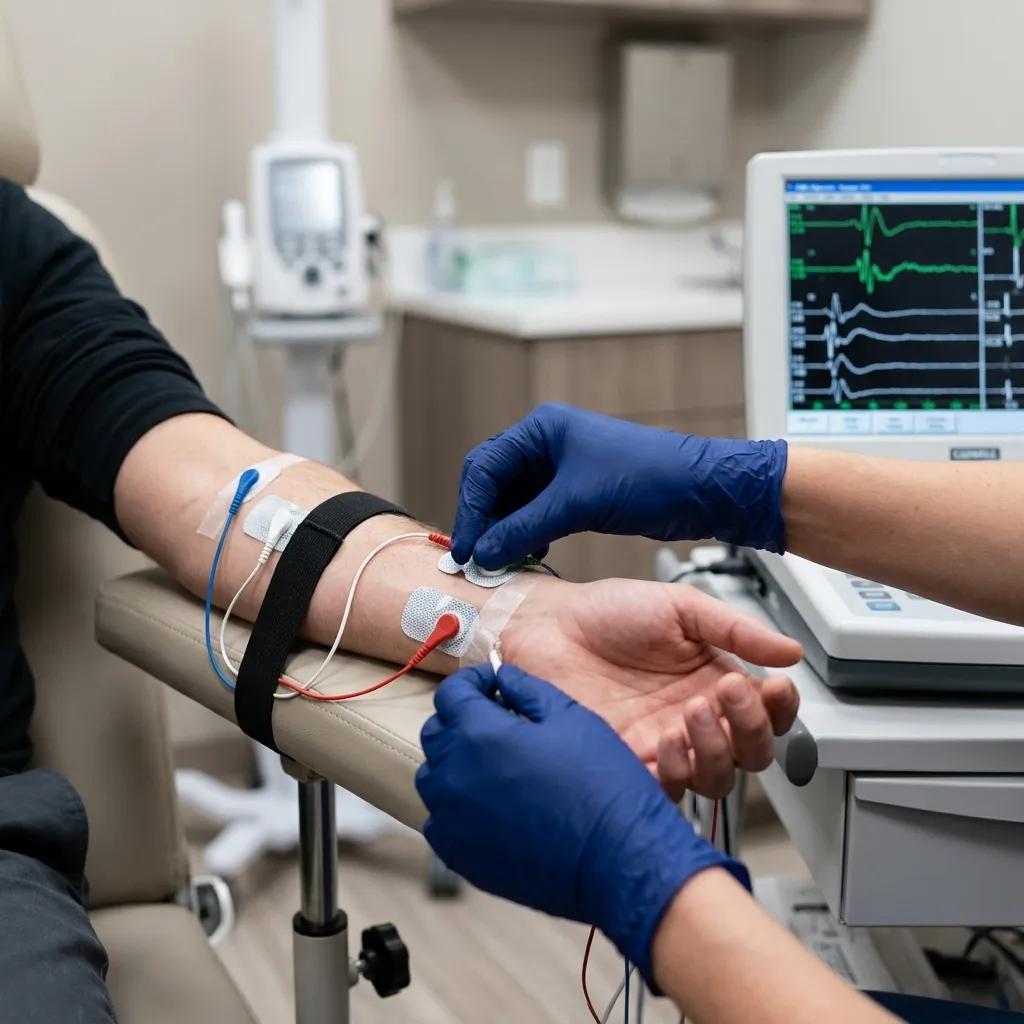
What is Precision EMG-NCV Diagnostic Testing?
When you experience shooting pain, muscle weakness, or a persistent 'pins and needles' sensation, the problem often originates deep within your nervous system. Standard physical exams and X-rays cannot see how your nerves are functioning. Precision Electromyography (EMG) and Nerve Conduction Velocity (NCV) testing are the clinical gold standards for evaluating the true physiological health of your peripheral nerves and muscles.
This diagnostic procedure is actually two separate, complementary tests. The NCV (Nerve Conduction Velocity) test utilizes mild electrical impulses applied to the skin to measure exactly how fast and how well your body's electrical signals are traveling along your nerve pathways. The EMG (Electromyography) portion involves inserting a microscopic, sterile pin directly into specific muscles to record their electrical activity, both at rest and during contraction. Together, these tests allow Dr. Rabara to map the exact location and severity of nerve compression, axonal damage, or demyelination.
What Conditions Does an EMG-NCV Diagnose?
Is an EMG-NCV
Right for You?
Early detection of nerve compression is critical. Prolonged nerve entrapment can lead to irreversible axonal damage and permanent muscle atrophy.
Ideal indications
Frequent dropping of objects or noticeable loss in grip strength.
Awakening with numb, tingling, or 'asleep' extremities.
Electric-like pain radiating down the cervical or lumbar spine.
Requirement for objective data before considering spinal surgery.
Clinical precautions
Active bleeding disorders or use of heavy anticoagulants (Precautions).
Cardiac pacemakers or implanted medical devices (Must disclose).
Active skin infections at proposed diagnostic insertion sites.
EMG-NCV Diagnostic Realities
Understanding the sensations and limitations of electrodiagnostic testing.
Mild Needle Discomfort
During the EMG phase, the insertion of the microscopic pin electrode may cause a sensation similar to a small pinch or acupuncture needle.
Temporary Muscle Soreness
It is normal to experience mild, localized muscle aching at the testing sites for 1 to 2 days following the procedure.
Timing Sensitivities
Nerve damage takes up to 21 days to fully manifest on an EMG. Testing too soon after an acute injury may yield a false negative.
MRI vs.
EMG-NCV Testing
The MRI (The Picture)
Like a high-resolution photo of wires in a house. It shows if a wire looks pinched, but not if electricity is flowing.
The EMG (The Electricity)
Acts as an electrician's multimeter. It provides objective data to prove whether that compression is causing damage.
In-Depth Clinical Science
Technical documentation for medical colleagues regarding electrodiagnostic pathophysiology.
Explore the Clinical Science: Wallerian Degeneration & Axonogenesis
Electrodiagnostics (EDX) allows us to quantify nerve health. When an axon is severely compressed, it undergoes Wallerian Degeneration distal to the injury site.
We identify spontaneous activity (fibrillation potentials, positive sharp waves) indicating 'denervation', allowing us to predict recovery vs permanent loss.
Detailed Diagnostic Pathways: Cervical & Lumbar Radiculopathy
We utilize the 'H-Reflex' and 'F-Wave' latencies to evaluate the proximal nerve segments closer to the spine, inaccessible by standard NCV.
This allows us to differentiate between localized entrapment (like Carpal Tunnel) and spinal root compression (Radiculopathy).
The 3-Step Testing Process
The Nerve Conduction Study (NCV)
We place surface electrodes on your skin and deliver brief, mild electrical impulses to map nerve speed and signal strength.
The Electromyography (EMG)
A micro-needle electrode is gently inserted into specific muscles to record internal electrical activity and detect muscle denervation.
The Clinical Diagnosis
Dr. Rabara analyzes the complex waveforms immediately to provide you with a precise, actionable diagnosis of your nerve health.
Clinical decision support
How electrodiagnostic findings guide a safer next step
Nerve-conduction studies and needle EMG evaluate different parts of nerve and muscle function. Used together, they can help localize a problem, estimate severity and chronicity, and distinguish conditions such as a focal entrapment from a nerve-root, plexus, generalized nerve, or primary muscle disorder. Results are not interpreted in isolation: temperature, age, anatomy, medical history, and the timing of the study can affect measurements.
A normal or equivocal study does not mean symptoms are imaginary, and some pain conditions or small-fiber disorders may not be detected by routine testing. The diagnostic plan therefore begins with the clinical question and ends with an explanation of what the test supports, what it does not exclude, and whether imaging, laboratory testing, observation, rehabilitation, or specialist review is needed.
How this evidence is applied at TeraCare
Dr. Rabara selects the nerves and muscles tested from the examination rather than using a one-size-fits-all panel. Patients receive an interpretation connected to their symptoms and a documented plan for the next decision.
Medical review: Dr. Ben Rabara, Physiatrist · Evidence reviewed August 22, 2026. This information supports shared decision-making and does not replace an individual examination or emergency care.
Clinical sources: AANEM Position Statement: Proper Performance and Interpretation of Electrodiagnostic Studies; AANEM Referral Indications for Electrodiagnostic Testing.
How this treatment fits your care plan
Nerve, Spine & Entrapment Care
Testing, decompression, pain control, and rehabilitation for nerve roots and peripheral nerves.
Your exact sequence depends on the diagnosis, safety screening, and response to treatment. A physiatrist will recommend only the steps that fit your case.
Where this treatment is available
Availability is generated from each active branch’s service record.
Common Questions
Does the EMG-NCV test hurt?
How do I prepare for my EMG-NCV appointment?
Are there any medical risks or contraindications?
How long does the diagnostic procedure take?
Can I return to work or drive after the test?
Why is it important that a Physiatrist performs this test?
What happens after I get my results?

Dr. Ben Rabara
Dr. Ben Rabara is a Physiatrist in Vigan City specializing in Physical Medicine and Rehabilitation. He focuses on non-surgical, precision treatments for musculoskeletal conditions, utilizing advanced diagnostics like MSK Ultrasound.
Medical Disclaimer: The information provided in this article is for educational purposes only and does not substitute for professional medical advice, diagnosis, or treatment. Always consult a qualified physician for your specific health conditions.
Precision Nerve Diagnostic Guides
Expert resources on identifying the exact source of numbness, tingling, and chronic nerve pain.