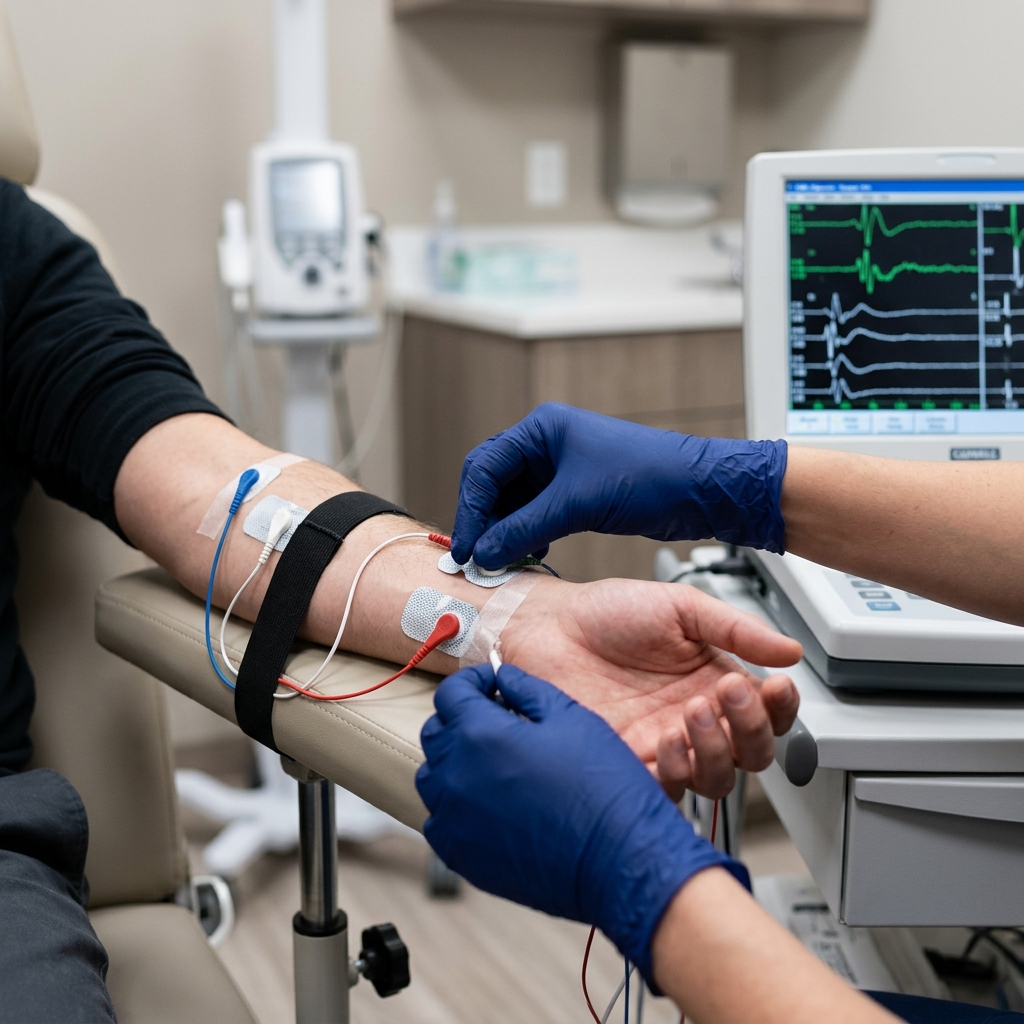
- — A 'stinger' or 'burner' involves a traumatic traction or compression of the brachial plexus in the shoulder, requiring careful clinical mapping.
- — An EMG-NCV study is the only objective diagnostic tool that can physically differentiate temporary nerve bruising (Neuropraxia) from active fiber death (Axonotmesis).
- — If an EMG shows that the nerve is still actively struggling, returning to contact sports carries an extremely high risk of permanent, irreversible nerve damage.
The collision is instantaneous. A hard tackle on the football field, a heavy fall on the basketball court, or an awkward twist during a sprint. In an instant, you feel a violent, white-hot flash of electricity shoot from your neck down into your fingertips, leaving your arm hanging completely limp and dead at your side.
These are the alarming realities of sports nerve injuries. While athletes, coaches, and sports physical therapists are highly trained to recognize muscle tears, ligament sprains, and bone fractures, traumatic injuries to the peripheral nervous system are frequently misunderstood, neglected, or misdiagnosed.
A nerve injury is not a simple structural tear that can be verified on a standard X-ray or MRI scan. It is a functional disruption of your body's communication grid. Whether you are dealing with a recurring shoulder stinger from contact sports or a progressive brachial plexus injury, a precision EMG NCV test is the absolute gold standard for mapping the severity of the damage.
Shoulder Stingers and Burners: Brachial Plexopathy in Contact Sports
In high-impact contact sports like rugby, basketball, football, and martial arts, the shoulder and neck undergo extreme mechanical forces. The most common nerve injury resulting from these forces is a "stinger" or "burner."
A stinger is a traumatic injury to the brachial plexus—the complex web of nerves that originates in your neck and travels under your collarbone to supply the entire arm.
There are two primary mechanical ways a stinger occurs:
- Traction (Stretching) Injury: A collision forces your head to bend sharply to one side while your shoulder on the opposite side is violently pressed downward. This action stretches the brachial plexus nerves beyond their physical limits, tearing the delicate protective sheaths of the nerve fibers.
- Compression (Pinching) Injury: Your head is forced backward and to one side, compressing the spinal nerve roots as they exit the neuroforamina in the neck. This direct mechanical squeeze blocks signal transmission instantly.
The classic presentation is unmistakable: an immediate, intense burning, stinging, or electrical shock sensation shooting down one arm, accompanied by a sudden loss of muscle strength. While most mild stingers resolve within minutes as signal flow returns, recurrent stingers or those with lingering weakness are signs of progressive nerve damage that requires a detailed board-certified evaluation to prevent permanent brachial plexus palsy.
The Physics of Nerve Damage: Grading Severity
To design a successful athletic recovery plan, we must first determine the exact grade of the nerve injury. In physical medicine, we use the classic Seddon Classification to grade nerve trauma into three distinct categories: Neuropraxia, Axonotmesis, and Neurotmesis.
The Role of EMG-NCV in Athlete Recovery & Return-to-Play
An EMG NCV test is the ultimate objective safety gate in sports medicine. Relying on an athlete's subjective feedback ("I feel fine") or basic manual muscle testing is highly dangerous. By testing the signal flow, Dr. Rabara isolates the exact millimeter of compression, preventing incorrect surgeries or ineffective rehab.
Reclaim Your Athletic Performance
Stop struggling with radiating nerve pain. Schedule a precision sports EMG-NCV study with Dr. Ben Rabara in Vigan City.
Physiatrist-Led Sports Rehab: Our Multi-Phase Protocol
At TeraCare Vigan, Dr. Ben Paolo Rabara combines state-of-the-art diagnostic mapping with advanced, non-surgical sports rehabilitation. For stingers, we focus on rebuilding deep neck stabilizers, correcting shoulder blade movement (scapular dyskinesis), and teaching protective tackling techniques.
References & Clinical Evidence
- [1] Weinberg, J., & Rhee, J. M. (2010). Cervical Spine Stingers and Burners in Athletes. Current Sports Medicine Reports, 9(1), 35-41.
- [2] Preston, D. C., & Shapiro, B. E. (2020). Electromyography and Neuromuscular Disorders: Clinical-Electrophysiologic Correlations (4th ed.). Elsevier.
* Clinical references are provided to support the medical claims made in this article. TeraCare adheres to evidence-based practices in physical medicine and rehabilitation.

Dr. Ben Rabara
Dr. Ben Rabara is a Board-Certified Physiatrist specializing in Physical Medicine and Rehabilitation. He focuses on non-surgical, precision treatments for musculoskeletal conditions, utilizing advanced diagnostics like MSK Ultrasound.
Medical Disclaimer: The information provided in this article is for educational purposes only and does not substitute for professional medical advice, diagnosis, or treatment. Always consult a qualified physician for your specific health conditions.