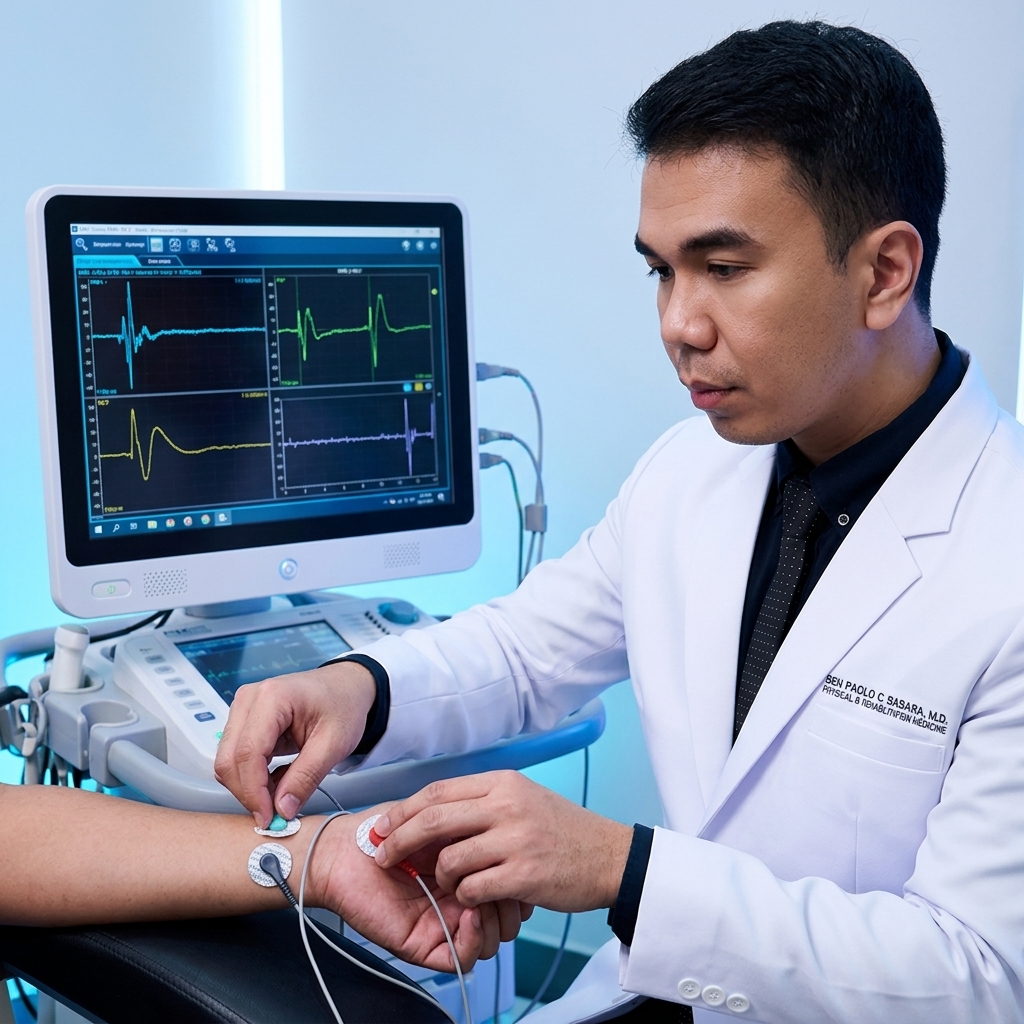
- — The primary fear regarding EMG-NCV tests is the anticipation of pain, which is heavily exaggerated by internet horror stories.
- — An NCV test uses skin stickers and delivers mild, millisecond electrical pulses that feel like a quick static shock or rubber band tap.
- — The needle EMG portion does not involve injections or blood withdrawal; it uses a microscopic, acupuncture-like solid-state electrode.
- — Preparing properly—such as avoiding all lotions and oils on the day of the test—is critical to ensure clear electrical signals and a fast procedure.
- — Differentiating between a neurologist and a physiatrist is key: a physiatrist (PM&R specialist) specializes in translating diagnostic data immediately into non-surgical physical rehab.
If your doctor has recently ordered an electrodiagnostic study, your very first action was likely a quick search online. Within minutes, you were probably reading forum posts and internet horror stories describing the procedure as a "painful torture session" filled with agonizing electric shocks and giant needles.
It is entirely natural to feel anxious when reading these descriptions. As humans, we are biologically wired to avoid electrical currents and needles. But as a board-certified Physical Medicine & Rehabilitation (PM&R) specialist, I hear patients say every single week: "Doctor, I delayed this test for months because I was terrified—but it was nothing like what I read online."
The truth is, the anticipation of pain is almost always far worse than the actual sensation. When performed by an empathetic, highly skilled physician using modern equipment, an EMG-NCV study is a highly tolerable, comfortable procedure.
But does EMG test hurt, and what should you realistically expect?
Let us dissect the physical sensations of the test, lay out a comprehensive EMG NCV test preparation checklist, and explain why choosing the right specialist—specifically understanding the differences between a neurologist vs physiatrist for nerve pain—is the key to a comfortable and definitive diagnosis.
Defining the Sensations: What an EMG-NCV Actually Feels Like
To demystify the procedure, we must analyze the physical sensations of its two distinct segments. We do not use general anesthesia or local numbing creams because we require your nerves and muscles to be fully active and chemically unaltered to record precise electrical signals.
1. The Nerve Conduction Velocity (NCV) Sensation
The NCV segment uses surface stickers to listen and a handheld stimulator to send brief, localized electrical pulses along your nerve pathways.
- The Pulse Sensation: Each electrical pulse lasts less than one millisecond (one-thousandth of a second). It does not feel like continuous electrical current or the agonizing shock of an outlet.
- The Physical Analogy: Most patients describe it as a sudden tapping on the skin, a quick snap of a rubber band, or the localized static shock you feel when touching a metal doorknob after walking across a carpet.
- The Motor Response: You will feel your fingers or toes twitch automatically. This is a purely physical, involuntary reflex as the nerve is stimulated. It is not painful, but it can feel unusual or startle you slightly on the first few pulses.
The moment the stimulator is lifted, the sensation disappears completely. There is absolutely no lingering pain, burning, or soreness.
2. The Needle Electromyography (EMG) Sensation
The needle EMG segment does not inject any fluids or draw blood. It uses a microscopic, solid-state electrode to translate muscle signals into sound waves.
- The Insertion: Because the needle is solid and extremely thin (about the thickness of an acupuncture needle), it slides easily through the skin. You will feel a minor, localized pinch, similar to having a hair plucked or receiving a small acupuncture treatment.
- The Internal Pressure: Once the microscopic needle is inside the muscle, there are no pain receptors within the muscle fibers themselves. However, you may feel a dull, deep pressure or a minor cramp-like sensation as Dr. Rabara gently moves the electrode to listen to different motor units.
- The Contraction: When Dr. Rabara asks you to flex or squeeze the muscle, you may feel a mild muscle ache, similar to the fatigue you feel during a heavy workout.
The second the needle is removed, the sensation stops. The entire needle phase for a single limb takes only 5 to 7 minutes.
The High Stakes of Delay: Why Avoiding the Test Prolongs Your Pain
Allowing internet fear to delay your 30-minute test is a severe clinical risk. When you have progressive nerve compression or muscle weakness, time is your greatest enemy.
Here is what happens when you delay an electrodiagnostic study:
- Permanent Axon Death: If a nerve is compressed (such as in severe Carpal Tunnel Syndrome or a pinched spinal nerve root), it is starved of blood. If left compressed for too long, the core electrical wires (axons) undergo irreversible degeneration. Early NCV detection is vital to save the nerve before it reaches this stage.
- Silent Muscle Atrophy: When a muscle is deprived of its nerve signals, it begins to shrink and waste away (muscle atrophy). Once muscle fibers are replaced by fatty scar tissue, physical strength cannot be fully recovered.
- Unnecessary Back Surgeries: Many patients undergo expensive, invasive spinal fusions or discectomies based solely on an MRI showing a "bulging disc." However, a bulging disc is often asymptomatic. Without an EMG-NCV to prove the disc is actually crushing a nerve, patients risk undergoing unnecessary surgeries that do not resolve their pain (Failed Back Surgery Syndrome).
Choosing 30 minutes of completely manageable, minor discomfort is the only way to obtain the definitive "proof" your medical team needs to target your recovery.
The Ultimate EMG-NCV Test Preparation Checklist
Proper preparation is key to a fast, accurate, and comfortable diagnostic session. Follow this clinical checklist carefully:
Patient Preparation Checklist
- 1. No Lotions, Oils, or Creams (Critical): Do not apply any moisturizers, body lotions, skin oils, or creams to your arms or legs on the day of the test. These substances create an electrical barrier that distorts the faint microvolt signals of your nerves.
- 2. Keep Your Limbs Warm: Cold limbs slow down nerve conduction speeds artificially, which can lead to an inaccurate diagnosis of neuropathy. Wear warm clothing, and if your hands or feet feel cold when you arrive, let our staff know so we can warm them with heating packs before starting.
- 3. Wear Loose, Comfortable Clothing: Wear loose garments (like shorts and a short-sleeved t-shirt) that allow easy access to your elbows, knees, calves, and shoulders. You will not need to undress if we can easily access these target areas.
- 4. Disclose All Medications: Continue taking your usual medications, but inform Dr. Rabara if you are on blood thinners (warfarin, aspirin, clopidogrel) or heavy muscle relaxants.
- 5. Pacemakers & Defibrillators: If you have an implanted cardiac pacemaker or defibrillator, the NCV test is still highly safe, but Dr. Rabara will adjust the electrical stimulation sites to ensure absolute cardiac safety.
Neurologist vs. Physiatrist for Nerve Pain: Understanding the Crossover
When seeking a specialized nerve test for legs or arms, patients are often confused about where to go. They ask: Should I see a neurologist or a physiatrist?
Both specialties undergo rigorous, multi-year clinical training to perform electrodiagnostic studies, and both are fully qualified to operate the equipment. However, their clinical philosophies and subsequent treatment pathways are highly distinct:
The Neurologist
A neurologist is a specialist who focuses primarily on brain and central nervous system disorders (such as epilepsy, multiple sclerosis, dementia, or Parkinson's disease).
If you undergo an EMG-NCV with a neurologist, they will provide a highly accurate diagnostic report. However, their treatment options are typically focused on medical prescriptions (pharmaceutical pain management) or referring you to a surgeon if a mechanical block is found.
The Physiatrist (Physical Medicine & Rehabilitation - PM&R)
A physiatrist is a medical doctor who specializes in physical function, mobility, and the non-surgical treatment of bone, muscle, and nerve disorders.
When you choose a physiatrist like Dr. Ben Rabara at TeraCare Vigan:
- Immediate Clinical Bridge: A physiatrist does not just hand you a diagnostic report and send you away. Because they specialize in physical rehabilitation, they immediately bridge the diagnosis with a non-surgical recovery plan.
- Musculoskeletal Crossover: A physiatrist evaluates how your nerve damage is affecting your physical posture, walking patterns (gait), muscle balance, and daily independence.
- Comprehensive Non-Surgical Care: Under one roof, a physiatrist can integrate your NCV findings into a targeted physical therapy program, design custom foot orthotics, prescribe specialized splints, or perform precise, ultrasound-guided nerve hydrodissection injections to mechanically free compressed nerves.
For patients struggling with localized nerve compressions (like Carpal Tunnel), sciatica pinched nerves, or diabetic neuropathy, a physiatrist serves as the ideal clinical architect to guide you from diagnosis to pain-free mobility without undergoing major surgery.
Clinical Analysis: Blind Delaying vs. Proactive Electrodiagnostic Prep
Let us contrast the clinical outcomes of delaying your test due to fear versus taking proactive diagnostic action:
| Clinical Parameter | Blind Delaying (Avoiding the Test) | Proactive Electrodiagnostic Preparation |
|---|---|---|
| Diagnostic Target | None: Relies on subjective internet comparisons and home guessing. | 100% Symmetrical: Pinpoints exact millisecond nerve speeds Distally. |
| Nerve Starvation & Axon Death | High: Unrelieved pressure leads to progressive, permanent axon death. | Prevented: Identifies compression early to initiate immediate pressure relief. |
| Treatment Accuracy | Low: Blind physical therapy or generic vitamin supplementation. | Highly Precise: Tailors physical rehabilitation directly to the damaged nerve. |
| Sensation Experienced | Prolonged, severe chronic nerve pain that worsens over time. | 30 minutes of mild, completely manageable tapping and pressure. |
Conquering Your Anxiety: Why TeraCare Vigan is Your Trusted Partner
At TeraCare Vigan, we understand that diagnostic testing can be intimidating. We do not treat you like a number on a schedule; we treat you with the absolute clinical empathy and respect you deserve.
When you schedule your EMG NCV test preparation study with Dr. Ben Paolo C. Rabara:
- Patient-Controlled Pace: Dr. Rabara personally conducts every single test, guiding you through each stimulation. If you feel anxious, he will explain the waveforms, show you the screen, adjust the pacing, or pause the study to ensure you remain fully comfortable.
- University-Grade Diagnostic Equipment: Our clinic utilizes state-of-the-art electrodiagnostic machines that feature advanced noise filtering and ultra-thin, premium electrodes. This ensures we capture pristine electrical signals quickly, reducing the duration of the test.
- Direct Physiatric Coordination: Because Dr. Rabara is a board-certified PM&R specialist, he immediately integrates your test findings into a comprehensive rehabilitation program, helping you bridge the gap between diagnosis and active healing.
- Accessible Northern Luzon Diagnostics: Patients in Ilocos Sur, Ilocos Norte, and Abra no longer need to travel to Manila's crowded university hospitals for professional electrodiagnostics. We provide university-grade precision right here in Vigan City.
Conclusion: Choose Answers Over Fear and Restore Your Function
Do not let exaggerated forum posts or internet fear prolong your physical suffering. Thirty minutes of minor, manageable discomfort is a tiny investment to protect your nerves, save your muscles from shrinking, and establish a clear, non-surgical roadmap to recovery.
Stop guessing why you are in pain, and stop delaying your healing. Schedule your precision, board-certified EMG-NCV study with Dr. Ben Rabara at TeraCare Vigan today.
Conquer Your Fear and Map Your Nerves
Stop delaying your diagnosis due to anxiety. Schedule a highly comfortable, board-certified EMG-NCV study with Dr. Ben Rabara in Vigan City.
Clinical Review Note: This educational guide was drafted under direct physician supervision and thoroughly reviewed for electrodiagnostic accuracy, anatomical precision, and patient safety before publication.
References & Clinical Evidence
- [1] American Association of Neuromuscular & Electrodiagnostic Medicine (AANEM). (2021). Patient Guide to Electromyography and Nerve Conduction Studies.
- [2] Preston, D. C., & Shapiro, B. E. (2020). Electromyography and Neuromuscular Disorders: Clinical-Electrophysiologic Correlations (4th ed.). Elsevier.
- [3] American Academy of Physical Medicine and Rehabilitation (AAPM&R). (2022). PM&R Knowledge Directory: Electrodiagnostic Medicine.
- [4] National Institute of Neurological Disorders and Stroke (NINDS). (2023). Neurological Diagnostic Tests and Procedures Fact Sheet.
* Clinical references are provided to support the medical claims made in this article. TeraCare adheres to evidence-based practices in physical medicine and rehabilitation.

Dr. Ben Rabara
Dr. Ben Rabara is a Board-Certified Physiatrist specializing in Physical Medicine and Rehabilitation. He focuses on non-surgical, precision treatments for musculoskeletal conditions, utilizing advanced diagnostics like MSK Ultrasound.
Medical Disclaimer: The information provided in this article is for educational purposes only and does not substitute for professional medical advice, diagnosis, or treatment. Always consult a qualified physician for your specific health conditions.