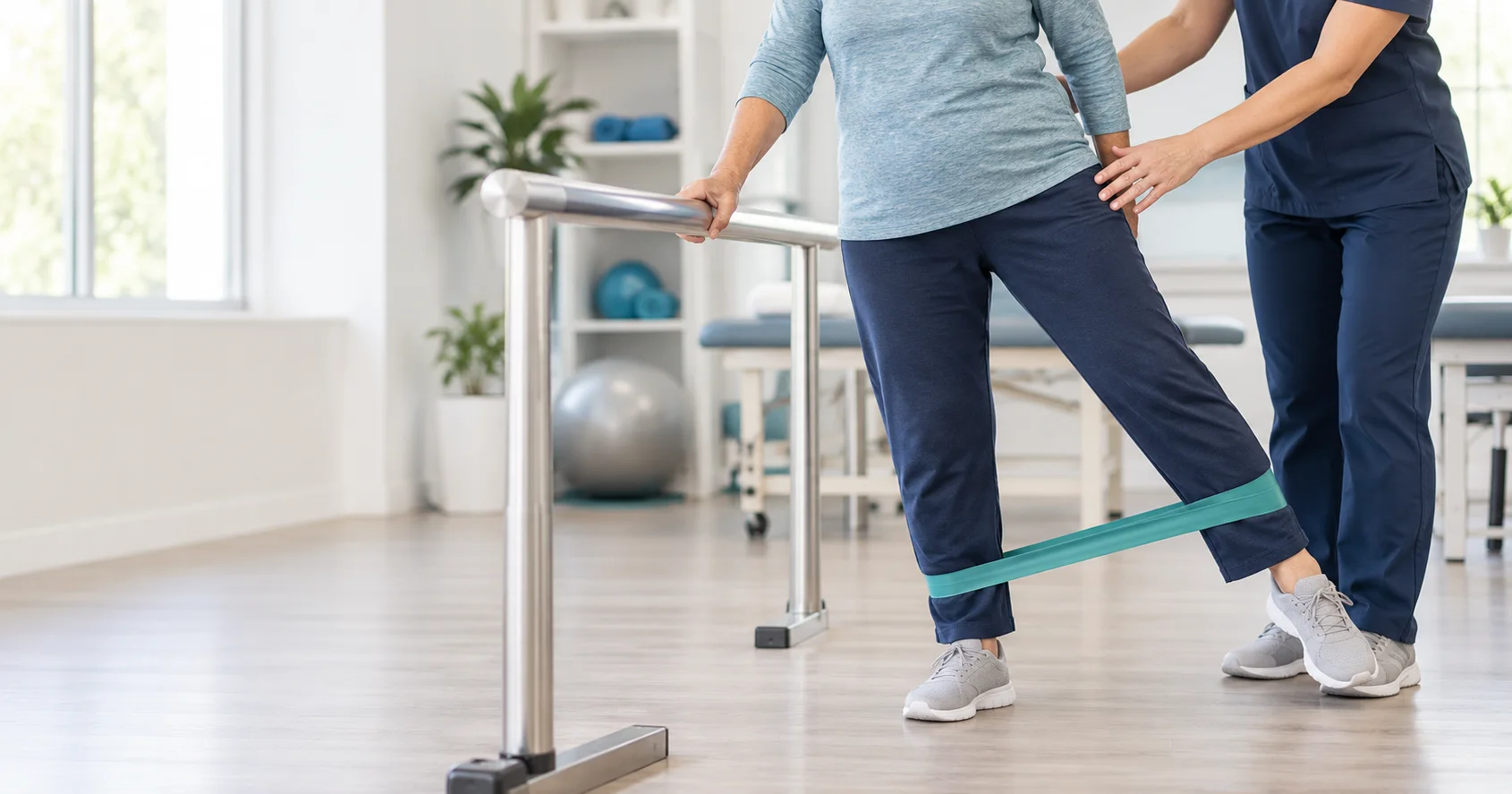
- — Osteoporosis is a condition in which bone strength is reduced. Weight-bearing exercise for osteoporosis is not one universal routine; the safe starting point depends on fracture history, pain, balance, strength, posture, vision, medicines and the person’s goals.
- — A useful osteoporosis exercise program for older adults may combine upright activity, resistance training, balance work, posture and fall-risk planning rather than relying on walking alone.
- — Physical therapy for osteoporosis can help screen movement risk, teach technique, adapt loading and build a progression that fits daily function. It cannot promise to reverse osteoporosis or prevent every fracture.
- — A recent fracture, sudden focal pain, loss of height, repeated falls or new weakness should be assessed before increasing impact, resistance or loaded bending.
Osteoporosis is a condition in which bone strength is reduced and a fall or ordinary load may cause a fracture more easily. If you have osteoporosis or low bone density, it is reasonable to ask whether exercise could make a fracture more likely. The answer is not a universal list of “good” and “bad” exercises. Weight-bearing exercise means working against gravity while standing or moving upright; for osteoporosis, it should be matched to your fracture history, current pain, balance, strength, posture, vision, medicines, movement technique and daily goals. A safe plan often combines upright activity, progressive strengthening, balance practice and fall-risk reduction, with professional assessment when risk is unclear.
What weight bearing exercises for osteoporosis are safest to start with?
Weight-bearing exercise means your body works against gravity while you are standing or moving upright. Walking is one familiar example, but it is not automatically the right first step for everyone. Some people may start with short, steady walks. Others may need supported standing, transfer practice, balance work or supervised strengthening before increasing distance, speed or impact.
Before choosing an exercise, ask four practical questions: Have you had a low-trauma or vertebral fracture? Do you have new or focal pain? Have you fallen or felt unsteady? Can you control the movement without holding your breath, losing balance or rounding and twisting the spine under load? These questions do not diagnose osteoporosis, but they help identify when an online routine is not enough.
A clinician may build a starting plan around a stable surface, appropriate footwear, a support nearby and a level of effort that can be repeated consistently. The first goal is not to prove toughness. It is to build safe capacity for walking, transfers, stairs, household tasks and other activities you want to keep doing.
How does fracture history change the exercise plan?
A prior fragility fracture is important information, not a reason to stop all movement. A vertebral, hip, wrist or other low-trauma fracture may change the amount of impact, the spinal positions, the starting load and the supervision needed. The plan may also need to account for pain, healing stage, confidence, medication, nutrition and the risk of another fall.
After a fracture, exercise may begin with safe breathing, posture, bed mobility, transfers, balance and gentle strengthening. More demanding weight-bearing or resistance work can be added when the treating team confirms that the movement and load are appropriate. A fracture history is a clinical risk signal, so the starting plan should be individualized before loading is increased (LeBoff et al., 2022; PMID: 35478046).
Do not use a healed-looking scar, a pain-free day or a social-media exercise video as clearance for jumping, running, heavy lifting or repeated loaded bending. Healing and bone strength are assessed in context.
How does physical therapy for osteoporosis make exercise safer?
Physical therapy for osteoporosis is not simply a list of stretches. In my clinic, I look for how a person stands, hinges, reaches, turns, steps, lifts, gets up from a chair and recovers from a balance challenge, and I recommend changes only after considering the full risk picture. I also ask how the symptom feels: is it sharp, dull, radiating, stiff, tingling, burning, catching or grinding? That description, together with examination, can show whether a movement becomes unsafe when the task is faster, heavier, more tiring or performed without support.
The plan may include education about neutral-spine strategies, hip-hinge technique, breathing, foot placement, balance reactions, assistive devices and how to make a home exercise easier or harder. The clinician can also coordinate with the physician when pain, a possible fracture, neurological symptoms or a medicine-related concern changes the risk picture.
The aim is not to make every person perform the same program. A tailored plan may be less dramatic than an internet challenge but more useful for the person’s actual life. Exercise reviews support using training as part of an individualized plan for strength, function and fracture-risk management, with appropriate precautions (Giallauria et al., 2023; PMID: 36976491).
Which exercises to improve bone density are realistic?
Searches for exercises to improve bone density often imply that one activity can rebuild bone. That is too simple. Exercise can support muscle strength, balance, physical function and bone loading, but research uses different programs, participants, doses and outcomes. A change in a bone-density measurement is not the same as proof that a person will never fracture.
A realistic program may combine weight-bearing activity, resistance training, balance and posture work. It may also address vision, footwear, home hazards, nutrition, medicines and the person’s fear of falling. Guidelines describe exercise as one part of broader fracture-risk management, not as a replacement for assessment or treatment when fracture risk is high (LeBoff et al., 2022; PMID: 35478046).
Walking may be a useful and accessible start, but walking alone may not train the strength and balance needed for every task. The best plan is the one that can be repeated safely, adjusted when symptoms or function change, and connected to a meaningful daily goal.
How should strength training for osteoporosis be progressed?
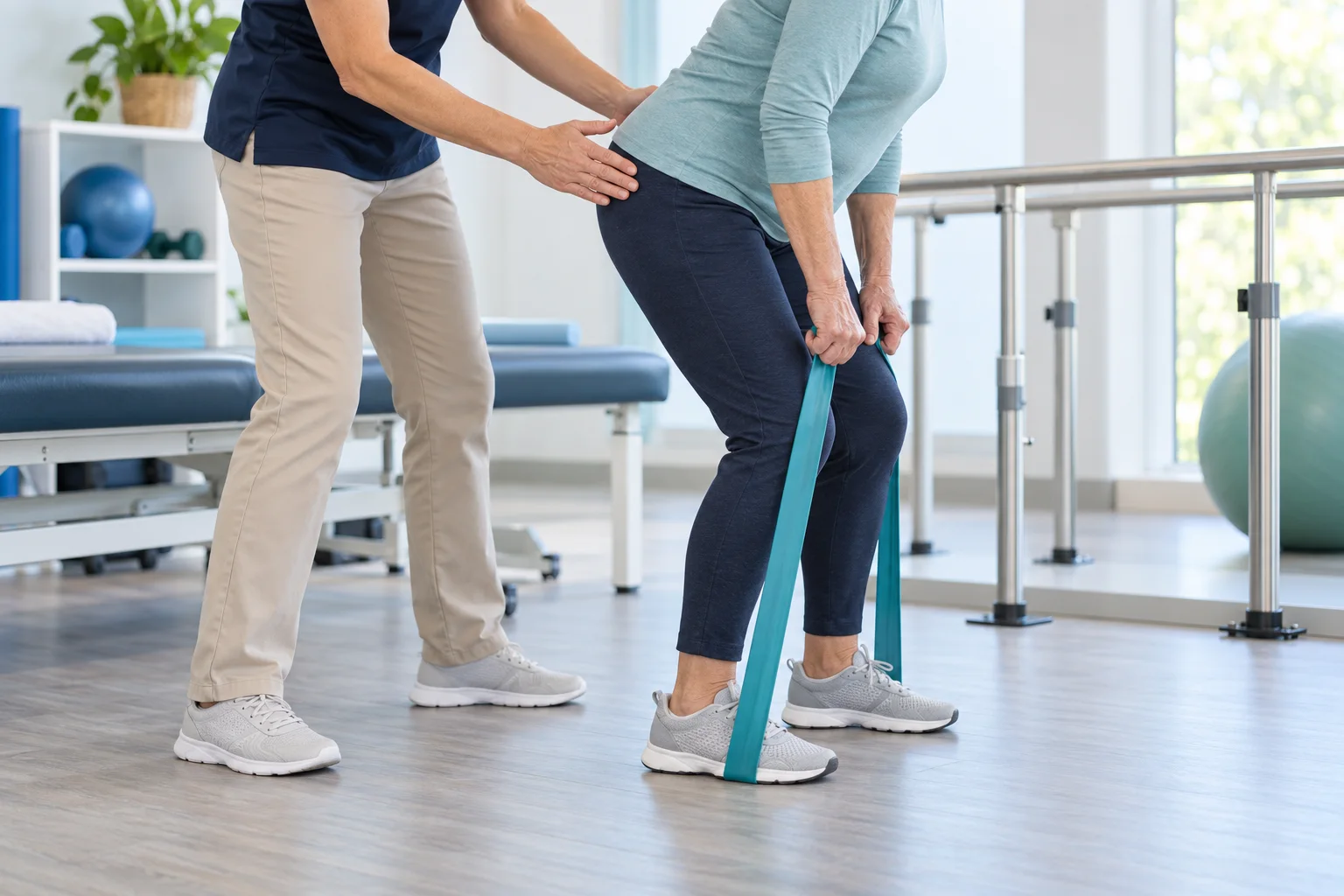
Strength training for osteoporosis should start with a movement you can control. A therapist may first adjust the range, speed, resistance, support and number of repetitions. As examples only, a clinician might begin with 5 minutes or 10 minutes of upright activity, one set of 5 reps or 10 reps, or 10 sec to 30 sec of supported balance practice, then review how the person responds. Those numbers are not a prescription; the correct dose depends on assessment, symptoms, recovery and technique. When the movement is steady and symptoms remain acceptable, one part of the task can be progressed. That might mean a slightly heavier resistance band, more repetitions, a longer walk or less hand support—not every change at the same time.
Keep the focus on breathing, alignment and control. A hip hinge can help a person pick something up while keeping the movement organized, but it still needs to be taught and practiced. A blanket instruction to “never bend” can make everyday tasks harder, while repeated loaded spinal flexion or twisting may be inappropriate for someone with a fragile spine. The safe choice is individual assessment and technique training.
Progression should be reviewed if pain becomes focal or persistent, balance worsens, fatigue changes technique, or the person develops new weakness, numbness or loss of function. Exercise research should inform a plan without being copied as a universal home prescription; loading still needs individual assessment and review (Giallauria et al., 2023; PMID: 36976491).
What should an osteoporosis exercise program for older adults include?
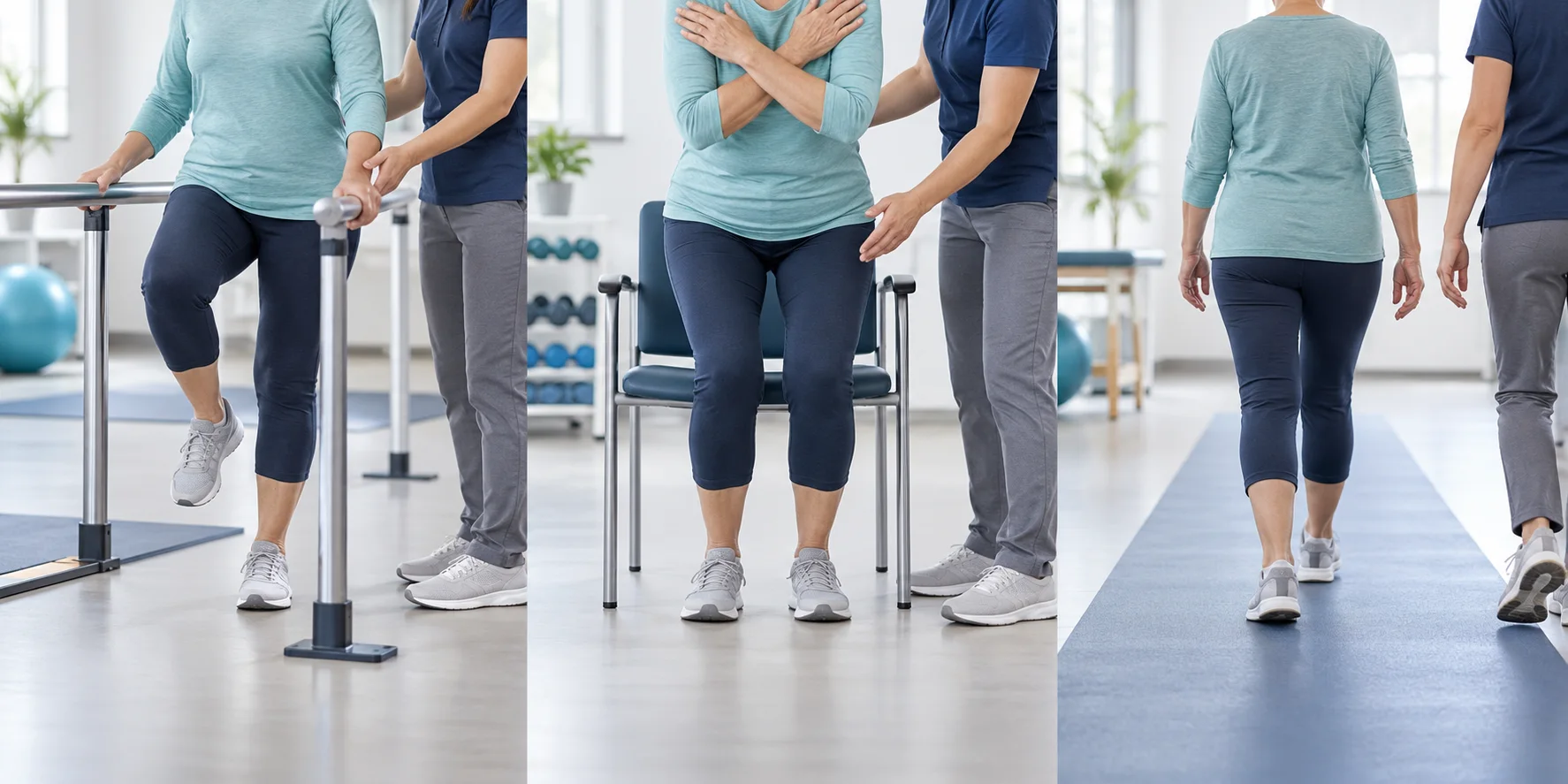
An osteoporosis exercise program for older adults should be practical enough to repeat and flexible enough to change. Depending on the person’s assessment, it may include:
- Upright activity: walking or another weight-bearing option that matches balance, foot comfort and endurance.
- Strength work: controlled resistance for the legs, hips, trunk and upper body, with technique and breathing monitored.
- Balance practice: tasks that challenge stepping, turning and reaching with safe support nearby.
- Posture and functional practice: standing tall, hinging, lifting, getting up from a chair and managing stairs or transfers.
- Fall-risk changes: review of footwear, vision, home hazards, assistive devices and confidence during daily activities.
Community-dwelling older adults can benefit from exercise that challenges balance and function, but the program needs to be adapted to ability and supervision. Exercise reviews support using movement as part of a broader plan rather than a promise that one class or walk eliminates risk (Giallauria et al., 2023; PMID: 36976491).
Choose a small number of movements that fit your home, schedule and support. A plan that requires equipment, floor transfers or fast changes of direction may need modification if those tasks are not realistic or safe.
| Part of the plan | What may be measured | When to review |
|---|---|---|
| Upright activity | Minutes, walking surface, support and balance quality | When symptoms, endurance or confidence changes |
| Strength work | Repetitions, resistance, breathing and movement control | When fatigue changes technique or pain becomes focal |
| Balance practice | Seconds, hand support, stepping and recovery reactions | After a fall, near-fall or new unsteadiness |
| Daily function | Stairs, chair transfers, lifting and the activity that matters to you | When the real-life goal improves or becomes harder |
Which movements may need modification when the spine is fragile?
There is no safe universal “avoid” list for every person, but some movements deserve a closer look when vertebral fracture or spinal fragility is part of the history. Repeated loaded rounding, forceful twisting, high-impact activity, quick direction changes or lifting away from the body may need to be reduced, taught differently or delayed. The decision depends on the movement, load, speed, symptoms, control and fracture history.
This does not mean the spine must be kept still. Gradual, supported movement can help maintain function and confidence. Ask a professional to show you how to turn, reach, hinge and lift for the tasks you actually do. Stop a movement that creates sudden focal pain or makes you lose control, and ask for a reassessment rather than guessing whether the pain is “normal.”
When should someone stop exercising and seek assessment?
Stop the session and seek prompt medical advice for sudden severe or focal pain, a major fall, inability to stand or bear weight, new weakness or numbness, a visible deformity, or pain that does not settle. New back pain with loss of height, new hip or groin pain, or a sudden change in walking can also need assessment for a possible fracture or another problem.
Do not wait for an online exercise plan when there may be an emergency. If symptoms are severe, the limb looks shortened or deformed, or you cannot safely move, use urgent care appropriate to your situation.
How can patients build a practical plan in Vigan or nearby communities?
A practical plan starts with the activity you want to keep doing: walking to the market, standing for cooking, using stairs, caring for family or getting up from a chair. Bring that goal, your fracture history, current symptoms, medicine and supplement list, and any bone-density or imaging report to an assessment. If you are unsure what a bone-density result means, review the guide to DEXA testing and osteopenia versus osteoporosis with your clinician, and read the calcium and vitamin D guide for nutrition questions. The clinician can then decide which questions need medical review, which exercises can begin safely, and how progress will be monitored.
You do not need to wait until you can perform a perfect exercise routine. You do need a clear safety boundary. Ask what to do if pain changes, when to reduce the load, how to use support, and when a follow-up is needed. A plan that respects transport, home space, family support and confidence is more likely to be followed.
Need a safer bone-health exercise plan?
A Vigan rehabilitation assessment can connect fracture history, balance, strength, posture and everyday goals before you increase loading.
Bottom line: The best weight-bearing exercises for osteoporosis are not chosen by keyword or by a one-size-fits-all list. They are selected around the person’s fracture risk, symptoms, balance, strength, technique and goals, then progressed gradually. Physical therapy can make the plan clearer and safer, while medical review remains important when fracture risk or warning symptoms are present.
Exercise is a tailored safety plan
The useful question is not “Which exercise fixes osteoporosis?” but “Which movement can this person do safely and progress?”
History changes the start
A vertebral or other fragility fracture, sudden pain, falls, weakness or balance difficulty can change the safest first step.
Walking is one piece
Upright activity may help, but strength, balance, posture and functional practice may need their own place in the plan.
Progress is monitored
Quality, control, symptoms, confidence and daily function matter alongside the amount of weight or distance.
References & Clinical Evidence
- [1] LeBoff MS, Greenspan SL, Insogna KL, et al. The clinician’s guide to prevention and treatment of osteoporosis. Osteoporos Int. 2022;33(10):2049-2102. PMID: 35478046. https://pubmed.ncbi.nlm.nih.gov/35478046/
- [2] Rizzoli R, Chevalley T. Nutrition and osteoporosis prevention. PMID: 39322861. https://pubmed.ncbi.nlm.nih.gov/39322861/
- [3] Papadopoulou SK, Papadimitriou K, Voulgaridou G, et al. Exercise and nutrition impact on osteoporosis and sarcopenia—the incidence of osteosarcopenia: a narrative review. PMID: 34960050. https://pubmed.ncbi.nlm.nih.gov/34960050/
- [4] Giallauria F, et al. Exercise training in frailty and fragility fractures. Aging Clin Exp Res. 2023. PMID: 36976491. https://pubmed.ncbi.nlm.nih.gov/36976491/
* Clinical references are provided to support the medical claims made in this article. TeraCare adheres to evidence-based practices in physical medicine and rehabilitation.

Dr. Ben Rabara
Dr. Ben Rabara is a Board-Certified Physiatrist specializing in Physical Medicine and Rehabilitation. He focuses on non-surgical, precision treatments for musculoskeletal conditions, utilizing advanced diagnostics like MSK Ultrasound.
Medical Disclaimer: The information provided in this article is for educational purposes only and does not substitute for professional medical advice, diagnosis, or treatment. Always consult a qualified physician for your specific health conditions.