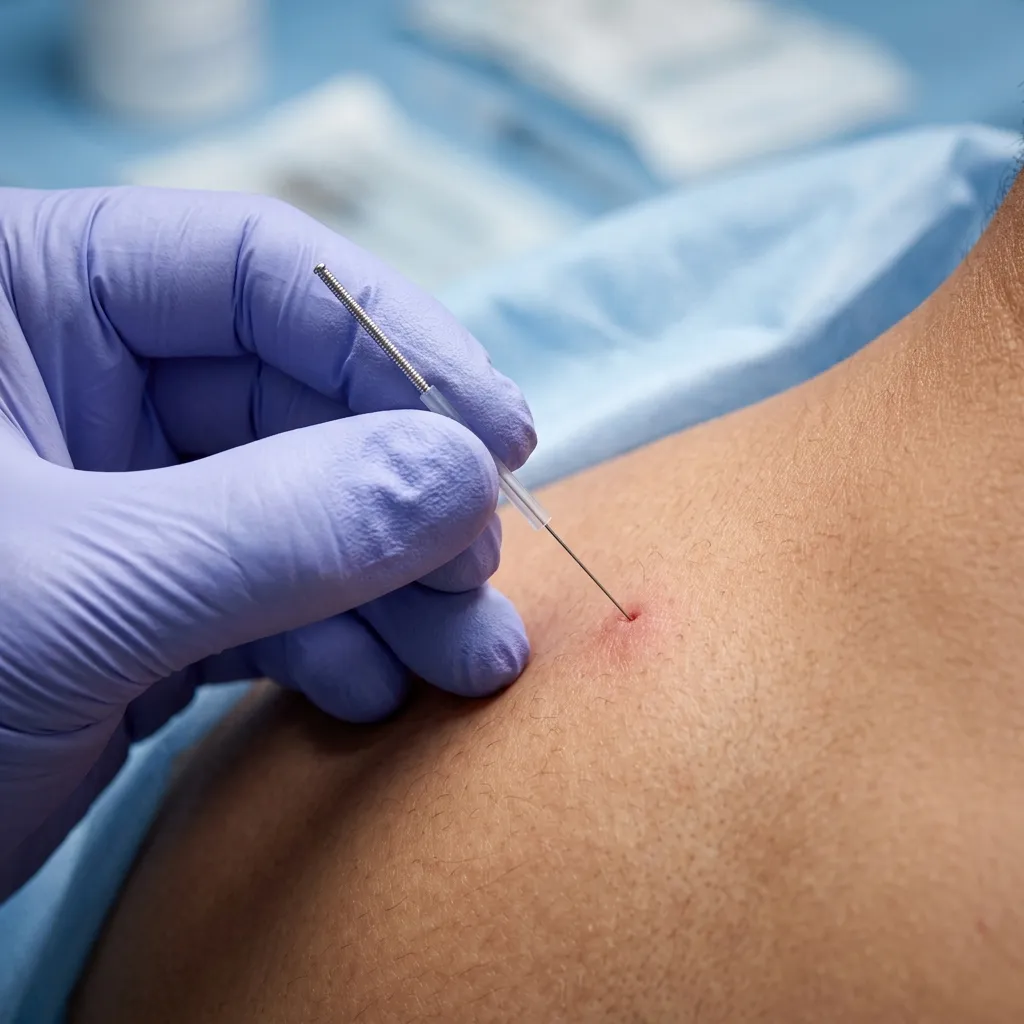
What is Myofascial & Perineural Therapy?
If you suffer from chronic muscle tightness, burning nerve pain, or stubborn "knots" in your neck and back, you already know that standard massage therapy only provides temporary relief. Severe muscle knots—medically known as myofascial trigger points—exist deep within the muscle belly, locked in a state of permanent contraction that human hands simply cannot press hard enough to release.
At TeraCare, we do not guess. Dr. Rabara utilizes a three-tiered interventional approach to soft-tissue pain: Medical Dry Needling (using an ultra-fine filament to mechanically reset the knot), Trigger Point Injections (delivering soothing anesthetics to deactivated hyper-irritable spots), and Perineural Injection Therapy (treating inflamed superficial nerves that cause burning and sensitivity). We diagnose the exact tissue layer causing your agony and apply the precise medical tool to resolve it.
Conditions That Respond to Needle Therapy
Is Needle Therapy Right for You?
Ideal indications
You have stubborn muscle knots that massage therapy cannot resolve.
Pushing on a knot in one area causes pain in another (e.g., shoulder knot causes headache).
You experience burning or tingly pain just beneath the skin.
You want to avoid taking daily oral muscle relaxants that cause drowsiness.
Clinical precautions
You have a severe, unmanageable fear of needles (trypanophobia).
Active skin infection or open wound over the targeted muscle.
Current severe lymphedema in the targeted limb.
Dry Needling & Injection Realities
Understanding the sensations and responses associated with trigger point therapy.
Local Twitch Response
Patients often experience an involuntary muscle twitch during the procedure, which can be briefly uncomfortable but indicates successful targeting.
Post-Treatment Soreness
Treated muscles frequently feel heavy or sore, similar to post-workout fatigue, for 24 to 48 hours.
Temporary Bruising
Minor bruising at the injection or needle site occasionally occurs and resolves spontaneously within a few days.
Which Soft-Tissue Treatment Do You Need?
Medical Dry Needling
Medication-free filament needle directly penetrates the muscle knot for a neurological reset.
Trigger Point Injections (TPI)
A tiny needle injects a localized anesthetic directly into the muscle knot to break the pain cycle.
Perineural Therapy (PIT)
Subcutaneous Dextrose blebs used to calm inflamed superficial sensory nerves.
The 3 Stages After Your Session
The Post-Workout Phase
The muscle may feel sore, heavy, or fatigued. We recommend staying hydrated and applying gentle heat to the area.
The Profound Relief Phase
Soreness subsides, revealing a dramatic decrease in chronic pain. Restoring resting length to the muscle makes movement feel freer.
The Reprogramming Phase
Crucial window for Physical Therapy. We teach the loosened muscle how to move correctly to prevent the knot from returning.
Clinical Science & Technical Details
For our medical colleagues and highly analytical patients, we provide these transparent technical details on the pathophysiology and interventional protocols.
Explore the Clinical Science: Mitochondrial Decay and The Twitch Response
A myofascial trigger point is caused by an 'energy crisis' at the motor endplate. Sustained release of acetylcholine causes permanent sarcomere contraction, creating localized ischemia. This traps acidic inflammatory biochemicals like bradykinin, continuously firing pain signals to the brain.
Medical Dry Needling disrupts this mechanically. The 'Local Twitch Response' (LTR) acts as a neurological circuit breaker, causing a massive release of acetylcholine and allowing the muscle fibers to relax back to their resting length instantly.
Detailed Diagnostic Pathways for Myofascial & Neural Syndromes
For tension headaches, we target the upper trapezius and suboccipital muscles, which frequently refer pain around the skull. In lower body cases, many 'sciatica' presentations are actually Piriformis Syndrome—a deep gluteal cramp.
Precision needles allow Dr. Rabara to penetrate deep into the gluteal or hip compartments—far deeper than manual therapy or massage—to deactivated fibers that are compressing the sciatic nerve.
Advanced Systemic Screening & Hemostasis Guidelines
Patient safety dictates our clinical protocols. Patients on significant anticoagulant therapy (e.g., Warfarin) must be carefully evaluated due to hematoma risk in deep muscle compartments. We strictly avoid limbs with active lymphedema or skin infections.
If a lidocaine allergy is present, we rely exclusively on filament-based Medical Dry Needling or Dextrose-based PIT to ensure a completely safe interventional experience.
The Physiatrist Advantage: Surgical-Level Anatomical Expertise
Dry needling is exceptionally safe when performed by a board-certified physician. In the thoracic region, the primary (though rare) risk is a pneumothorax. Dr. Rabara's surgical-level understanding of three-dimensional anatomy virtually eliminates this risk.
We utilize strict aseptic techniques and single-use, sterile filiform needles. For stubborn knots, we may pivot to 'peppering' TPI techniques with ultrasound guidance to ensure the medication washes out the localized acidic environment of the knot.
The 3-Step Clinical Process
Anatomical Mapping
Dr. Rabara conducts a hands-on physical exam, manually tracing muscle fibers and cutaneous nerves to locate the exact source of your pain.
Clinical Intervention
Using sterile technique, Dr. Rabara applies the appropriate modality—Dry Needling, TPI, or PIT—directly to the dysfunctional tissue.
Range of Motion Test
Immediately post-procedure, we re-test your movement. Most patients notice instant improvements in range and a sharp decrease in pain density.
Common Questions
Does the procedure hurt?
How many sessions will I need?
Is this just acupuncture?
Is it covered by PhilHealth or HMOs?
Can I exercise after my session?
References & Clinical Evidence
- [1] Clinical guidelines and evidence-based research supporting Dry Needling & Trigger Point Injections in Vigan City.
- [2] Relevant peer-reviewed literature on efficacy and safety outcomes in rehabilitation.
* Clinical references are provided to support the medical claims made in this article. TeraCare adheres to evidence-based practices in physical medicine and rehabilitation.

Dr. Ben Rabara
Dr. Ben Rabara is a Physiatrist in Vigan City specializing in Physical Medicine and Rehabilitation. He focuses on non-surgical, precision treatments for musculoskeletal conditions, utilizing advanced diagnostics like MSK Ultrasound.
Medical Disclaimer: The information provided in this article is for educational purposes only and does not substitute for professional medical advice, diagnosis, or treatment. Always consult a qualified physician for your specific health conditions.