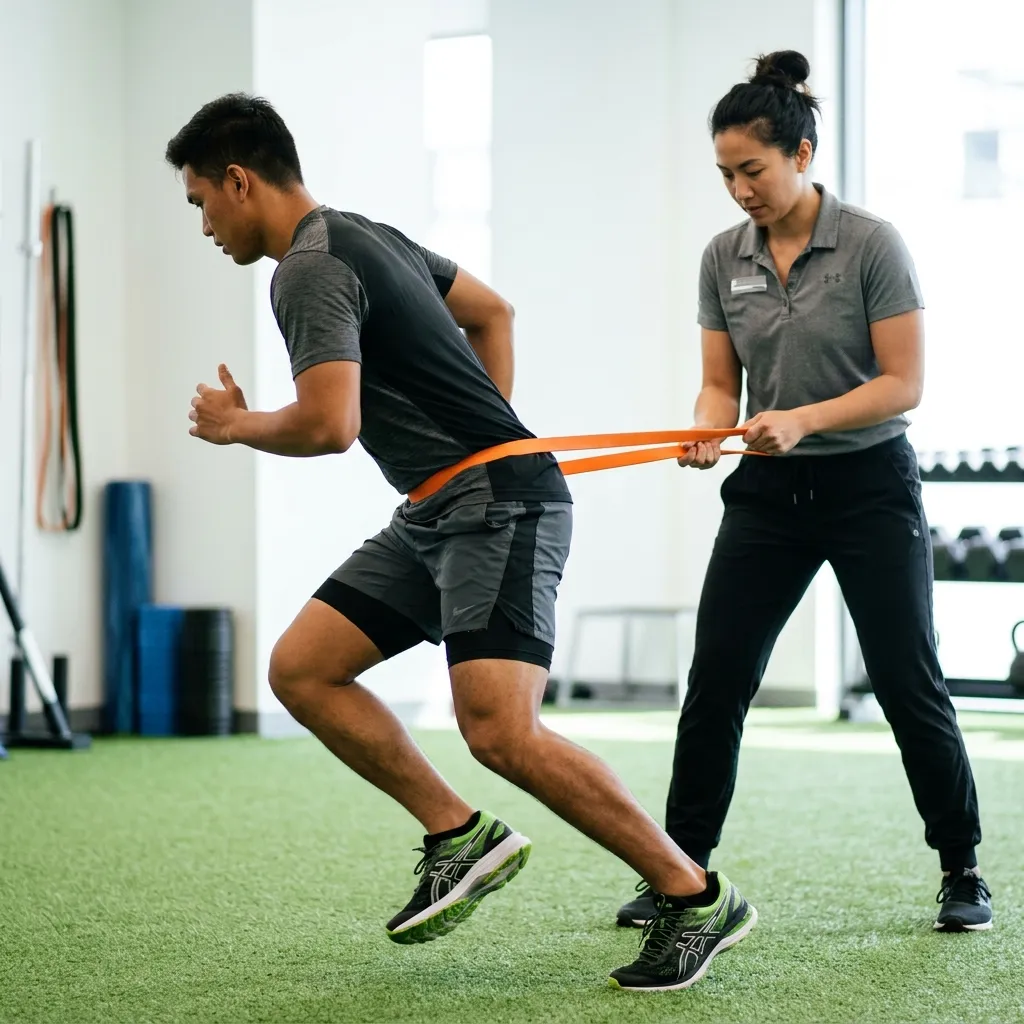
The Science of the Comeback
When an athlete suffers an injury, the most frustrating advice they can receive is, "Just rest it for six weeks." While initial tissue protection is critical, prolonged rest actually causes muscles to atrophy, tendons to weaken, and joints to stiffen. Standard medical care stops when the pain goes away. Sports Medicine goes much further. Our goal is not just a pain-free joint; our goal is a joint that can withstand the explosive forces of running, jumping, and cutting without re-injury.
TeraCare bridges the gap between the medical clinic and the playing field. Dr. Rabara designs periodized, physician-led rehabilitation blueprints tailored to your specific sport. Whether you are recovering from an acute ACL tear or battling chronic runner's knee, we utilize advanced orthopedic physical therapy protocols to identify the biomechanical flaws that caused the injury and correct them, ensuring your comeback is stronger than your setback.
Athletic Injuries We Rehabilitate
Is Sports Medicine
Right for You?
You do not need to be a professional athlete to benefit from sports medicine. If your goal is to return to an active, pain-free lifestyle, this is the appropriate clinical pathway.
Ideal indications
Injury sustained at the gym, on the court, or during a run failing to heal.
Preparing for or recovering from orthopedic surgery (ACL, Rotator Cuff).
Chronic pain occurring only during specific athletic movements (throwing, squatting).
Transitioning from basic PT back to heavy weightlifting or high-impact sports.
Clinical precautions
Acute, severe fracture requiring immediate surgical casting or pinning.
Goal is generalized relaxation or spa-style massage rather than active recovery.
Unmanaged system instability prevents high-intensity exertion.
Sports Medicine Recovery Realities
Understanding the realities of athletic injury rehabilitation.
Psychological Frustration
Athletes frequently battle mild depression, loss of identity, and intense frustration while sidelined during long recovery protocols.
Strict Load Management
Pushing through pain is detrimental. Recovery requires strict adherence to prescribed load limits and mandatory rest days.
Risk of Re-Injury
Returning to competition prematurely, before functional symmetry is achieved, exponentially increases the risk of catastrophic re-injury.
How Does Sports
Rehab Differ?
Generic Physical Therapy
Focuses on activities like walking and stairs. Discharge occurs once range of motion is full and resting pain is gone.
Precision Sports Medicine
Focuses on high-velocity athletic performance. Discharge requires passing rigorous Return-to-Play tests proving 1:1 symmetry.
Passive Recovery
Focuses on waiting and hope. Discharge occurs once initial swelling subsides.
The 3 Phases of
Athletic Recovery
Acute Phase (Protect & Activate)
Controlled swelling management and manual therapy to reduce pain and activate surrounding muscles.
Strength Phase (Load & Build)
Hypertrophy and force production focus, introducing heavier resistance to rebuild muscle mass.
Power Phase (Speed & Agility)
Sport-specific plyometrics, lateral cutting, and reaction drills to prepare for competition.
In-Depth Clinical Science
For our medical colleagues and highly analytical patients, we provide these transparent technical details.
Explore the Clinical Science: Mechanotransduction and Tissue Capacity
Core philosophy is rooted in Mechanotransduction—converting mechanical loading into cellular responses. Injured tissues require specific, progressive loads to heal; under-loading causes fibrotic weakness.
We find the 'Goldilocks zone' for loading. For tendinopathies, we implement heavy slow resistance (HSR) and eccentric protocols to stimluate Type I collagen alignment.
Detailed Diagnostic Pathways for Sports Pathology
For multidirectional athletes, ACL or ankle sprains require neuromusclular control training. We focus on deceleration mechanics and landing kinematics.
For overhead athletes, we assess scapular dyskinesia—retraining the serratus anterior and lower trapezius to upwardly rotate the scapula.
Advanced Systemic & Post-Surgical Contraindications
We maintain strict communication with operating surgeons, adhering flawlessly to Weight-Bearing and ROM restrictions. Absolute contraindications include acute systemic infections or suspected DVT.
The Return-to-Play Process
Biomechanical Evaluation
Dr. Rabara analyzes your movement patterns, strength deficits, and joint stability to identify why the injury occurred and build your custom blueprint.
Progressive Tissue Loading
You work with our therapists to gradually increase the stress on your healing tissue, transitioning from basic isolation exercises to complex, full-body movements.
Objective Return-to-Play Testing
Before you are cleared for the field, you must pass a battery of grueling, sport-specific physical tests to mathematically prove your body is ready for competition.
Clinical decision support
Sports injury care balances healing with safe participation
Sports-medicine assessment considers the injured tissue, mechanism, training load, equipment, technique, recovery, nutrition, sleep, prior injury, and the athlete’s season and goals. Imaging is used when it can answer a clinical question; a scan finding alone does not determine pain, readiness, or treatment. Rehabilitation progresses from symptom control and capacity building to sport-specific exposure.
Return is a shared risk decision rather than a declaration that the athlete is “100% safe.” Fracture, dislocation, major swelling, repeated giving way, concussion symptoms, chest pain, fainting, unexplained shortness of breath, or progressive neurologic findings needs appropriate urgent or specialist assessment. Children and adolescents also require attention to growth plates and training volume.
How this evidence is applied at TeraCare
Dr. Rabara connects the diagnosis to the athlete’s real workload, sets criteria for each rehabilitation stage, and coordinates coaching, imaging, or surgical input when the examination or progress indicates it.
Medical review: Dr. Ben Rabara, Physiatrist · Evidence reviewed August 22, 2026. This information supports shared decision-making and does not replace an individual examination or emergency care.
Clinical sources: 2016 Consensus Statement on Return to Sport.
How this treatment fits your care plan
MSK, Joint & Tendon Care
Diagnosis, symptom control, tissue repair, and return to movement for joint, muscle, and tendon problems.
Your exact sequence depends on the diagnosis, safety screening, and response to treatment. A physiatrist will recommend only the steps that fit your case.
Where this treatment is available
Availability is generated from each active branch’s service record.
Common Questions
How do I know when I am ready to return to my sport?
I am not a competitive athlete; I just want to run pain-free. Is this for me?
Can I still lift weights while I am in rehab?
Why do I need to see Dr. Rabara before starting sports rehab?
Is Sports Rehabilitation covered by my insurance or PhilHealth?
References & Clinical Evidence
- [1] Clinical guidelines and evidence-based research supporting Sports Medicine & Injury Recovery.
- [2] Relevant peer-reviewed literature on efficacy and safety outcomes in rehabilitation.
* Clinical references are provided to support the medical claims made in this article. TeraCare adheres to evidence-based practices in physical medicine and rehabilitation.

Dr. Ben Rabara
Dr. Ben Rabara is a Physiatrist in Vigan City specializing in Physical Medicine and Rehabilitation. He focuses on non-surgical, precision treatments for musculoskeletal conditions, utilizing advanced diagnostics like MSK Ultrasound.
Medical Disclaimer: The information provided in this article is for educational purposes only and does not substitute for professional medical advice, diagnosis, or treatment. Always consult a qualified physician for your specific health conditions.
Sports Recovery & Performance Guides
Expert resources on overcoming athletic injuries, optimizing biomechanics, and safely returning to the field.