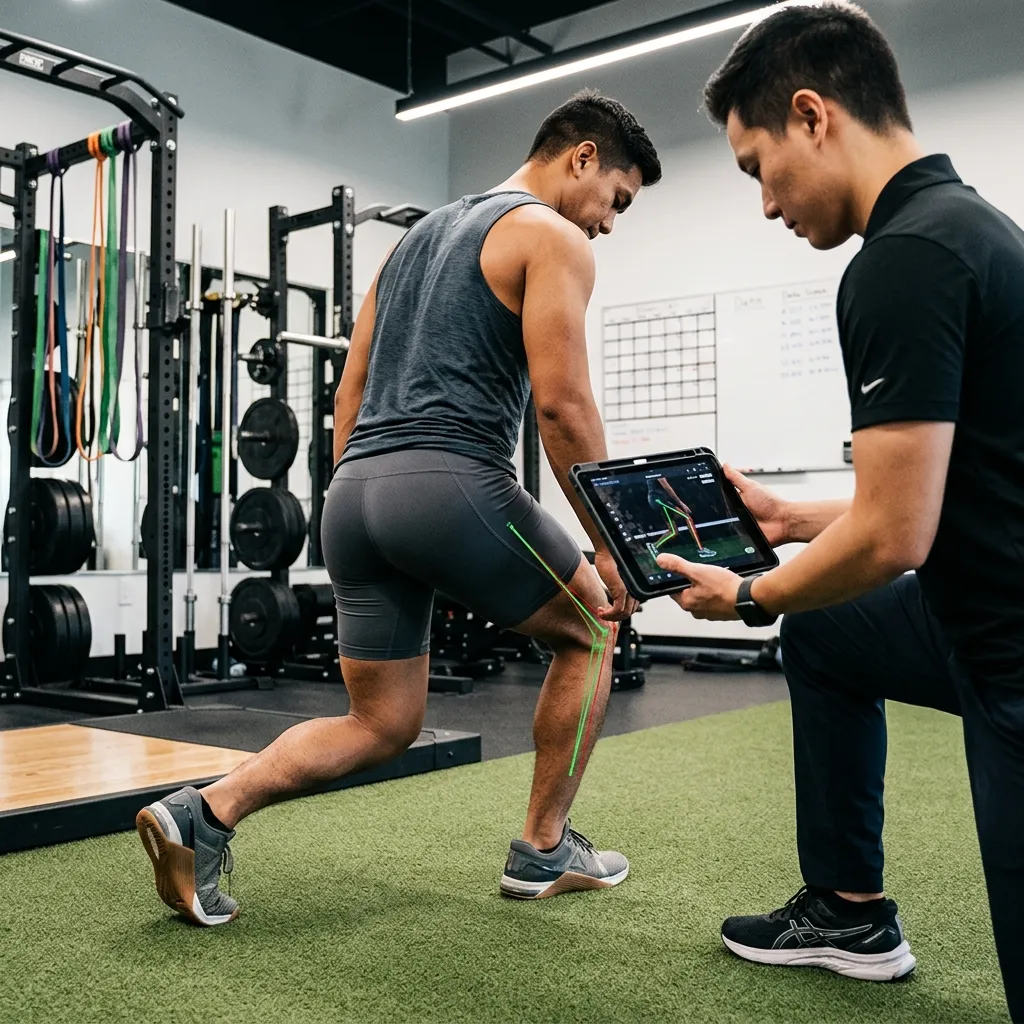
The Misaligned Racecar
When a high-performance athlete experiences pain, standard medical advice often fails. A general practitioner will prescribe painkillers and tell you to strictly 'take a month off.' This is biologically equivalent to taking a Formula 1 racecar with a misaligned chassis and simply changing the shredded tires. The tires aren't the problem; the alignment is. As soon as you hit the track again, your underlying flawed movement patterns will shred the new tires.
Practitioner's Insight: We analyze you like a machine. If your knee hurts at mile three of your marathon, your knee is not the culprit—it is the victim of a power leak in your hip. By recording your movement, slowing it down frame-by-frame, and analyzing joint angles, we identify the exact mechanical failure causing the overload. Our programs rewire your nervous system, allowing you to train around the injury while we permanently fix the misaligned chassis.
Plugging the Power Leaks in Your Sport
Are You Ready to Do the Work?
The Elite Athlete Mindset
This is not a passive clinic where you lie on a bed with a hot pack. This is an active, high-intensity athletic training facility. We partner with patients who view their body as an instrument that requires precise tuning.
Ideal indications
Competitive athletes or hobbyists whose injury limits performance.
Patients told to 'just rest' but the pain returns when playing.
Coachable individuals willing to fix form with light weight first.
Post-surgical patients needing rigorous 'return to sport' protocols.
Clinical precautions
Looking for a quick passive 'crack' without corrective work.
Immediate acute phase of a massive trauma (e.g., fresh fracture).
Patients unwilling to modify training load temporarily.
Biomechanics & Sports Training Realities
Understanding the demands of high-level return-to-sport programs.
Movement Deconstruction
Athletes must often unlearn ingrained, faulty movement patterns before rebuilding proper biomechanics, which can temporarily decrease performance.
Delayed Return-to-Play
Passing clinical strength tests does not mean immediate return to full competition; sport-specific load tolerance must be proven first.
Delayed Onset Muscle Soreness (DOMS)
High-intensity eccentric loading and plyometric training will routinely cause significant muscle soreness 24 to 48 hours post-session.
Why Generic Physical Therapy Fails Athletes
Standard Medical Care
Prescribes NSAIDs and dictates rest. Athlete loses fitness and muscle mass, returning weaker and more prone to re-injury.
Elite Sports Training
Detailed biomechanical analysis using barbells, plyometrics, and high-speed video. We don't just eliminate pain—we increase performance.
Generic PT Clinic
Uses basic ultrasound and light bands. They lack the heavy equipment and biomechanical knowledge to simulate high-speed sport demands.
The Path to Peak Performance
Acute Management
Calm the tissue. We modify your training to maintain fitness while giving the injured site the exact rest needed to drop inflammation.
Corrective Rewiring
Intensive training of new mechanics. Building strength in weak kinetic links and overwriting faulty motor patterns.
High-Performance Return
Sprint, jump, and lift heavy under supervision. Return as a mechanically superior, more explosive version of your former self.
Clinical Science & Technical Details
For our medical colleagues and highly analytical patients, we provide these transparent technical details on the pathophysiology and interventional protocols.
Explore the Clinical Science: The Kinetic Chain and Load Capacity
Regional Interdependence dictates that knee pain is often a hip or foot problem. We assess the entire kinetic chain to find the neuromuscular deficit.
We increase tissue tensile capacity using the SAID Principle, ensuring your physiological threshold exceeds the mechanical stress of your sport.
Detailed Diagnostic Pathways: The Force-Velocity Curve
Rehabilitation must transcend healing and address sport-specific demands. We shift your force-velocity curve to the right using ballistic and plyometric training.
This ensures you return not just healed, but measurably more explosive than before the injury.
Advanced Systemic Screening: Central Nervous System Fatigue
CNS fatigue frequently drives biomechanical breakdown. If your nervous system is 'fried' from overtraining, motor control degrades rapidly.
We evaluate training volume and recovery metrics, potentially utilizing strategic load management to build resilience without system catabolism.
Managing Neuroplasticity and Motor Enablers
Corrective exercise is about overwriting faulty motor engrams in the motor cortex. This requires extreme cognitive focus during the 'conscious competence' phase.
Our 8-week programs transition these patterns into 'unconscious competence,' where safe, explosive movement becomes your new automatic default.
Inside the Procedure: Return to Play (RTP) Objective Criteria
We never clear athletes based on time. We use objective testing like the Limb Symmetry Index (LSI) and Single-Leg Hop batteries.
The injured limb must demonstrate at least 90-95% of the power and stability of the uninjured limb before the athlete is cleared for competition.
The Importance of Tissue Capacity vs. Load
Injuries occur when applied load exceeds tissue capacity. We chart your Acute:Chronic Workload Ratio (ACWR) to prevent rapid spikes in mechanical stress.
We teach you how to scientifically periodize your training volume to allow your tendons and ligaments to adapt safely to elite-level forces.
The Blueprint to Bulletproof Athletics
The Biomechanical Audit
We put you on the treadmill or under the barbell. Using slow-motion video, we map your joint angles and locate the exact 'power leak' causing your pain.
Tissue Prep & Activation
We optimize tissue using IASTM or manual therapy, then perform isolated activation drills to 'wake up' dormant muscles required for your sport.
Sport-Specific Loading
We transition to the gym floor for specific, monitored exercises that simulate sport demands, progressively increasing load and speed.
Common Questions
How do I fix knee pain when running without stopping completely?
Why does my lower back hurt after deadlifting or squatting?
Can physical therapy help me jump higher or run faster?
Do you offer sports physical therapy in the Philippines covered by PhilHealth?
What is the fastest way to recover from shin splints?
References & Clinical Evidence
- [1] Clinical guidelines and evidence-based research supporting Sport-Specific Training & Biomechanics Program Vigan City.
- [2] Relevant peer-reviewed literature on efficacy and safety outcomes in rehabilitation.
* Clinical references are provided to support the medical claims made in this article. TeraCare adheres to evidence-based practices in physical medicine and rehabilitation.

Dr. Ben Rabara
Dr. Ben Rabara is a Physiatrist in Vigan City specializing in Physical Medicine and Rehabilitation. He focuses on non-surgical, precision treatments for musculoskeletal conditions, utilizing advanced diagnostics like MSK Ultrasound.
Medical Disclaimer: The information provided in this article is for educational purposes only and does not substitute for professional medical advice, diagnosis, or treatment. Always consult a qualified physician for your specific health conditions.