- — Knee pain when running is not proof that your form is wrong. Pain location, timing, training changes, strength, fatigue, and other symptoms matter before any form cue is chosen.
- — Running gait analysis can describe movement and loading patterns for discussion, but it cannot identify one guaranteed cause or replace a medical examination when symptoms are persistent or concerning.
- — For selected runners with a patellofemoral pain pattern, gait retraining may be an adjunct to education, load management, and progressive knee- and hip-focused exercise—not a replacement for them.
- — Change one variable at a time and monitor symptoms during the run, afterward, and the following morning. A cue that helps one runner can aggravate another.
- — Locking, major swelling, inability to bear weight, fever with a hot red knee, deformity, or rapidly changing sensation needs prompt medical assessment rather than self-directed gait drills.
Knee pain when running is not proof that your running form is wrong. First look at where the pain is, when it begins, what happens afterward, and whether training volume, hills, speed, fatigue, or another symptom changed. A running gait analysis may help identify a movement or loading pattern to discuss, but it cannot diagnose every cause or replace an examination when pain is persistent or concerning.
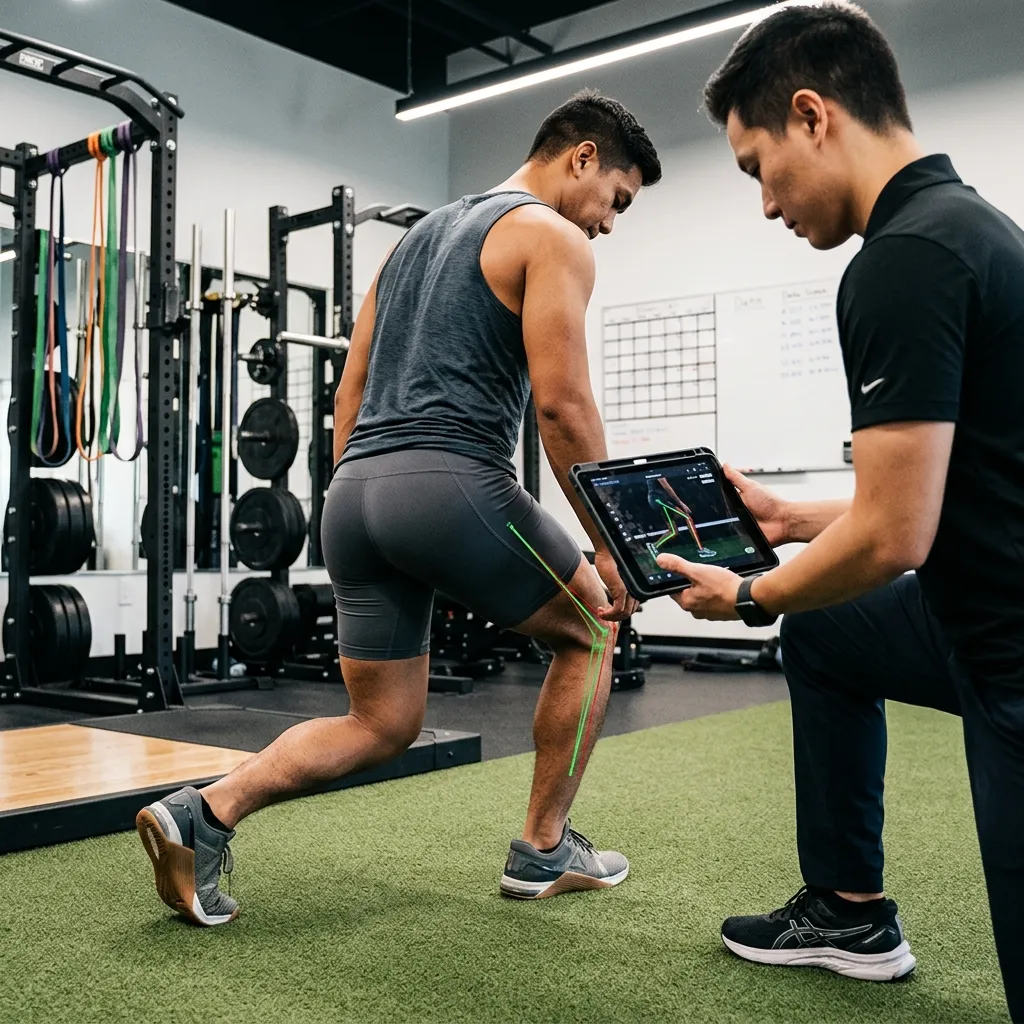
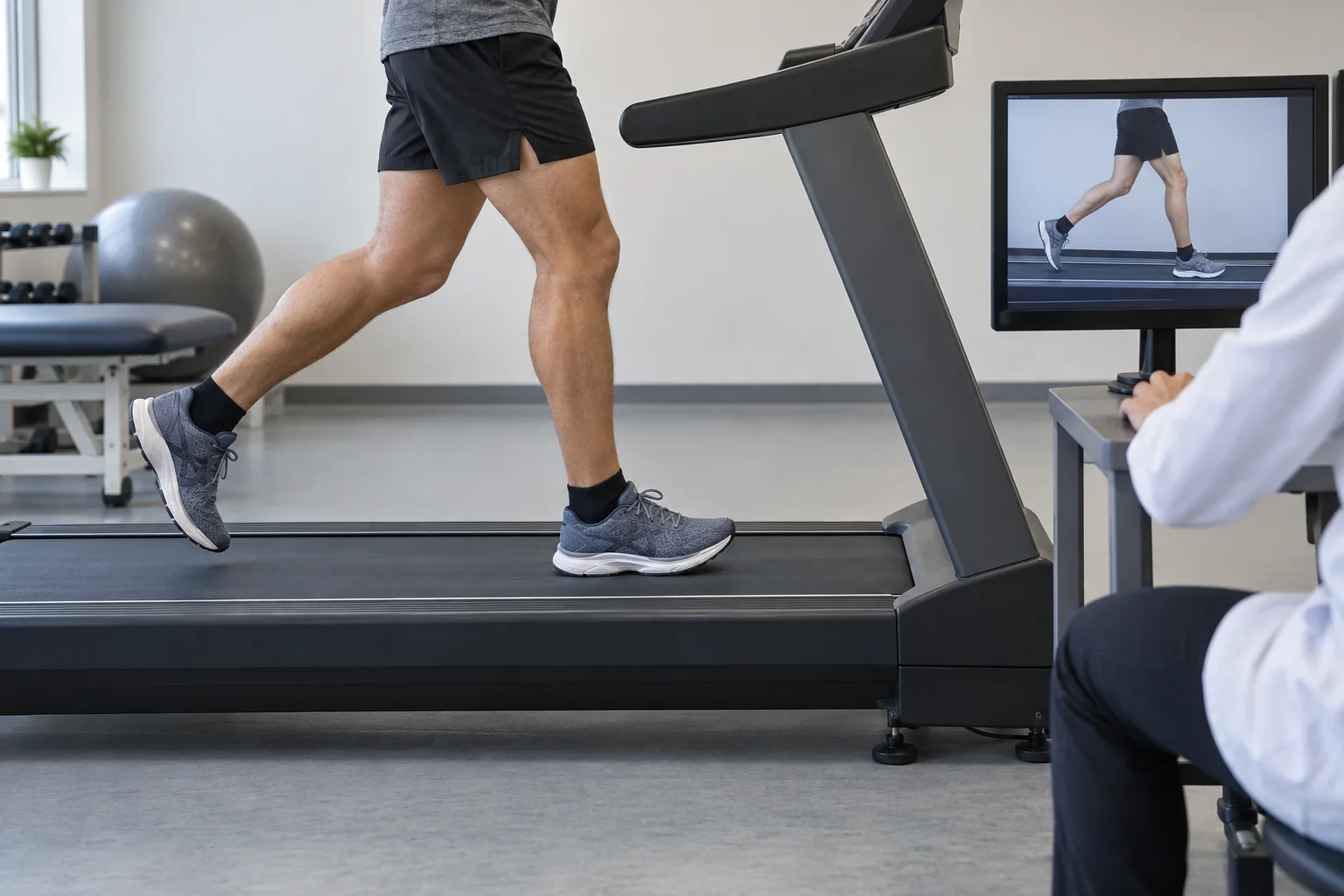
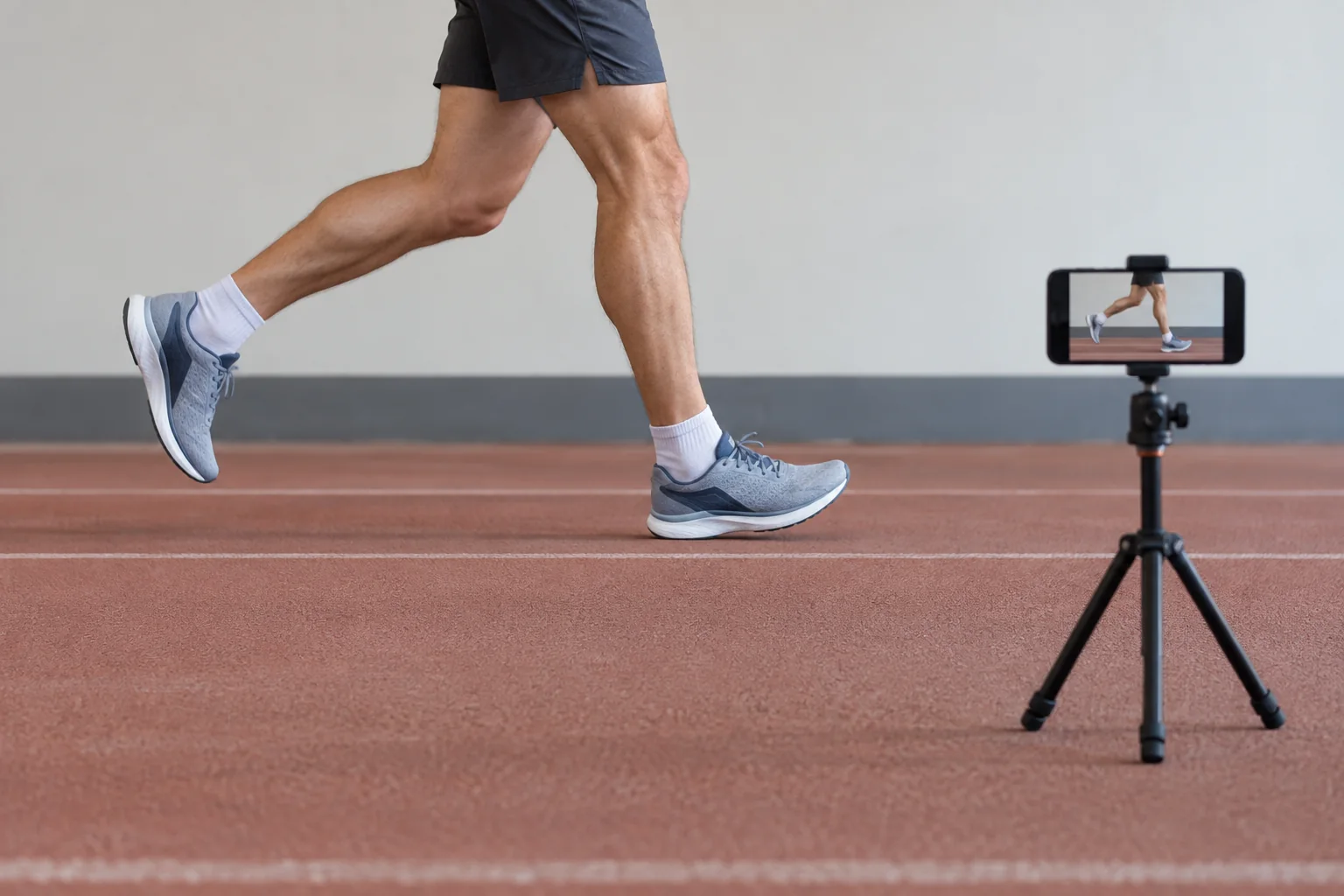
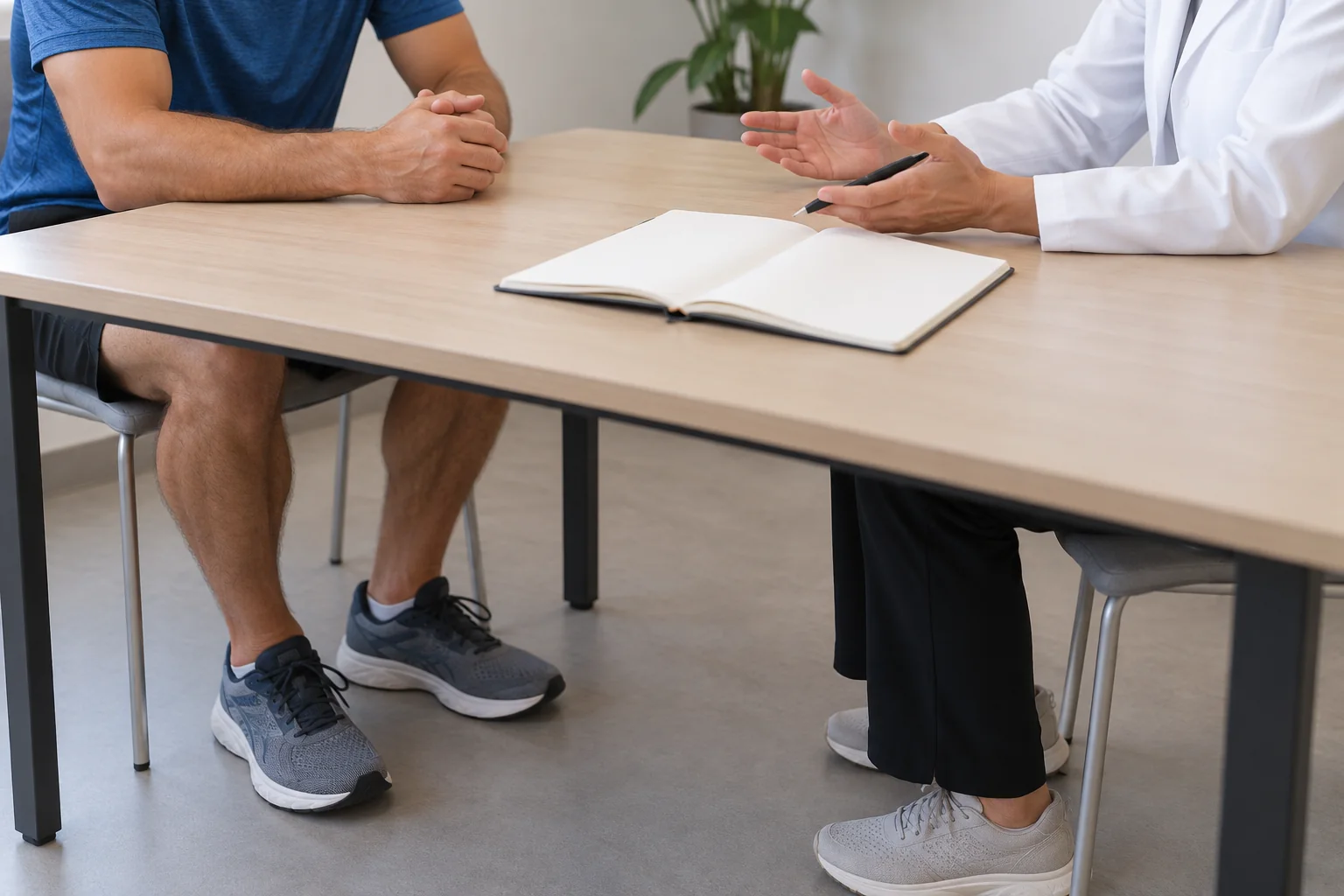
The images on this page are AI-generated educational scenes. They do not show a specific patient, examination, treatment result or return-to-running outcome.
What should you do about knee pain when running?
Start with a symptom and load check, not a form verdict. Note the exact location—around the kneecap, along the joint line, on the inside or outside, behind the knee, or over a focal bony area—and whether symptoms begin during the run, afterward, or the next morning. Record recent changes in distance, pace, hills, intervals, surface, shoes, recovery, and strength training. A predictable pain threshold is useful information, but it is not a diagnosis.
If a run hurts, do not use “pushing through” as your test of toughness. Reduce or pause the activity that provokes the pain and choose only comfortable alternatives while you arrange advice. Pain around or behind the kneecap that is aggravated by running, stairs, squatting, jumping, or prolonged sitting can fit a patellofemoral pain pattern (pain around or behind the kneecap), but similar symptoms can have other causes and need clinical context (Willy et al., 2019; PMID: 31475628).
A sensible first appointment should ask more than “How does your foot land?” It should cover the symptom timeline, training goals, prior injury, ordinary walking and stairs, strength and mobility, swelling, locking, giving way, and neurological symptoms. That information determines whether running gait analysis is appropriate now or whether diagnosis and protection come first.
What can running gait analysis show when your knee hurts?
Running gait analysis is an observation and measurement process, not a treatment by itself. Depending on the clinical question, an assessment may compare an easy run with a symptom-provoking pace, view the runner from the side, front, and rear, and consider cadence (steps per minute), stride, foot placement, trunk and pelvis movement, knee motion, fatigue, strength, and the person’s goals. The useful question is not “Does this look perfect?” but “Does this finding plausibly relate to the symptoms, capacity, and task we are trying to improve?”
The evidence does not support a single visual signature for runner’s knee. In runners with patellofemoral pain, gait differences may be causes, consequences, or correlates of pain. One randomized trial found that adding gait retraining to education did not improve symptoms or function more than education alone, even though step rate and a loading measure changed (Esculier et al., 2018; PMID: 28476901). That is why an assessment should lead to a monitored plan—not a frightening label or a list of “bad” body parts.
What a running video cannot show
- It cannot rule out a meniscus, ligament, tendon, bone-stress, inflammatory, infectious, vascular, hip, or spine-related problem.
- It cannot prove that one visible movement caused the pain, or that changing it will cure the pain.
- It cannot decide by itself whether you need imaging, medication, a brace, a period of reduced impact, or urgent care.
- It cannot predict your recovery date from another runner’s video or timeline.
A normal-looking gait also does not make pain imaginary. Conversely, an asymmetry is not automatically a defect. The interpretation has to stay connected to symptoms and function.
How is a clinical assessment different from a shoe-store gait check?
A retail gait check may be useful for discussing comfort, fit, and footwear preferences. It usually answers a different question from a clinical assessment: which shoe feels suitable, rather than why a painful knee is limiting running or whether the symptoms need medical evaluation. A clinical conversation starts with your history and safety screen, then decides whether movement observation adds anything useful. A pronation label should never be treated as a diagnosis, and a shoe recommendation should not delay care for swelling, locking, instability, or pain that is worsening.
Can you film your running at home?
If it is safe to run, a short side and rear video at a comfortable pace can help you remember what was observed. Use a stable camera, a clear surface, and a distance that does not require you to provoke pain. Note the speed, surface, shoes, and when symptoms began. Do not keep repeating a painful run to obtain a better clip, and do not use a video to diagnose yourself. If you share a video, remove identifying details and treat it as context for a clinician rather than a verdict.
Make the next running decision clearer
Bring your pain timeline and recent training changes to an assessment so the next step can be based on your symptoms, not a generic form checklist.
Why might proper running form matter for knee pain?
“Proper running form” is not one universal posture, cadence, or foot strike. A runner may look different because of speed, terrain, fatigue, anatomy, experience, or a strategy that is comfortable and efficient for that person. The clinically relevant question is whether a modifiable movement or load pattern is consistently paired with symptoms and whether a small, reversible change improves tolerance without creating a new problem.
For selected adults with a clinically consistent patellofemoral pain pattern, a 2026 umbrella review found that the most commonly studied strategies included approximately 5–10% cadence increases, softer-landing cues, foot-strike changes (changing which part of the foot lands first), and feedback. Its conclusion was cautious: gait retraining may be a feasible adjunct, while the evidence is heterogeneous, longer-term effects and prevention remain uncertain, and rapid changes may aggravate the calf or Achilles (Petri et al., 2026; PMID: 42295581).
This is why I would not tell every runner to reach 180 steps per minute, stop heel striking, land on the forefoot, or force the knees into a particular line. In a laboratory study, some runners with patellofemoral pain improved with one modification while others worsened; foot-strike changes could also shift load toward the Achilles (Esculier et al., 2023; PMID: 36726397). “Better form” has to mean better tolerated running for that person, not closer imitation of an internet template.
How can you fix running gait without guessing at the cause?
The safest way to approach how to fix running gait is to make the smallest useful change after the pain pattern has been screened. If there are no red flags and a clinician agrees that a movement trial is reasonable, use one cue at a time, keep the change modest, and test it at an easy intensity. Track pain during the run, later that day, the next morning, and in a simple task such as stairs or walking.
- Choose the question. Is the goal to reduce a repeatable pain response, tolerate an easy run, manage fatigue-related form change, or prepare for a specific surface or hill?
- Change one variable. A small cadence or quieter-landing trial is easier to interpret than a new cadence, new shoes, new surface, new mileage, and new exercises all at once.
- Respect new symptoms. Calf, Achilles, foot, hip, back, or rapidly increasing knee symptoms are reasons to reduce the change and reassess—not proof that you need to work harder.
- Progress capacity as well as skill. Gait cues do not replace progressive strength, education, recovery, and a gradual return to distance, hills, or speed.
- Reassess the plan. If the response is unclear, short-lived, or worse the next day, stop adding corrections and return to the diagnostic question.
In a small randomized trial, impact and cadence retraining improved running pain more than no intervention at six months in selected runners with patellofemoral pain, but the sample was small and the study did not prove that a biomechanical change caused the improvement. The programs were supervised and progressive; the result should not be copied as a universal home prescription (de Souza Júnior et al., 2024; PMID: 38198492).
Can running form and knee pain be related?
They can be related without one being the sole cause. A sudden increase in running demand may exceed current capacity; fatigue may change a runner’s movement; pain may then change the gait further. Hills, speedwork, surface, footwear, recovery, and strength can also alter the task. The presence of a visible hip drop, knee movement, overstride, or asymmetry does not establish which link matters in your case.
The reverse is also important: a movement difference may be a response to pain rather than the original problem. A 2023 review of gait characteristics in patellofemoral pain reported that observed differences may be compensations after pain, not causes before it (Bazett-Jones et al., 2023; PMID: 36334239). That is a strong reason to avoid blame-based language and to test a proposed change against symptoms and function rather than appearance alone.
Myth: “If my knee hurts, I just need to fix my form.”
More accurate: form may be one modifiable part of a larger problem, but the same pain can involve training load, tissue capacity, strength, fatigue, or a condition that gait drills cannot address. The first correction is often better decision-making about when to stop, modify, or seek assessment.
When can runner’s knee physical therapy help?
Runner’s knee physical therapy may help when the examination supports a patellofemoral pain pattern or another rehabilitation-responsive problem and the plan is matched to irritability and capacity. Best-practice guidance places education and knee-targeted exercise at the center; hip-and-knee exercise, movement or running retraining, orthoses, taping, or manual therapy may be selected as supporting options after assessment (Neal et al., 2024; PMID: 39401870).
A practical rehabilitation plan usually connects three layers: what you do now, what your body can tolerate, and what your running goal requires. That may mean temporarily reducing distance or speed, building knee- and hip-focused strength, restoring comfortable single-leg control, and then reintroducing impact. The order and dose should be adjusted if pain, swelling, or next-day function worsens.
Continue, modify, or stop?
| Pattern | Reasonable next step |
|---|---|
| Comfortable and stable | Keep the session easy and record the response. Do not add several new variables at once. |
| Pain starts earlier, lasts longer, or changes ordinary walking | Modify or pause the provoking run and arrange clinical advice rather than repeatedly testing the same distance. |
| Swelling, locking, giving way, a pop, inability to bear weight, or systemic symptoms | Stop self-directed gait correction and seek prompt or urgent assessment depending on severity. |
Which knee symptoms mean you should stop running and seek care?
Arrange a non-emergency clinical assessment for recurrent swelling, painful clicking or catching, repeated giving way, focal joint-line or bone pain, focal tendon pain, symptoms that persist despite sensible load modification, or a return-to-run problem that keeps recurring. The purpose is not to force a label from a video; it is to decide what needs protection, what can be loaded, and whether imaging or another referral is appropriate.
Do shoes or pronation decide the answer?
No. A comfortable, suitable shoe can be part of a runner’s practical plan, but a retail pronation label or a new shoe does not diagnose the source of knee pain. Avoid changing shoes, surface, mileage, cadence, and foot strike at the same time. If footwear is part of the discussion, change it gradually and judge it by comfort, symptoms, and function—not by the promise that one model corrects every runner.
Cracking or grinding can also create understandable worry. A systematic review found that knee crepitus occurs in pain-free people as well as people with knee conditions, with low to very low certainty around pooled estimates and associations. Noise alone is not a reliable reason to diagnose a structural problem or to start gait correction (Couch et al., 2025; PMID: 39375004). Pain, swelling, locking, function, and the whole clinical history carry more weight.
Transparent limitation: Much of the supplied background evidence for this run was abstract-only, and the runner-specific gait studies were heterogeneous, often small or short-term, and focused mainly on selected adults with patellofemoral pain. They do not establish a universal cadence, foot strike, shoe, exercise, recovery time, or injury-prevention rule. The page also cannot assess your knee, observe your running, or determine whether imaging is needed.
Bring the whole running story
A careful assessment starts with the pain pattern, training history, and goal, then decides whether gait analysis or physical therapy belongs in the plan.
Running Gait Analysis Realities
A useful assessment should make a safer decision clearer, not make one visual pattern carry the whole diagnosis.
A video is context, not a verdict
The same movement can be normal for one runner and poorly tolerated by another. Symptoms, capacity, fatigue, and training load change the interpretation.
Form changes are experiments
Cadence, foot strike, posture, or softer-landing cues should be introduced gradually and monitored. They are not universal corrections.
Rehabilitation remains active
For a suitable patellofemoral pain pattern, education, load management, and progressive knee- and hip-focused exercise remain central even when gait retraining is added.
References & Clinical Evidence
- [1] Petri AC, Martins TB, Martins T, Souza J, Migliorini F, Maffulli N, Okubo R. Gait Retraining for Patellofemoral Pain in Runners: An Umbrella Review of Clinical and Biomechanical Evidence. Sports Med Open. 2026;12:69. PMID: 42295581. DOI: 10.1186/s40798-026-01051-8.
- [2] de Souza Júnior JR, et al. Effects of two gait retraining programs on pain, function, and lower limb kinematics in runners with patellofemoral pain: A randomized controlled trial. PLoS One. 2024;19(1):e0295645. PMID: 38198492. DOI: 10.1371/journal.pone.0295645.
- [3] Esculier JF, Bouyer LJ, Roy J-S. Running gait modifications can lead to immediate reductions in patellofemoral pain. Front Sports Act Living. 2023;4:1048655. PMID: 36726397. DOI: 10.3389/fspor.2022.1048655.
- [4] Neal BS, Lack SD, Bartholomew C, Morrissey D. Best practice guide for patellofemoral pain based on synthesis of a systematic review, the patient voice and expert clinical reasoning. Br J Sports Med. 2024;58(24):1486–1495. PMID: 39401870. DOI: 10.1136/bjsports-2024-108110.
- [5] Esculier J-F, et al. Effects of a running retraining program on lower limb biomechanics, pain and function in runners with patellofemoral pain: A randomised controlled trial. Br J Sports Med. 2018. PMID: 28476901. DOI: 10.1136/bjsports-2016-096988.
- [6] Bazett-Jones DM, et al. Gait characteristics and patellofemoral pain: a systematic review and meta-analysis. Sports Med. 2023. PMID: 36334239. DOI: 10.1007/s40279-022-01781-1.
- [7] Willy RW, et al. Patellofemoral Pain. J Orthop Sports Phys Ther. 2019. PMID: 31475628. DOI: 10.2519/jospt.2019.0302.
- [8] Couch JL, King MG, De Oliveira Silva D, Whittaker JL, et al. Noisy knees—knee crepitus prevalence and association with structural pathology: a systematic review and meta-analysis. Br J Sports Med. 2025. PMID: 39375004. DOI: 10.1136/bjsports-2024-108866.
- [9] Rhind JH, Khawar H, Webb M, Guthrie H. The locked knee. Br J Hosp Med (Lond). 2024. PMID: 38300674. DOI: 10.12968/hmed.2022.0215.
- [10] American Academy of Family Physicians. Initial Evaluation of Knee Pain. Am Fam Physician. 2018;98(9):576–585.
- [11] Alberta Health Services. Provincial Knee Primary Care Clinical Pathway. 2026.
* Clinical references are provided to support the medical claims made in this article. TeraCare adheres to evidence-based practices in physical medicine and rehabilitation.

Dr. Ben Rabara
Dr. Ben Rabara is a Board-Certified Physiatrist specializing in Physical Medicine and Rehabilitation. He focuses on non-surgical, precision treatments for musculoskeletal conditions, utilizing advanced diagnostics like MSK Ultrasound.
Medical Disclaimer: The information provided in this article is for educational purposes only and does not substitute for professional medical advice, diagnosis, or treatment. Always consult a qualified physician for your specific health conditions.