
- — Lower back pain after lifting weights is a symptom, not an online diagnosis. The lift, symptom behavior, neurologic findings and functional change all affect the next step.
- — Deadlift-inclusive exercise may help selected people with low back pain, but the evidence is minimal and does not show greater benefit than low-load motor-control exercise.
- — Deadlift biomechanics can explain why heavy or repetitive loading deserves care, but modeled spinal loads are not personal injury thresholds.
- — There is no evidence-supported universal return-to-lifting percentage, set-and-repetition scheme or timeline. Progress should follow assessment and response.
- — New bladder, bowel or sexual-function changes, saddle numbness, severe or progressive weakness, major trauma, fever with back pain or rapidly worsening function need urgent assessment.
The images on this page are AI-generated educational scenes. They do not show a specific patient, examination, treatment result or return-to-lifting outcome.
Lower back pain after lifting weights is not automatically a strain, a “slipped disc,” or proof that you used bad form. The safest next step is to stop testing the painful lift, screen for urgent symptoms, and assess the exact movement, load, onset, leg symptoms, strength and function. This page cannot diagnose your back or give a universal return-to-deadlift date.
A lifter may call the sensation tightness, a sharp catch, a deep ache, “sore for days,” or hindi ito delayed-onset muscle soreness (DOMS). The useful clinical question is not only where the pain sits. It is what changed during or after the set, whether symptoms spread, whether walking or sleep changed, and whether the pattern is settling or becoming more limiting. Weightlifting-specific reviews describe the lower back as a common injury site and note that squat and deadlift history changes the differential diagnosis. (Ross et al., 2023; PMID: 37315158)
The research used for this guide has important limits. Several clinical sources were available only as abstracts, the direct evidence for deadlift-inclusive rehabilitation is small, and no source supports a universal load, set-and-repetition plan or return timeline. Patient forums helped identify familiar language and fears, but they are not evidence for a diagnosis or treatment. Use the page to decide what information matters and when assessment is needed, not to self-clear a painful lift.
What should you do about lower back pain after lifting weights?
When lower back pain begins during or after training, first remove the provoking lift from the session and observe what the symptoms do. Do not repeatedly add weight to “check” whether the back is ready. If there are no warning signs, comfortable position changes and gentle movement may be reasonable while you arrange the next step; if pain is severe, worsening, function-limiting or associated with leg symptoms, assessment should come before exercise advice.
What information changes the decision about lower back pain after lifting weights?
- Onset: Did the pain occur during the rep, immediately after the set, later that day or the next morning?
- Quality and spread: Is it a local ache, sharp catch, burning or electric sensation, or pain travelling into the buttock or leg?
- Function: Can you bend, sit, stand, walk, sleep, work and change position as usual?
- Neurologic change: Is there new numbness, tingling, weakness, foot control change or altered walking?
- Training context: What lift, load change, repetition range, fatigue level, stance and prior episode preceded it?
A familiar, mild post-training ache that is not spreading and is steadily becoming easier is a different decision from immediate sharp pain, pain that worsens after the session, or pain that changes basic movement. The difference is not a self-diagnosis. It is a reason to choose monitoring, modification or clinical assessment with more care. If the same pain returns whenever you hinge, squat or pull, the recurrence itself is useful information even when a coach says the visible form looks acceptable.
What can deadlift lower back pain mean?
Deadlift lower back pain can reflect several different problems, and the same training movement can load more than one structure. The weightlifter-specific differential described in the reviewed literature includes muscle strain or ligamentous sprain, degenerative disc disease, disc herniation, spondylolysis (a stress injury of part of the vertebra), spondylolisthesis (one vertebra slipping relative to another) and lumbar facet syndrome (pain attributed to the small joints at the back of the spine). These are possibilities to assess, not labels you can assign from a pain map or a single painful repetition. (Ross et al., 2023; PMID: 37315158)
A local ache around the muscles does not prove a muscle injury, just as pain down a leg does not prove a disc herniation. A nerve-related pattern may include radiating pain, pins-and-needles or weakness, but those symptoms still need a neurologic examination. A stress-related problem such as spondylolysis is a condition-specific diagnosis; repetitive extension sports can be associated with it, but not every lifter with pain has a pars injury. (Mohile et al., 2022; PMID: 36526328)
This is why pressing harder on a tight area, stretching until it hurts, changing shoes, wearing a belt or switching immediately to a Romanian deadlift (RDL) cannot answer the central question by itself. Those choices may alter how a movement feels, but a short-term change in sensation does not identify the tissue or establish that the back is ready for heavier work. The patient-language research shows that lifters encounter conflicting explanations such as “weak back,” “bad form,” DOMS, spasm or disc bulge without an examination.
The goal of weightlifting back injury rehabilitation is therefore not to find the most dramatic explanation. It is to identify the safest working diagnosis, protect function while the picture is clarified, and then rebuild the capacity needed for the person’s actual training. That may include physical therapy, activity modification and technique or mobility discussion, but none of these should be presented as a guaranteed cure.

Why does lower back pain after deadlift need an individual assessment?
Lower back pain after deadlift needs individual assessment because the lift is only one part of the story. In a clinical evaluation, I would want the exact variation, starting position, load change, repetition and fatigue context, the moment symptoms began, the trend afterward, and whether the person has had similar episodes. I also need to know about leg radiation, numbness, tingling, weakness, gait change, sleep and everyday function.
The examination then connects those answers to movement and safety. It may include observation of a comfortable hinge or squat pattern, spinal and hip movement, strength, sensation, reflexes, walking and other neurologic findings. The purpose is not to grade your form or find a single “bad” muscle. It is to decide whether the presentation can be modified and monitored, needs a structured rehabilitation plan, or needs imaging or referral before loading continues.
Routine imaging is not automatically helpful for an uncomplicated acute episode without focal neurologic deficits or red flags. The reviewed low-back-pain guidelines recommend history and examination first, with imaging considered when a specific concern, warning sign or likely change in management makes it useful. A scan can show a structural finding without proving that it is the source of the pain. (VA/DoD Clinical Practice Guideline for Low Back Pain, 2022; NICE NG59)
Bring the details that make your training reproducible: the lift variation, recent changes in volume or intensity, whether pain began under load or later, and which daily tasks are now difficult. If you have a safely recorded training video, it may help describe the movement, but it cannot replace an examination or prove causation. The assessment should also account for work, commuting, sleep, cost, travel and the amount of supervised follow-up that is realistic.
Start With a Weightlifter-Specific Assessment
A PM&R assessment can connect your symptom pattern, neurologic screen, movement demands and rehabilitation options before you reload the barbell.
What does low back pain in weightlifters have to do with squat and deadlift history?
Low back pain in weightlifters has to be interpreted in the context of squat and deadlift history because those movements create a different exposure pattern from ordinary daily activity. The weightlifter review found that lower-back pain was often associated with the squat or deadlift, while also emphasizing that the diagnosis and treatment approach should reflect the athlete’s unique movement patterns. That is a reason to ask better questions, not proof that one lift caused the episode. (Ross et al., 2023; PMID: 37315158)
In practice, the useful variables may include floor versus elevated pulls, conventional versus sumo stance, squat depth, the range at which symptoms begin, the speed of the repetition, fatigue, rest between sets and recent changes in training. A clinician may discuss one variable at a time so that the response can be interpreted. Changing five things at once can make the next episode impossible to understand.
Technique deserves a calm explanation. The clinical review supports attention to technique, mobility and muscular imbalance when lifters want to continue training, and the NSCA position statement supports conservative, incremental progression with technical competency in performance training. Neither source proves that a particular cue prevents injury or that a coach’s approval clears a symptomatic athlete. (Comfort et al., 2023; PMID: 36952649)
This approach also avoids turning pain into a moral judgment. A lifter can have a technically consistent repetition and still exceed current tolerance through a sudden load increase, high volume, fatigue or a condition that needs assessment. Conversely, a painful repetition does not prove that the spine is permanently damaged. The safest language is capacity and response: what can the person tolerate now, what changes symptoms, and what happens after the task?
What can deadlift biomechanics explain about low back pain?
Deadlift biomechanics can explain why heavy or repetitive loading deserves respect, but it cannot predict an individual injury. A narrative review reported substantial modeled compressive and shear spinal loads during heavy deadlifts, yet it found no direct study measuring low-back biomechanics during repetitive deadlifts. The authors combined evidence from limited deadlift studies and other repetitive-lifting tasks, so the estimates should not be turned into a personal danger threshold. (Ramirez et al., 2022; PMID: 34875981)
Fatigue is a plausible reason to pay attention to volume and technical consistency, not a proven deadlift-specific mechanism that can be diagnosed from a video. The review explicitly states that the effects of lumbar fatigue during repetitive deadlifting remain unknown. This uncertainty matters when someone says that a rounded back, a belt, a bar path or a particular stance is the sole cause of pain.
Deadlift studies of healthy trained adults also describe muscle activation, including the spinal extensors and posterior-chain muscles, but muscle activation is not the same as pain, tissue damage, injury risk or treatment benefit. A movement can recruit a muscle strongly without telling us whether that movement is suitable for a person with current symptoms. The rehabilitation decision still depends on examination, irritability and function (Martín-Fuentes et al., 2020; PMID: 32107499).
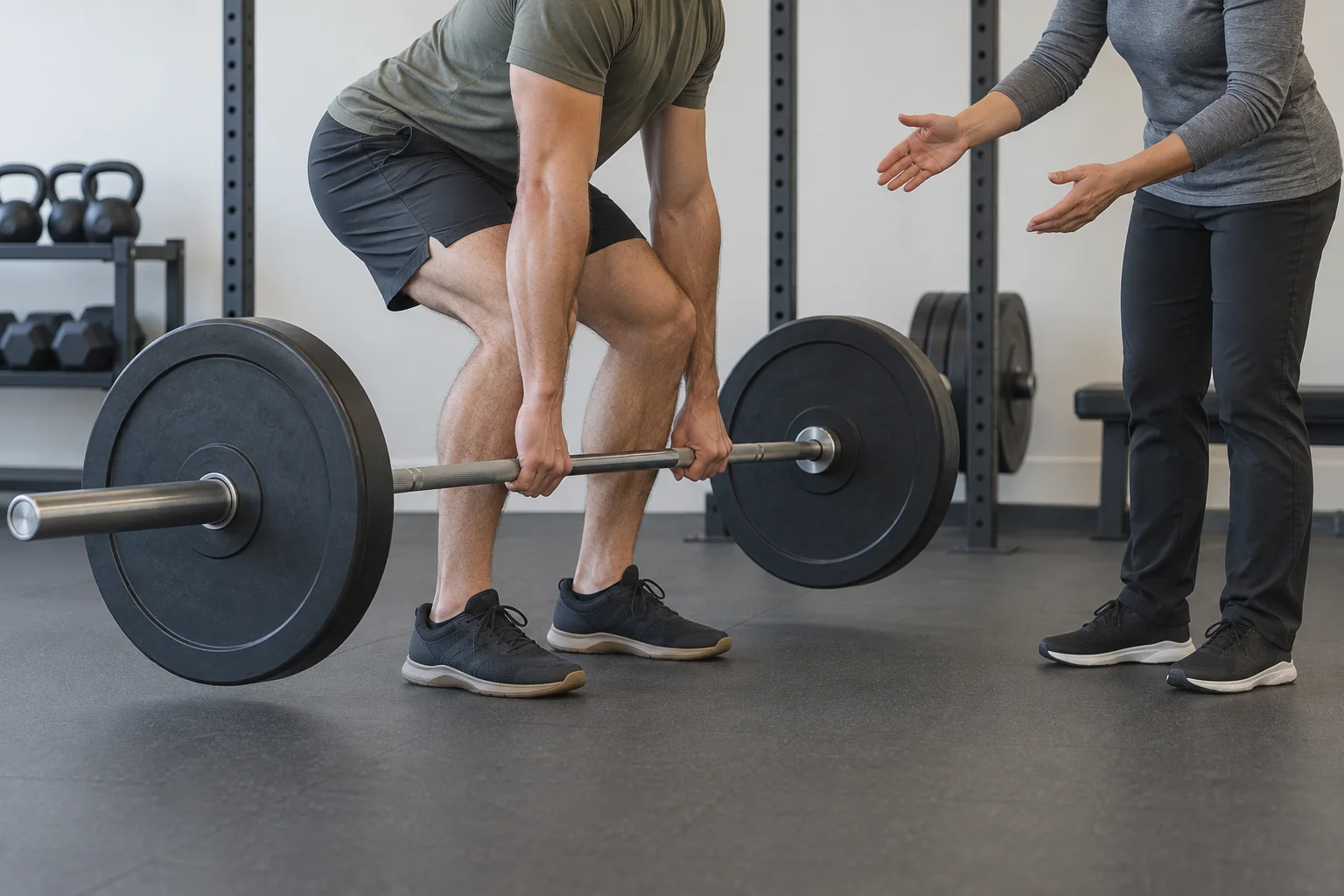
Biomechanics boundary
A modeled spinal load can explain why a task is demanding. It cannot tell you that your back is damaged, that a specific kilogram amount is unsafe, or that a neutral-spine cue makes every repetition safe.
How is weightlifting back injury rehabilitation progressed?
Weightlifting back injury rehabilitation is progressed by clinical criteria rather than by a fixed calendar. The first stage is to remove the clearly aggravating exposure and keep only movement that is safe for the person’s current presentation. When warning signs are absent, this often means finding tolerable ways to change position, walk or train around the problem instead of repeatedly provoking the same lift. If symptoms are severe, neurologic or worsening, the first stage is assessment, not a home progression.
Illustrative, assessment-led framework: The sequence below is not a self-clearance test or a universal return-to-lifting protocol. Diagnosis, neurologic findings, symptom irritability, comorbidities and day-to-day function can change the order or require a pause. Stop and seek reassessment for new neurologic symptoms, worsening function or a changed working diagnosis.
- Clarify the starting point: identify the working pain pattern, neurologic status, key functional limits and any reason to refer or image before loading.
- Calm the provoking task: reduce or pause the lift that reliably reproduces symptoms. Do not confuse temporary symptom relief with tissue healing or clearance.
- Rebuild movement capacity: use clinician-selected hinge, squat, trunk, hip or general conditioning work that matches the examination and can be repeated without a meaningful worsening trend.
- Reload one variable at a time: a clinician may adjust range, variation, load, repetitions, rest or frequency. The aim is to learn what the back tolerates, not to prove toughness.
- Return to the training demand: only progress toward floor pulls, heavier squats, Olympic-lift derivatives or CrossFit-style sessions when function and symptom response support that decision.
The evidence for deadlift-inclusive rehabilitation is especially important to state plainly. A review found that programs including deadlifts can improve pain and function in people with low back pain, but they were not more beneficial than low-load motor-control exercise, and the evidence was minimal. The abstract does not provide a safe load, number of sets, repetitions, frequency or return protocol. “May be appropriate for selected people” is not the same as clearance to deadlift. (Fischer et al., 2021; PMID: 33626500)
A practical review point is whether the modified task is stable during the session and afterward, whether daily function is improving, and whether the next-day trend is acceptable for that person. This is a clinical monitoring principle, not a universal pain score or a promise that every response can be predicted. If symptoms become more widespread, sleep or walking deteriorates, or new numbness or weakness appears, reduce the load and reassess rather than advancing the program.
Physical therapy can contribute through movement assessment, education, exercise selection, supervised progression and training modifications. Its role is not to impose one “correct” exercise or keep a lifter busy while a serious condition is missed. The plan should explain what each exercise is intended to change, when it is inappropriate, what progress would look like, and when the working diagnosis needs to be revisited.

Which symptoms mean you should stop lifting and seek urgent care?
Stop lifting and seek emergency care for new urinary retention, urinary or fecal incontinence, loss of bowel control, new sexual-function disturbance, numbness around the groin or inner thighs (saddle numbness), severe or progressive weakness in a leg, or a major loss of walking ability. These symptoms can indicate serious neurologic involvement and should not be tested with stretching, massage, manipulation or another heavy set. The goal is to move quickly toward appropriate medical assessment.
Seek prompt assessment rather than continuing the lifting program when you have:
- Neurologic change: new or worsening leg radiation, numbness, tingling, weakness, altered walking or loss of foot control.
- Systemic concern: fever or feeling acutely unwell with back pain, particularly with infection risk factors or immunosuppression.
- Structural concern: significant trauma, suspected fracture, osteoporosis, long-term corticosteroid use or a young athlete with a possible overuse stress injury.
- Concerning course: cancer history, unexplained weight loss, persistent non-improving pain or a clear decline in sleep, walking or self-care.
A radiating symptom is not automatically a disc herniation, and the absence of a red flag does not prove that a lift is safe. It simply changes the urgency and the type of decision needed. Recurrent pain every time you deadlift, pain that remains function-limiting, or symptoms that repeatedly return after self-treatment deserve a structured review even when emergency symptoms are absent.
This page is for patient education, not individualized medical advice. It cannot determine your diagnosis, prescribe medication, interpret an MRI, or clear you for a barbell, squat, deadlift or CrossFit session. If pain is affecting walking, sleep, work, daily activities or your ability to train, a PM&R assessment can help connect the symptom pattern, safety screen and rehabilitation plan to a realistic next step.
What the Evidence Cannot Tell You From a Search Result
A safer lifting decision uses the research without pretending it can diagnose one person online.
Pain Is Not a Diagnosis
A deadlift history changes the differential, but a painful location or a delayed onset does not identify the tissue involved.
Biomechanics Are Not Personal Thresholds
Modeled compression and shear estimates describe study conditions. They cannot tell you which load will injure or protect your back.
Return Is Not a Calendar Date
The evidence does not establish a universal percentage, repetition scheme or timeline for returning to squats, deadlifts or CrossFit.
References & Clinical Evidence
- [1] Ross R, Han J, Slover J. Chronic Lower Back Pain in Weight Lifters: Epidemiology, Evaluation, and Management. JBJS Rev. 2023. PMID: 37315158. DOI: 10.2106/JBJS.RVW.22.00228.
- [2] Ramirez VJ, Bazrgari B, Gao F, Samaan M. Low Back Biomechanics during Repetitive Deadlifts: A Narrative Review. IISE Trans Occup Ergon Hum Factors. 2022. PMID: 34875981.
- [3] Fischer SC, Calley DQ, Hollman JH. Effect of an Exercise Program That Includes Deadlifts on Low Back Pain. J Sport Rehabil. 2021. PMID: 33626500. DOI: 10.1123/jsr.2020-0324.
- [4] Fares MY, Fares J, Salhab HA, Khachfe HH, et al. Low Back Pain Among Weightlifting Adolescents and Young Adults. Cureus. 2020. PMID: 32789068. DOI: 10.7759/cureus.9127.
- [5] Mohile NV, Kuczmarski AS, Lee D, Warburton C, et al. Spondylolysis and Isthmic Spondylolisthesis: A Guide to Diagnosis and Management. J Am Board Fam Med. 2022. PMID: 36526328. DOI: 10.3122/jabfm.2022.220130R1.
- [6] Tung T, et al. Injuries in weightlifting and powerlifting: an updated systematic review. BMJ Open Sport Exerc Med. 2024. PMID: 39650568. DOI: 10.1136/bmjsem-2023-001884.
- [7] Comfort P, Haff GG, Suchomel TJ, et al. National Strength and Conditioning Association Position Statement on Weightlifting for Sports Performance. J Strength Cond Res. 2023. PMID: 36952649. DOI: 10.1519/JSC.0000000000004476.
- [8] Martín-Fuentes I, Oliva-Lozano JM, Muyor JM. Electromyographic activity in deadlift exercise and its variants: A systematic review. PLoS One. 2020. PMID: 32107499. PMCID: PMC7046193. DOI: 10.1371/journal.pone.0229507.
- [9] U.S. Department of Veterans Affairs and Department of Defense. VA/DoD Clinical Practice Guideline for the Diagnosis and Treatment of Low Back Pain. 2022. https://www.healthquality.va.gov/guidelines/Pain/lbp/.
- [10] National Institute for Health and Care Excellence. Low back pain and sciatica in over 16s: assessment and management (NG59). https://www.nice.org.uk/guidance/ng59/chapter/recommendations.
* Clinical references are provided to support the medical claims made in this article. TeraCare adheres to evidence-based practices in physical medicine and rehabilitation.

Dr. Ben Rabara
Dr. Ben Rabara is a Board-Certified Physiatrist specializing in Physical Medicine and Rehabilitation. He focuses on non-surgical, precision treatments for musculoskeletal conditions, utilizing advanced diagnostics like MSK Ultrasound.
Medical Disclaimer: The information provided in this article is for educational purposes only and does not substitute for professional medical advice, diagnosis, or treatment. Always consult a qualified physician for your specific health conditions.