
- — Graston Technique is a branded form of instrument-assisted soft-tissue mobilization, or IASTM. The names overlap, but a brand name does not prove that one tool is superior for every diagnosis.
- — The best-supported role for IASTM is usually a time-limited adjunct to assessment, exercise, education, and load planning. A visible skin mark is not a measure of treatment success.
- — Gua Sha is a separate traditional practice with a surface scraping or press-stroking action. Research includes small trials and a cautious systematic review, so its benefits should not be overstated.
- — Safety depends on the skin, bleeding risk, tissue irritability, diagnosis, medicines, and symptoms that may need another evaluation. Severe or unexplained symptoms should not be scraped first.
- — The useful comparison is not “Which tool wins?” It is “Which approach fits the working diagnosis, the functional goal, and the safest progression for this person?”
Graston Technique can be safe for a carefully selected person, but it is not automatically safe simply because the instrument is smooth, stainless steel, or used in a rehabilitation clinic. A clinician should first establish what may be causing the pain, whether the skin and deeper tissues can tolerate contact, and what functional change the session should create. The tool is secondary to that reasoning.
Patients often use Graston, IASTM, muscle scraping, blading, and Gua Sha as though they describe one treatment. They do not always do so. Graston Technique is a branded approach described in one study as a form of instrument-assisted soft-tissue mobilization, or IASTM (Sevier and Stegink-Jansen, 2020; PMID: 33238244). IASTM is the broader category. Gua Sha may look similar but comes from a different traditional and clinical context.
The internet can mistake a visible mark for evidence. The decision should follow the symptom pattern, examination, tissue irritability, medical history, and functional response.
What Is Graston Technique and How Does It Relate to IASTM?
Graston Technique is a branded form of instrument-assisted soft-tissue mobilization, while IASTM is the larger family of instrument-assisted techniques. Both may involve a clinician gliding a shaped instrument over lubricated skin, but the name alone does not tell you the exact instrument, training system, force, target tissue, diagnosis, or exercise plan. In the comparison study, the full Graston protocol and IASTM-only approach were tested separately; the authors did not show that every IASTM method is the same as the branded protocol.
An instrument can change how contact is distributed and give the clinician tactile information. It cannot see through the skin, confirm that a painful spot is scar tissue, or prove that fascia has been permanently released. Range of motion can be limited by a joint, tendon, muscle, nerve sensitivity, pain-related guarding, or a combination, so the same “tight” feeling can lead to different plans.

What Is IASTM, and What Should the Treatment Label Tell You?
- IASTM: a category of instrument-assisted soft-tissue techniques, not one universal protocol.
- Graston Technique: a branded approach within that category, with its own protocol and training context.
- Gua Sha: a term used for traditional and contemporary scraping practices that may intentionally create petechiae.
- Massage: a broad hands-on category that may use pressure, gliding, kneading, or other manual inputs without an instrument.
How Do Graston Technique and IASTM Compare With Massage?
Graston and other IASTM techniques use an instrument to focus contact; massage uses the hands and varies in pressure, surface area, and purpose. The relevant question is whether the input helps a specific activity without creating a flare that prevents the next rehabilitation step.
A systematic review and effect-size analysis of IASTM included 13 randomized trials and reported support for range of motion in uninjured participants and pain or patient-reported function in injured participants. It also emphasized the need for more high-quality research and broader generalization (Seffrin et al., 2019; PMID: 31322903). This is useful evidence, but it is not a ranking of IASTM against every massage style for every diagnosis.
In a small study of people with limited ankle dorsiflexion, 6 treatments over 3 weeks were compared with control, with the post-treatment measurement taken 24–48 hours after the sixth treatment. The Graston group improved standing dorsiflexion compared with control, but no difference was found between Graston Technique and IASTM (Sevier and Stegink-Jansen, 2020; PMID: 33238244). That finding supports a narrow conclusion: a branded protocol may be useful in a defined context, while the evidence does not justify claiming universal superiority over another IASTM approach.
Which Tool Fits Which Clinical Question?
A tool comparison is useful only when it remains connected to diagnosis, tolerance, and active rehabilitation.

Need help deciding whether a tool fits?
A physiatry assessment connects the painful movement, medical history, and safest rehabilitation option before treatment is chosen.
How Is Gua Sha for Muscle Strain Different From Clinical IASTM?
Traditional Gua Sha is commonly described as press-stroking the body surface with a smooth-edged instrument to intentionally raise therapeutic petechiae. One pilot study reported that these marks lasted 2–5 days (Lauche et al., 2012; PMID: 22928824). Clinical IASTM may also produce redness or tenderness, but it does not follow one universal traditional meaning and should not be judged by how dark or extensive the mark becomes.
The strongest caution is evidence quality. A systematic review of controlled Guasha trials included five randomized and two controlled clinical trials. It reported that some studies suggested favorable pain effects, but the quality was poor or low and concluded that current evidence was insufficient to show effectiveness for pain management (Lee et al., 2010; PMID: 20205902). That does not prove that Gua Sha never helps. It means the evidence does not support a confident promise for every patient.
Two small randomized studies reported short-term improvements in selected chronic neck or low-back-pain groups. The low-back trial randomized 50 patients, used a 100 mm visual analog scale, and reported no serious adverse events; the neck pilot used a 10 cm scale, while the open neck trial reported a 29.9 mm group difference after 1 week (Braun et al., 2011; PMID: 21276190; Lauche et al., 2012; PMID: 22928824; Saha et al., 2019; PMID: 30712747). These study-specific observations do not justify scraping unexplained pain at home or replacing examination with a traditional label.
What Does Gua Sha for Muscle Soreness Mean for a Safe Plan?
Muscle soreness after activity is not enough to identify the cause or choose a scraping technique. A clinician should check the timing, skin response, swelling, strength, sensation, and movement pattern before deciding whether Gua Sha belongs in the plan or whether another assessment is needed.
Does Graston Technique Work for Pain and Movement?
It may help some people with a short-term movement or symptom goal, but the research does not support a guaranteed or universal result. The evidence supports a monitored trial, not a promise that a tool will break up scar tissue, remodel fascia, or repair a tendon. The outcome should be a meaningful task, such as walking, reaching, gripping, or a sport-specific movement, rather than the appearance of the skin.
The study design matters. One IASTM systematic review found different products, body regions, participants, comparison treatments, and outcomes. A chronic mechanical neck-pain trial compared IASTM with myofascial release across 8 sessions over 4 weeks, found no significant between-group difference, and had no control group, so the authors noted that improvement could not be attributed confidently to either intervention (Shewail et al., 2023; PMID: 37270471). This is why a single favorable trial should not become a marketing claim.
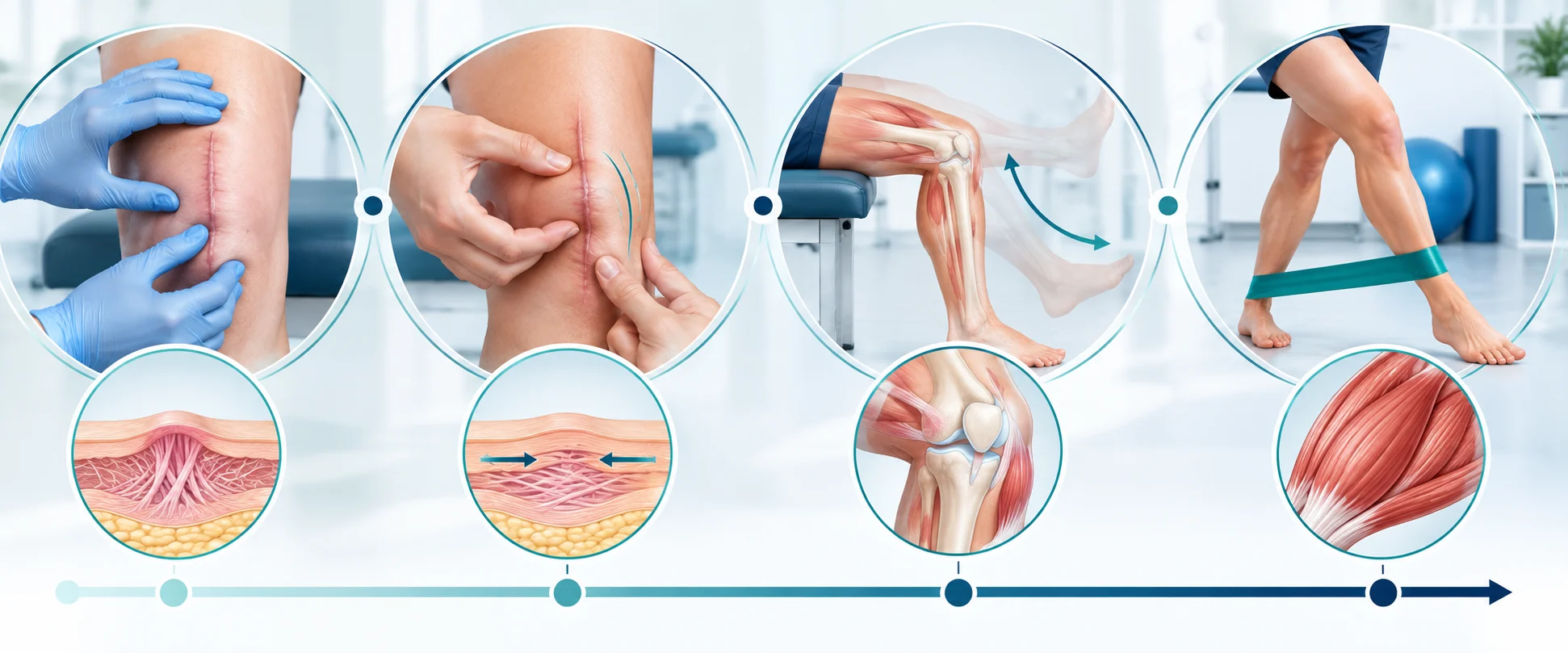
A practical clinical progression is straightforward. The clinician defines a baseline task, uses the least provocative contact that could reasonably help, and reassesses the task after the intervention. If the task improves and the response settles, the next step is usually active practice that uses the available motion. If there is no meaningful response, the working diagnosis and treatment plan deserve review. If pain escalates, the tissue or diagnosis may not be ready for that input.
What Does the Evidence Say About Tool Effects?
Mechanisms should be described as possibilities, not as facts inferred from a scrape mark.
What can a clinician measure after IASTM?
A clinician can measure a relevant range of motion, a functional task, symptom irritability, or tolerance of an exercise before and after a brief trial. These outcomes are more useful than assuming that a change in color means that deep scar tissue was removed. In the 2022 simulated-treatment study, trained clinicians showed reliability in measured one-handed IASTM forces, but the authors identified the effect of different force ranges on patient outcomes as a question for future research (Duffy et al., 2022; PMID: 35108674).
Why does a temporary change not prove a permanent tissue change?
Pain sensitivity, protective muscle activity, attention, joint position, and the broader treatment context can change how movement feels in the short term. That change may be valuable, especially if it helps a person practice. It does not by itself prove that fascia was permanently released, a tendon was repaired, or an adhesion was physically erased.
When should the trial be reduced or stopped?
Reduce or stop when the skin becomes intensely painful, symptoms become radiating or progressively numb, swelling increases, bruising is unexpected, or the person cannot complete the planned movement afterward. A treatment response that repeatedly blocks exercise is not a successful progression simply because the session felt intense.
What Does Treatment Feel Like, and What Soreness Is Expected?
Patients may describe pressure, pulling, rubbing, warmth, tenderness, or a feeling of tightness being challenged. The sensation should be communicated in real time. The clinician can change the contact angle, pressure, speed, lubricant, treatment area, or stop the technique. “No pain, no gain” is not an appropriate safety rule for instrument work.
Localized tenderness or mild redness may settle, but every bruise should not be dismissed automatically. Traditional Gua Sha intentionally raises petechiae, while a clinical IASTM session may or may not produce visible marks. Neither a mark nor the absence of a mark tells a clinician whether the painful tissue was correctly identified. The more useful measures are symptom trend, skin integrity, and function over the next day or two.
Which responses should change the plan?
- Usually discuss during the session: pressure that is too strong, sharp pain, increasing tenderness, or discomfort that prevents normal movement.
- Arrange same-day assessment: rapidly expanding bruising, unexpected bleeding, marked swelling, fever with spreading redness or warmth, or worsening pain after an injury.
- Seek emergency help: sudden loss of function, rapidly progressive weakness or numbness, severe sudden swelling and pain, trouble breathing, fainting, confusion, or chest pain.

Is Graston Technique Safe for Everyone, or Who Should Get Medical Clearance First?
No scraping technique is appropriate for everyone. A clinician should delay or modify it when the skin is open, infected, severely inflamed, fragile, or healing from a recent procedure. The screening history should include bleeding disorders, medicines that affect clotting, unexplained bruising, significant swelling, active fever, a suspected fracture, severe acute injury, and symptoms that suggest a vascular or neurologic problem. These are screening considerations rather than a complete universal list.
The location matters. A painful spot over a tendon may be irritable and need carefully graded loading. A painful spot near a nerve may produce burning, tingling, or weakness that should not be chased with more pressure. Pain with heat, spreading redness, fever, or rapidly increasing swelling may require evaluation for a problem outside routine soft-tissue treatment. A tool should never be used to postpone that assessment.
Safety also includes what happens after the session. A patient who lives far from Vigan City or travels from another Northern Luzon community may need a plan that is practical between visits. The clinician should explain what mild response is acceptable, what activity should be modified, which exercise maintains progress, and exactly when to contact the clinic or seek urgent care. A technically elegant treatment that leaves the patient unsure what to do next is not a complete rehabilitation plan.
When Might Tennis Elbow Scraping Be Considered, and What Else Should Be Checked?
Tennis elbow scraping may be considered only after the clinician has confirmed that the pain pattern is compatible with a load-sensitive lateral-elbow problem and has checked nearby alternatives. Outer-elbow pain can overlap with tendon pain, joint irritation, radial-nerve sensitivity, neck-related pain, referred pain, or an injury that needs a different pathway. Scraping cannot distinguish these causes on its own.
The clinician looks for the movement that reliably reproduces the symptoms: gripping, lifting a pan, turning a key, resisted wrist extension, elbow motion, neck position, or a sustained work posture. The examination also checks strength, sensation, swelling, range of motion, and the person's work demands. If the pain is highly irritable, a strong instrument input may add sensitivity rather than create useful movement. The first treatment may therefore be education, relative load modification, gentle isometrics, or another assessment rather than scraping.
When an adjunct is appropriate, it should support a progression. The patient may use the immediately more comfortable motion to practice controlled wrist and forearm loading, then gradually restore grip and work tolerance. The progression is based on how symptoms behave during the activity and later that day or the next morning, not on how much bruising appears. Persistent weakness, numbness, night pain, marked swelling, or loss of function changes the threshold for further evaluation.
How Should a Clinician Choose a Tool and Treatment Plan?
Tool choice should follow the clinical question. If the goal is to make a movement easier for exercise, the clinician should measure that movement. If the goal is comfort, the discussion should cover how long the change lasts and what active step follows. If the patient expects a tool to remove scar tissue or cure chronic pain, that expectation needs correction before treatment. Clear expectations are part of safety.
Putting those findings into care is also practical. Reviews suggest that IASTM may help selected range-of-motion, pain, or function outcomes, but they do not define one best tool, force, or schedule. In a provincial setting, the most defensible plan may be a short supervised trial followed by a clear home program rather than repeated passive visits that are difficult to attend. The clinician should monitor skin response, pain behavior, neurologic symptoms, and a functional task. If the task does not improve over a reasonable reassessment window, the clinician should reconsider the diagnosis or escalate evaluation instead of increasing pressure.
1Screen the person
Clarify the symptom pattern, recent injury, skin condition, medicines, bleeding history, swelling, nerve symptoms, and functional limitation before choosing contact.
2Define the target
Choose a measurable movement or activity goal, then decide whether an instrument, hands-on treatment, exercise, education, or another test best fits the question.
3Use a tolerable dose
Adjust area, pressure, angle, and duration to the tissue and the person's response. Force is not a badge of quality and is not a universal prescription.
4Reassess and progress
Repeat the same functional test, pair any useful change with active rehabilitation, and stop or change direction when the response is absent, excessive, or diagnostically concerning.

What Should You Ask Before a Scraping Session?
Before treatment, ask what diagnosis or working explanation is being considered, what the tool is expected to change, and how that change will be measured. Ask what other treatment follows and what would make the clinician stop. If the answer is only that the tissue needs to be “broken up,” ask which structure was assessed and what evidence supports that interpretation.
You should also disclose medicines that affect bleeding, a history of unusual bruising, skin disease, recent operations or injections, a new injury, fever, swelling, numbness, weakness, and symptoms that travel along a limb. These details are not obstacles to care; they help select a safer pathway. A cautious clinic should postpone a tool and clarify the diagnosis rather than create a skin response that obscures a more important symptom.
Graston Technique, IASTM, massage, and Gua Sha can each occupy a place in a carefully selected plan, but none should be treated as a universal answer. The safest decision is the one that matches the diagnosis, respects tissue tolerance, uses a meaningful functional goal, and leaves the patient with a clear next step. When the diagnosis is uncertain or symptoms are worsening, assessment comes before scraping.
Want a clearer plan for persistent pain?
Bring the movement that hurts, the treatment you have tried, and your medical history for a focused PM&R assessment in Vigan City.
What Can the Comparison Not Promise?
A tool can be useful without being magical, universal, or risk-free.
A brand is not a diagnosis
Graston Technique identifies a branded approach within the broader IASTM category. It does not identify the tissue causing your pain or make assessment optional.
A mark is not a score
Redness or petechiae can reflect contact at the skin surface. They do not prove that a tendon, fascia, scar, or muscle problem was found or repaired.
Relief is not the same as recovery
A short-term change matters most when it helps a measurable task and is followed by appropriate active rehabilitation and reassessment.
References & Clinical Evidence
- [1] Seffrin CB, et al. (2019). Instrument-Assisted Soft Tissue Mobilization: A Systematic Review and Effect-Size Analysis. Journal of Athletic Training. PMID: 31322903.
- [2] Bush HM, et al. (2020). Comparison of the Graston Technique® With Instrument-Assisted Soft Tissue Mobilization for Increasing Dorsiflexion Range of Motion. Journal of Sport Rehabilitation. PMID: 33238244.
- [3] Lee MS, et al. (2010). Using Guasha to treat musculoskeletal pain: a systematic review of controlled clinical trials. Chinese Medicine. PMID: 20205902; PMCID: PMC2827462.
- [4] Braun M, et al. (2011). Effectiveness of traditional Chinese "gua sha" therapy in patients with chronic neck pain: a randomized controlled trial. Pain Medicine. PMID: 21276190.
- [5] Lauche R, et al. (2012). Randomized controlled pilot study: pain intensity and pressure pain thresholds in patients with neck and low back pain before and after traditional East Asian "gua sha" therapy. American Journal of Chinese Medicine. PMID: 22928824.
- [6] Saha FJ, et al. (2019). Gua Sha therapy for chronic low back pain: A randomized controlled trial. Complementary Therapies in Clinical Practice. PMID: 30712747.
- [7] Duffy S, et al. (2022). Clinician Reliability of One-Handed Instrument-Assisted Soft Tissue Mobilization Forces During a Simulated Treatment. Journal of Sport Rehabilitation. PMID: 35108674.
- [8] Shewail F, et al. (2023). Instrument-assisted soft tissue mobilization versus myofascial release therapy in treatment of chronic neck pain: a randomized clinical trial. BMC Musculoskeletal Disorders. PMID: 37270471.
* Clinical references are provided to support the medical claims made in this article. TeraCare adheres to evidence-based practices in physical medicine and rehabilitation.

Dr. Ben Rabara
Dr. Ben Rabara is a Board-Certified Physiatrist specializing in Physical Medicine and Rehabilitation. He focuses on non-surgical, precision treatments for musculoskeletal conditions, utilizing advanced diagnostics like MSK Ultrasound.
Medical Disclaimer: The information provided in this article is for educational purposes only and does not substitute for professional medical advice, diagnosis, or treatment. Always consult a qualified physician for your specific health conditions.