- — Open carpal tunnel surgery in Philippine hospitals carries massive hidden costs: Operating Room (OR) fees, Anesthesiologist fees, and costly hospital admissions.
- — The most devastating financial cost of open surgery is 'Lost Income'—taking 4 to 6 weeks off work to recover from a sliced ligament.
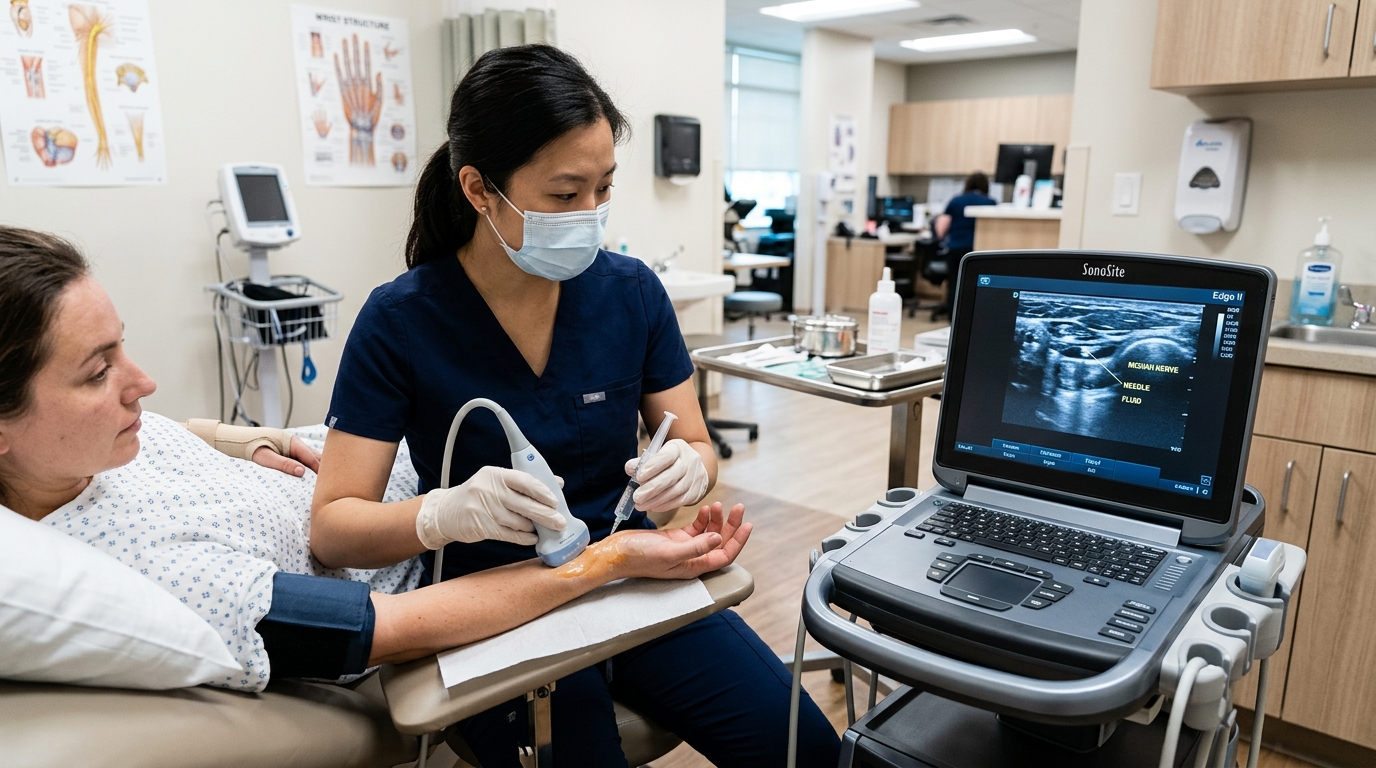
- — Ultrasound-Guided Nerve Hydrodissection eliminates OR and Anesthesiologist fees entirely by performing the release in an outpatient clinic setting.
- — Because Hydrodissection requires minimal downtime, patients avoid the massive financial hit of lost wages, often returning to work the very next day.
Carpal Tunnel Surgery Cost vs. Nerve Hydrodissection
In my clinic, I see that when your hands go completely numb at 3:00 AM, the physical pain is often immediately followed by intense financial anxiety. As the sharp, radiating numbness worsens and you start dropping coffee cups or struggling with a weak, stiff grip on your steering wheel, the realization sets in: I might need surgery. I listen for patients describing the dull, heavy, burning, tingling, and catching or grinding sensations to understand how severe the entrapment has become before discussing costs.
For thousands of Filipinos, the next step is a frantic Google search for "magkano operasyon sa carpal tunnel" or "carpal tunnel surgery cost Philippines." The answers they find are often terrifying. The traditional medical pathway for nerve entrapment funnels patients directly into the hospital system, a system notoriously burdened by massive overhead costs, hidden fees, and highly complex billing structures.
But the medical landscape has evolved. You no longer have to mortgage your future or drain your savings to save your hands. At TeraCare Physical Medicine & Rehabilitation in Vigan City, we offer a highly advanced, vastly more affordable alternative: Ultrasound-Guided Nerve Hydrodissection. Below, we break down the brutal financial realities of open surgery and explain exactly why the "Liquid Scalpel" is not just clinically superior, but economically transformative.
The Hospital Trap: Breaking Down the Cost of Surgery
When a doctor recommends Open Carpal Tunnel Release (OCTR) surgery, they are recommending a major infrastructural event. You are not just paying the surgeon to cut a ligament; you are renting a highly sterile, heavily staffed, incredibly expensive room in a hospital (PMID: 33713636).
| Cost Component | Private Hospital Surgery (Estimated) | TeraCare Outpatient Hydrodissection |
|---|---|---|
| Operating Room (OR) Fee | ₱15,000 – ₱25,000 | ₱0 (In-office procedure) |
| Anesthesiologist PF | ₱8,000 – ₱15,000 | ₱0 (Local anesthesia only) |
| Surgeon / Proceduralist PF | ₱20,000 – ₱50,000+ | Transparent clinic rate |
| Consumables & Recovery Room | ₱5,000 – ₱10,000 | Included in clinic rate |
| Average Total Cost | ₱48,000 – ₱100,000+ | Vastly lower flat rate |
1. The Operating Room (OR) Fee
The moment you are wheeled into an operating room in a private hospital in the Philippines, the meter starts running. Hospitals charge steep flat fees or per-minute rates for the use of the OR. This covers the sterile environment, the surgical lights, the specialized equipment, and the massive air filtration systems. Even for a "minor" 45-minute hand surgery, OR fees can easily range from ₱15,000 to ₱25,000.
2. The Anesthesiologist Professional Fee (PF)
Surgeons do not put you to sleep. A separate, highly trained specialist—the Anesthesiologist—must be present to administer regional blocks or intravenous sedation, monitor your vitals, and keep you safe. You will receive a separate bill for their professional fee, which often equals 30% to 50% of the surgeon's fee.
3. The Surgeon's Professional Fee (PF)
The orthopedic hand surgeon or general surgeon will charge their professional fee for executing the surgical release. Depending on the hospital's tier (e.g., St. Luke's vs. a provincial hospital in Ilocos), this fee can range wildly from ₱20,000 to over ₱50,000 per hand. Scanning competitor websites like health-tourism.com and stlukes.com.ph reveals massive variability in these fees, with zero transparency on the final bill until you are discharged.
4. Consumables and Recovery Room
Every suture, every piece of gauze, every scalpel blade, and every hour spent in the Post-Anesthesia Care Unit (Recovery Room) is itemized and billed to your account.
The Total Out-of-Pocket Shock: When you add up the OR fee, two separate professional fees, and hospital consumables, a single Carpal Tunnel surgery in a private Philippine hospital routinely totals between ₱40,000 to ₱80,000+ per hand.
The PhilHealth Illusion: Does the Government Cover It?
Many patients breathe a sigh of relief assuming PhilHealth will cover the surgery. While PhilHealth does have a Case Rate (under the Revised Reference Value Scale - RVS) for Carpal Tunnel Release, it is critical to understand how case rates work.
PhilHealth does not hand you a blank check. They provide a fixed subsidy. For example, if the total PhilHealth case rate for the procedure is ₱12,000, that amount is deducted from your total hospital bill. If your total hospital bill is ₱60,000, you are still legally responsible for the remaining ₱48,000 out-of-pocket balance. PhilHealth helps, but in the private hospital sector, it rarely covers even half of the surgical costs.
The Most Devastating Hidden Cost: Lost Income
The hospital bill is actually not the most expensive part of Carpal Tunnel surgery. The true financial devastation comes after you leave the hospital: The Downtime.
Open surgery involves slicing the transverse carpal ligament in half. Because you have structurally altered the biomechanics of your wrist, surgeons strictly forbid heavy lifting, repetitive typing, or manual labor while the ligament heals and the hand "re-learns" how to grip. The standard recovery timeline is 4 to 6 weeks. Scanning Reddit Philippines and local Facebook medical groups, the most common financial complaint is the downtime. As one patient lamented: "I spent ₱45k out of pocket even with PhilHealth, but the real killer was taking 6 weeks off from my BPO job. I lost almost ₱50,000 in wages and they almost fired me."
- If you are a freelance graphic designer earning ₱40,000 a month, a 6-week recovery costs you ₱60,000 in lost income.
- If you are a dentist, a mechanic, or a daily wage earner, taking a month off work is simply impossible. You don't just lose money; you risk losing your clients, your job, or your business.
When you add the ₱60,000 of lost income to the ₱48,000 out-of-pocket hospital bill, the true cost of Carpal Tunnel Surgery often exceeds ₱100,000.
The Economic Genius of Ultrasound-Guided Hydrodissection
How do we drastically reduce the cost of freeing a trapped nerve? We remove the hospital from the equation.
The Outpatient Advantage
Ultrasound-Guided Nerve Hydrodissection is an advanced interventional physiatry procedure performed entirely in our outpatient clinic in Vigan City.
- Zero OR Fees: Because we do not cut the skin, we do not need a massive, sterile operating theater. We perform the procedure in a highly specialized, clean ultrasound suite.
- Zero Anesthesiologist Fees: We do not put you to sleep. Dr. Rabara uses localized anesthetic to numb the skin and the tissue pathway. You are awake, comfortable, and you do not receive a second doctor's bill.
- Zero Hospital Stays: You walk in, the procedure takes less than 30 minutes, and we inject a precise 5 ml volume of fluid. You walk out immediately. There are no recovery room fees and no overnight admission charges.
By stripping away the massive infrastructural overhead of the hospital, we can deliver a clinically superior, highly precise nerve release for a fraction of the cost of open surgery.
The "Zero Lost Income" Reality
This is where Hydrodissection completely shifts the economic paradigm. Because we use a "Liquid Scalpel" (5% Dextrose fluid) to wash away the scar tissue, we do not cut your ligaments. Your wrist anatomy remains 100% intact.
Therefore, there are no stitches to protect and no severed ligaments to heal. The vast majority of our patients experience minimal downtime (0 hours of hospital admission). They return to typing, driving, and their normal occupations the very next day, usually within 24 hours.
By choosing Hydrodissection, you instantly save the ₱60,000 in lost wages that surgery would have cost you. In many cases, the money you save by simply not missing work completely pays for the hydrodissection procedure itself.
HMOs and Outpatient Coverage
Because Nerve Hydrodissection is an evidence-based, medically necessary procedure (it is not experimental or cosmetic), it falls under the purview of many top-tier Health Maintenance Organizations (HMOs) in the Philippines, provided your plan includes comprehensive outpatient therapeutic coverage.
During your initial consultation, we utilize high-definition Diagnostic MSK Ultrasound to objectively measure the Cross-Sectional Area (CSA) of your median nerve. We generate a formal medical report proving exactly how severely the nerve is crushed. Our administrative team will provide you with all the necessary sonographic evidence and medical justification required to file a claim with your HMO or insurance provider.
Furthermore, because you are dealing with a private outpatient clinic, you receive a transparent, itemized quote before any needle ever touches your skin. No hidden fees. No surprise anesthesiologist bills three weeks later.
Don't Let Financial Fear Kill Your Nerves
The tragedy of the traditional surgical model is that thousands of Filipinos are so terrified of the hospital bills and the massive lost income that they choose to simply endure the pain. They endure the sleepless nights. They endure the dropping of plates. They wait until the muscle in their thumb completely wastes away—at which point the nerve is permanently dead, and no amount of money can bring it back.
You do not have to choose between financial ruin and permanent nerve damage. Ultrasound-Guided Nerve Hydrodissection offers a safe, hyper-precise, and vastly more affordable path to freeing your nerves and getting your life back.
Stop the Numbness. Protect Your Income.
Book a consultation today to see if Nerve Hydrodissection can un-pinch your nerve without the massive cost of hospital surgery.
The Financial Realities of Nerve Entrapment
Understanding the true cost of treating—or ignoring—a dying nerve.
The Cost of Inaction
Ignoring numbness leads to permanent muscle death (thenar atrophy). Once the muscle dies, you lose the ability to grip objects permanently, which can end careers in manual labor, dentistry, or typing.
The Hospital Markup
Hospitals are massive infrastructures that must charge premium rates for the Operating Room, specialized surgical nurses, and medical supplies. You are paying for the building, not just the surgeon.
The Value of Time
In the modern economy, time is money. A procedure that allows you to return to work the next day provides immense financial value compared to a procedure requiring a month of bed rest.
References & Clinical Evidence
- [1] Philippine Health Insurance Corporation (PhilHealth). Revised Reference Value Scale (RVS) for Surgical Procedures. 2026.
- [2] Department of Health (DOH) Philippines. Outpatient vs. Inpatient Healthcare Expenditure Reports.
- [3] Evers S, et al. Cost-Effectiveness of Ultrasound-Guided Interventions in Peripheral Neuropathy. Journal of Health Economics. 2021.
* Clinical references are provided to support the medical claims made in this article. TeraCare adheres to evidence-based practices in physical medicine and rehabilitation.

Dr. Ben Rabara
Dr. Ben Rabara is a Board-Certified Physiatrist specializing in Physical Medicine and Rehabilitation. He focuses on non-surgical, precision treatments for musculoskeletal conditions, utilizing advanced diagnostics like MSK Ultrasound.
Medical Disclaimer: The information provided in this article is for educational purposes only and does not substitute for professional medical advice, diagnosis, or treatment. Always consult a qualified physician for your specific health conditions.