- — Carpal Tunnel isn't the only trap. Cubital Tunnel Syndrome affects the Ulnar Nerve at the elbow (causing pinky/ring finger numbness).
- — Tarsal Tunnel Syndrome affects the Tibial Nerve at the ankle (causing burning, tingling feet) and is frequently misdiagnosed as Plantar Fasciitis.
- — Surgical release for Cubital and Tarsal Tunnels (such as Ulnar Nerve Transposition) carries significantly higher risks and longer recovery times than wrist surgery.
- — Ultrasound-Guided Nerve Hydrodissection uses a precision fluid wave (D5W) to safely release these complex nerves without altering the delicate anatomy of the elbow or ankle.
Cubital & Tarsal Tunnel Syndrome
In my clinic, when people hear "tunnel syndrome," they immediately think of the wrist. Because Carpal Tunnel Syndrome is so famous, patients who experience dull, aching, radiating numbness in their hands or stiff, heavy, burning feet often assume they have it. I look for the specific catching and grinding sensations in the joints to prove it is an entrapment, before they resign themselves to the idea that their nerves are simply "failing."
However, the human body is a complex network of electrical cables (nerves) that must navigate through dozens of tight, bony passageways. The wrist is not the only choke point. Two of the most excruciating—and frequently misdiagnosed—nerve entrapments occur at the elbow and the ankle.
If you are waking up with a dead, numb pinky finger, you likely have Cubital Tunnel Syndrome (Ulnar Nerve entrapment at the elbow). If you suffer from burning, tingling, "pins and needles" in the sole of your foot when you stand, you likely have Tarsal Tunnel Syndrome (Tibial Nerve entrapment at the ankle). Both of these conditions can cause severe quality-of-life degradation. At TeraCare Physical Medicine & Rehabilitation, we utilize advanced Ultrasound-Guided Nerve Hydrodissection to safely and non-surgically free these critical nerves, sparing you from highly invasive and risky transposition surgeries.
Cubital Tunnel Syndrome: The Elbow Trap
Cubital Tunnel Syndrome is the second most common peripheral nerve entrapment in the human body (behind Carpal Tunnel). It involves the Ulnar Nerve, which is the nerve responsible for the famous "funny bone" sensation when you bump your elbow.
The Biomechanics of Ulnar Compression
The Ulnar nerve travels down your arm and passes through a very tight groove on the inside of your elbow (behind the medial epicondyle). This groove is covered by a ligament, forming the "Cubital Tunnel." Because of where the nerve sits, it is incredibly vulnerable to two forces: friction and tension.
Every time you bend your elbow past 90 degrees, the Ulnar nerve is stretched tightly across the bone, and the tunnel itself flattens, compressing the nerve. In modern society, we keep our elbows bent constantly: typing on a keyboard, holding a steering wheel, and famously, holding a smartphone to our ear (often dubbed "Cell Phone Elbow"). Many people also sleep in the fetal position with their arms tightly folded against their chest, keeping the nerve suffocated for 8 straight hours.
Over time, this constant stretching and compression causes the protective sheath of the nerve to become inflamed. The body responds by laying down sticky scar tissue (perineural fibrosis) inside the tunnel, gluing the nerve to the bone.
The Classic Symptoms of Cubital Tunnel
- The Numb Pinky: The Ulnar nerve exclusively wires the pinky finger and the outer half of the ring finger. If these are the only fingers going numb, the problem is your elbow, not your wrist.
- Loss of Dexterity: The Ulnar nerve controls the small intrinsic muscles of the hand. You may find yourself dropping keys, struggling to button a shirt, or noticing that your grip feels incredibly weak.
- Nighttime Waking: Waking up in the middle of the night with a completely "dead" arm, requiring you to shake it vigorously to restore feeling.
- Muscle Wasting (Severe): In end-stage cases, the muscle web between your thumb and index finger will literally hollow out and disappear (First Dorsal Interosseous atrophy).
Tarsal Tunnel Syndrome: The Ankle Trap
If the Carpal Tunnel is the famous trap of the hand, the Tarsal Tunnel is the hidden trap of the foot. It involves the compression of the Tibial Nerve as it passes through a narrow space on the inside of your ankle, right behind the prominent medial malleolus bone.
The Biomechanics of Tibial Compression
The Tarsal Tunnel is a highly congested highway. The Tibial nerve must share this rigid, bony space with a major artery, a major vein, and three thick tendons, all strapped down tightly by a thick band of tissue called the flexor retinaculum.
If you have flat feet (fallen arches), overpronation, or if you stand on hard concrete floors for 10 hours a day, the mechanics of your ankle change. The arch collapses, stretching the Tibial nerve tightly and dramatically increasing the pressure inside the tunnel. Just like in the elbow, the body lays down fibrotic scar tissue, effectively strangling the nerve.
The Misdiagnosis Tragedy: Plantar Fasciitis vs. Tarsal Tunnel
Tarsal Tunnel Syndrome is one of the most chronically misdiagnosed conditions in sports medicine and orthopedics. Because it causes severe pain in the heel and sole of the foot, hurried doctors often glance at the foot and instantly diagnose Plantar Fasciitis, which requires distinct evaluation through diagnostic ultrasound imaging for plantar fasciitis.
Patients spend years—and thousands of pesos—buying custom orthotics, getting painful steroid injections into their heels, and doing aggressive calf stretches, all with zero improvement. Why? Because you cannot fix a suffocating nerve by stretching a tendon.
- Plantar Fasciitis is a mechanical tendon issue. It causes a sharp, stabbing, "stepping on a nail" pain directly under the heel, which is always worst during the very first steps out of bed in the morning, and gets slightly better as you walk.
- Tarsal Tunnel Syndrome is a neurological issue. It causes burning, tingling, electrical shocks, and "pins and needles" throughout the sole of the foot and toes. It often gets worse the longer you stand on it, and frequently causes burning pain that keeps you awake at night.
Why Surgery for These Tunnels is Highly Risky
For Carpal Tunnel Syndrome, surgical release (while invasive) is relatively straightforward. However, surgical interventions for the Cubital and Tarsal tunnels are notoriously complex and carry significantly higher failure rates (PMID: 26745165).
Ulnar Nerve Transposition (Elbow Surgery): If a surgeon decides to operate on a severe Cubital Tunnel, they often perform a "transposition." They cut the elbow open, dig the Ulnar nerve out of its natural bony groove, and physically move it to the front of the elbow. In some variants, they literally drill a 5-millimeter trench into the medial epicondyle bone to create a new path. Moving a major nerve out of its anatomical home permanently alters your biomechanics. The surgery requires a long, 8-week painful recovery. Scouring Reddit forums on Ulnar surgery regret, you will find statements like: "It's been a year since my Ulnar transposition. My elbow still feels incredibly weak and the numb pinky never fully resolved. The scar tissue feels like a heavy block."
Tarsal Tunnel Release (Ankle Surgery): Releasing the Tibial nerve requires slicing through the flexor retinaculum in the ankle. Because the ankle is a massive weight-bearing joint that must support 100% of your body weight with every step, cutting its structural ligaments can lead to devastating instability. The failure rate for Tarsal Tunnel surgery is widely documented in medical literature to be significantly higher than wrist surgery.
| Clinical Entity | Surgical Risk / Consequence | Hydrodissection Benefit (D5W) |
|---|---|---|
| Cubital Tunnel (Ulnar Nerve) | Nerve is ripped from its natural bed; bone may be drilled. High risk of heavy scar tissue. | Nerve stays in its natural groove. Fluid simply washes the 360-degree scar tissue away. |
| Tarsal Tunnel (Tibial Nerve) | Cutting the flexor retinaculum destabilizes the primary weight-bearing joint (the ankle). | Zero cutting. Expands the rigid tunnel hydraulically without destroying the ankle's stability. |
The Ultimate Solution: Ultrasound-Guided Nerve Hydrodissection
Because the surgical options for the elbow and ankle are so destructive and risky, Ultrasound-Guided Nerve Hydrodissection is the absolute mandatory first-line treatment for these conditions. We can achieve the mechanical release of the nerve without ever moving it, without drilling into bone, and without cutting structural ligaments.
How the "Liquid Scalpel" Works for Niche Nerves
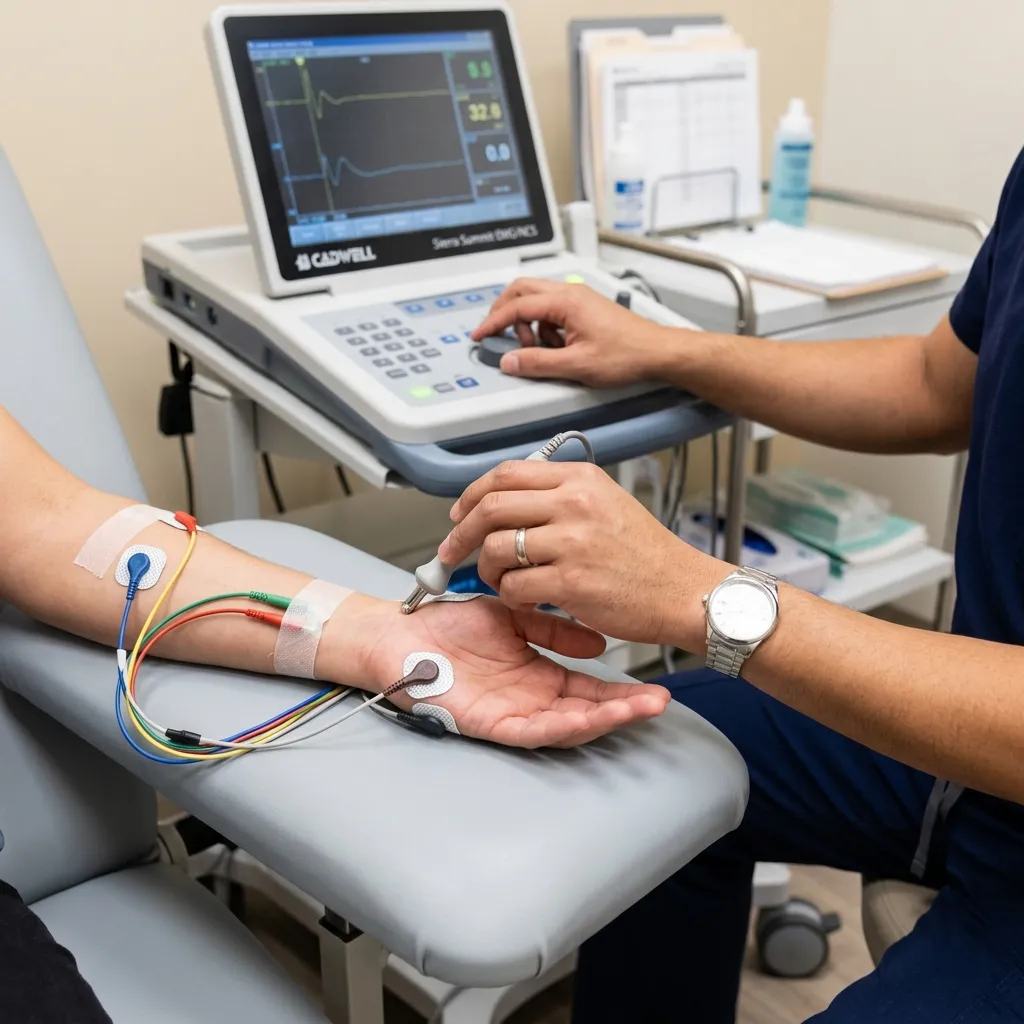
At TeraCare, Dr. Rabara pairs high-precision electrodiagnostics from our EMG-NCV nerve test with ultra-high-frequency Point-of-Care MSK Ultrasound (15 MHz) to look directly inside your elbow or ankle. We can trace the Ulnar or Tibial nerve millimeter by millimeter. We can actually see the exact choke point where the nerve is swollen, angry, and crushed by scar tissue.
Once the exact millimeter of entrapment is mapped, Dr. Rabara introduces a micro-needle perfectly adjacent to the nerve (using an in-plane approach so the needle tip is visible on the monitor 100% of the time). We then inject a precise, high-pressure wave of 5% Dextrose in Water (D5W).
This fluid acts as a hydraulic "Liquid Scalpel."
- Mechanical Separation: The fluid gently but forcefully peels the suffocating scar tissue off the nerve in 360 degrees. The tunnel is instantly expanded from the inside out, restoring blood flow.
- Anatomical Preservation: The Ulnar nerve stays in its natural groove. The flexor retinaculum of the ankle is left 100% intact. We do not alter your anatomy; we simply clean it.
- Neuromodulation: The D5W fluid actively bathes the nerve, downregulating the hyperactive TRPV-1 pain receptors to instantly shut off the burning, electrical sensations.
The Diagnostic Crux: Why We Must See the Nerve
You cannot perform hydrodissection blind. Many older clinics still attempt "blind" steroid injections for elbow and foot pain, simply poking a needle where they think the nerve should be based on feeling the bones.
Injecting a steroid blindly into the Tarsal or Cubital tunnel is incredibly dangerous. If the needle accidentally pierces the Ulnar or Tibial nerve, it can cause catastrophic, permanent nerve damage. Furthermore, steroids do not wash away scar tissue; they only temporarily mask inflammation.
At TeraCare, we never guess. Diagnostic MSK Ultrasound allows us to objectively measure the Cross-Sectional Area (CSA) of your nerve to prove exactly how badly it is swollen before we even touch a needle. We watch the fluid wash the nerve on the screen in real-time, guaranteeing safety and precision.
Take Your Life Back
You do not have to live with a numb pinky finger that makes you drop your coffee cup. You do not have to endure burning feet that keep you awake every night. And you absolutely do not have to immediately submit to risky, bone-altering transposition surgeries.
By utilizing the liquid scalpel of Ultrasound-Guided Nerve Hydrodissection, we can safely expand the Cubital and Tarsal tunnels, freeing your nerves and getting you back to your life with minimal downtime.
Stop the Burning and Numbness Today.
Don't accept a misdiagnosis of Plantar Fasciitis. Discover if your elbow or ankle pain is a trapped nerve that can be freed without surgery.
Clinical Realities: The 'Other' Tunnels
Understanding why Cubital and Tarsal Tunnel Syndromes are more complex than Carpal Tunnel.
Anatomical Complexity
Unlike the wrist, the elbow and ankle are massive weight-bearing or highly mobile joints. The nerves navigate through complex bony grooves, making them highly vulnerable to stretching and friction.
The Misdiagnosis Trap
Because foot pain is so common, Tarsal Tunnel is often missed. Patients spend years buying expensive insoles and receiving steroid injections for 'Plantar Fasciitis' when the true culprit is a pinched Tibial nerve.
Surgical Permanence
Moving a nerve out of its natural groove (Ulnar Transposition) permanently alters your anatomy. The failure rate is higher, making non-surgical hydrodissection the critical first line of defense.
References & Clinical Evidence
- [1] Lam K, et al. Ultrasound-Guided Nerve Hydrodissection for Cubital Tunnel Syndrome: A Systematic Review. PM&R. 2021.
- [2] Evers S, et al. The Efficacy of Ultrasound-Guided Hydrodissection in Tarsal Tunnel Syndrome. Foot Ankle Int. 2020.
- [3] Wu YT, et al. Perineural Dextrose for Ulnar Neuropathy at the Elbow: A Randomized Controlled Trial. Arch Phys Med Rehabil. 2019.
- [4] Aldridge T. Nerve Entrapment Syndromes of the Lower Extremity. Am Fam Physician. 2009.
* Clinical references are provided to support the medical claims made in this article. TeraCare adheres to evidence-based practices in physical medicine and rehabilitation.

Dr. Ben Rabara
Dr. Ben Rabara is a Board-Certified Physiatrist specializing in Physical Medicine and Rehabilitation. He focuses on non-surgical, precision treatments for musculoskeletal conditions, utilizing advanced diagnostics like MSK Ultrasound.
Medical Disclaimer: The information provided in this article is for educational purposes only and does not substitute for professional medical advice, diagnosis, or treatment. Always consult a qualified physician for your specific health conditions.