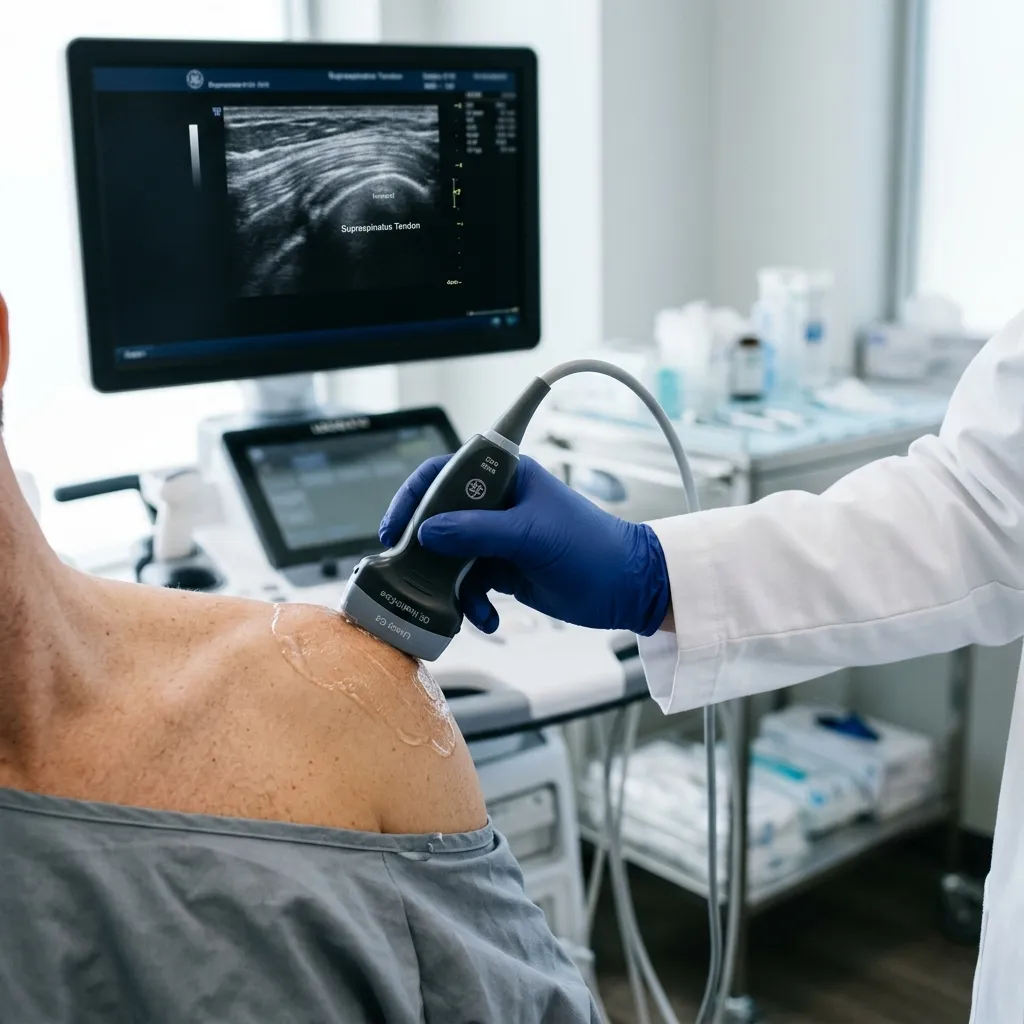
- — Ultrasound-guided injections use real-time imaging to ensure the needle reaches the exact target while avoiding nerves and blood vessels.
- — Blind or 'landmark-guided' injections rely on touch and 'feel,' which can lead to missing the target in up to 30-40% of cases in certain joints.
- — Precision delivery minimizes 'off-target' side effects and significantly reduces procedural pain.
- — Using MSK ultrasound transforms an injection from a blind procedure into a diagnostic and therapeutic certainty.
I often see patients in clinic who tell me, "Doc, I already had a cortisone shot and it didn't work. I don't think they're for me." When I dig deeper, I usually find that the injection was performed "blind"—meaning the physician relied only on their hands to feel for landmarks and "guess" where the needle should go.
In modern rehabilitation medicine, "guessing" is no longer the gold standard. Utilizing ultrasound guided joint injection technology allows us to see the needle move through the tissue in real-time, ensuring that every drop of the anti-inflammatory injection reaches the exact anatomical target.
Why blind cortisone shots fail
Blind steroid injections fail primarily because the medication is deposited into the wrong tissue layer, missing the target joint space, bursa, or tendon sheath. Without real-time imaging, even experienced clinicians can inadvertently inject medication into fat, muscle, or healthy tissue, leading to poor pain relief and increased localized side effects.
In my clinical experience, the "accuracy gap" is surprising. Studies have shown that in the shoulder, blind injections can miss the subacromial bursa up to 30% of the time. In the knee, even "easy" injections can end up in the fat pad instead of the joint space. When an injection fails, it is often not a failure of the medication, but a failure of delivery.
What is an ultrasound-guided injection?
An ultrasound-guided injection utilizes a high-frequency musculoskeletal ultrasound probe to visualize internal anatomy, including joints, tendons, and nerves, in real-time during the procedure. This allows the physician to track the needle's tip with millimeter precision, ensuring that medication is delivered exactly into the pathological site while avoiding sensitive structures.
Think of it like using a GPS instead of a paper map. With a cortisone vs gel injection, the target is often a space no wider than a few millimeters. The ultrasound allows me to "see through the skin" and navigate around blood vessels and nerves that shouldn't be touched.
What I explain to patients before recommending ultrasound precision
Ang ipinapaliwanag ko muna sa pasyente ay ang pagkakaiba ng "guessing" at "seeing." Many patients are afraid of needles, and I explain that ultrasound actually makes the needle less scary because we don't have to move it around to find the right spot.
I tell them:
- "Precision reduces pain." When we don't hit the bone lining or a nerve, the procedure is significantly more comfortable.
- "We verify the hit." I can literally show you the medication entering the joint space on the screen. There is no doubt whether the medicine got where it needed to go.
- "It's a two-in-one procedure." Before we inject, we use the ultrasound to look at the tissue. Sometimes the imaging shows us that an injection isn't actually what you need, saving you from an unnecessary procedure.
When ultrasound-guided injections are reasonable
Ultrasound guidance is reasonable and highly recommended for injections into deep joints like the hip, small spaces like the wrist or trigger finger, and complex areas like the shoulder's rotator cuff. It is also the preferred method for patients with difficult anatomy, high body mass, or those who have had previous unsuccessful blind injections.
I also consider it mandatory when we are performing a peri-tendinous injection. Injecting steroids *into* a tendon can weaken it, but injecting *around* it (the sheath) can be very helpful. Ultrasound is the only way to be 100% sure we are not inside the tendon fibers.
When I become more cautious
Clinical caution with ultrasound-guided procedures increases if there is active skin infection at the site of the probe placement or if the patient is unable to remain still for the precision work required. While the imaging improves safety, it does not eliminate the standard medical risks associated with the medication itself, such as infection or allergic reactions.
| Blind Injection (Landmark) | Ultrasound-Guided Injection |
|---|---|
| Relies on "feel" and anatomical touch. | Relies on real-time visual confirmation. |
| Accuracy: 60-75% in some joints. | Accuracy: 95-100% in nearly all joints. |
| Higher risk of "hitting a nerve" or bone. | Visual avoidance of nerves and vessels. |
Common side effects of precision injections
Side effects of ultrasound guided cortisone injection are similar to standard shots, including temporary site soreness, a steroid flare, or minor bruising. However, because the delivery is more precise, the incidence of "off-target" side effects like fat atrophy or skin discoloration is often lower than with blind techniques.
Less common but more serious risks
Serious risks like joint infection or nerve injury remain possible but are statistically minimized by the use of real-time imaging to navigate the needle away from vital structures. Maintaining a sterile field and using "no-touch" techniques during ultrasound guidance are critical steps we take at TeraCare to ensure maximum safety.
Are repeated precision injections dangerous?
Repeated injections, even when performed with ultrasound precision, carry cumulative risks to the cartilage and local tissue if administered too frequently. The goal of precision is to make every shot count, reducing the total number of injections a patient needs over their lifetime by ensuring each one delivers its full therapeutic effect.
Who should be more careful with steroid injections?
Patients with bleeding disorders, those on blood thinners, or individuals with poorly controlled diabetes must be screened carefully before any injection. The ultrasound allows us to see blood vessels to avoid them, which is a major safety advantage for patients on anticoagulants.
What ultrasound injections can and cannot do
Ultrasound-guided injections can ensure the medication reaches the exact target, but they cannot make the medication work if the underlying diagnosis is incorrect or the condition is purely mechanical. Precision delivery improves the *odds* of success, but it does not change the biological limitations of the cortisone or gel being used.
Steroid injection vs PRP: The role of ultrasound
Whether we are using intra articular steroid injection or regenerative options like PRP, ultrasound is essential for success. For PRP (Platelet-Rich Plasma), precision is even more critical because we are often trying to hit a very specific small tear in a tendon—something that is physically impossible to do accurately without a "visual guide."
| Safe When... | Caution When... |
|---|---|
| Diagnosis is clear and inflammatory. | Active infection at the site. |
| Previous blind injections failed. | Upcoming surgery in the same joint. |
| Need to avoid deep nerves/vessels. | Uncontrolled bleeding disorders. |
What to expect before, during, and after the precision injection
Before the injection, I will perform a brief diagnostic scan to map your anatomy. During the procedure, you will see a screen showing your joint and the needle's progress. After the procedure, the recovery is similar to a standard injection, with the added confidence that the medication was deposited in the exactly correct location.
Red flags after injection: when to contact a doctor
Contact our clinic immediately if you experience signs of infection such as fever, chills, or rapidly spreading redness and warmth at the site. While ultrasound increases precision, it does not remove the need for standard post-procedural vigilance.
How I decide if ultrasound is needed
My decision to use ultrasound is based on the complexity of the joint, the patient's prior treatment history, and the need for diagnostic clarity. If I cannot be 100% certain of the needle's location by touch alone, I will always choose the safety and precision of ultrasound guidance.
Philippine/local practical considerations
In Vigan and across Ilocos Sur, ultrasound-guided injections are a specialized service. Many patients have only ever had blind shots in the past. At TeraCare, we believe that bringing this level of precision to our local community is essential for improving the success rates of pain management and reducing unnecessary referrals to surgery.
Stop Guessing, Start Seeing
Schedule an ultrasound-guided assessment to see if precision injection can solve the pain that blind shots couldn't reach.
References & Clinical Evidence
- [1] ElMeligie, M. M., Allam, N. M., Yehia, R. M., & Ashour, A. A. (2023). Effectiveness of ultrasound-guided versus landmark corticosteroid injection in the treatment of shoulder pain: An update. Journal of Ultrasound, 26(6), 593–604.
- [2] Zadro, J., Rischin, A., Johnston, R. V., & Buchbinder, R. (2021). Image-guided versus injection without image guidance for shoulder pain. Cochrane Database of Systematic Reviews, 8(8), CD009147.
- [3] Wu, T., Song, H. X., Dong, Y., & Li, J. H. (2024). Comparison of ultrasound- vs. landmark-guided injections for musculoskeletal pain: An umbrella review. Journal of Rehabilitation Medicine, 56, jrm9589.
- [4] Kane, D., & Koski, J. (2016). Musculoskeletal interventional procedures: With or without imaging guidance? Best Practice & Research Clinical Rheumatology, 30(4), 736–750.
- [5] Dale, A. M., Harris-Adamson, C., Rempel, D. M., & Eisenberg, C. (2017). Effectiveness of ultrasound-guided compared to blind steroid injections in the treatment of carpal tunnel syndrome. Arthritis Care & Research, 69(7), 1060–1065.
* Clinical references are provided to support the medical claims made in this article. TeraCare adheres to evidence-based practices in physical medicine and rehabilitation.

Dr. Ben Rabara
Dr. Ben Rabara is a Board-Certified Physiatrist specializing in Physical Medicine and Rehabilitation. He focuses on non-surgical, precision treatments for musculoskeletal conditions, utilizing advanced diagnostics like MSK Ultrasound.
Medical Disclaimer: The information provided in this article is for educational purposes only and does not substitute for professional medical advice, diagnosis, or treatment. Always consult a qualified physician for your specific health conditions.