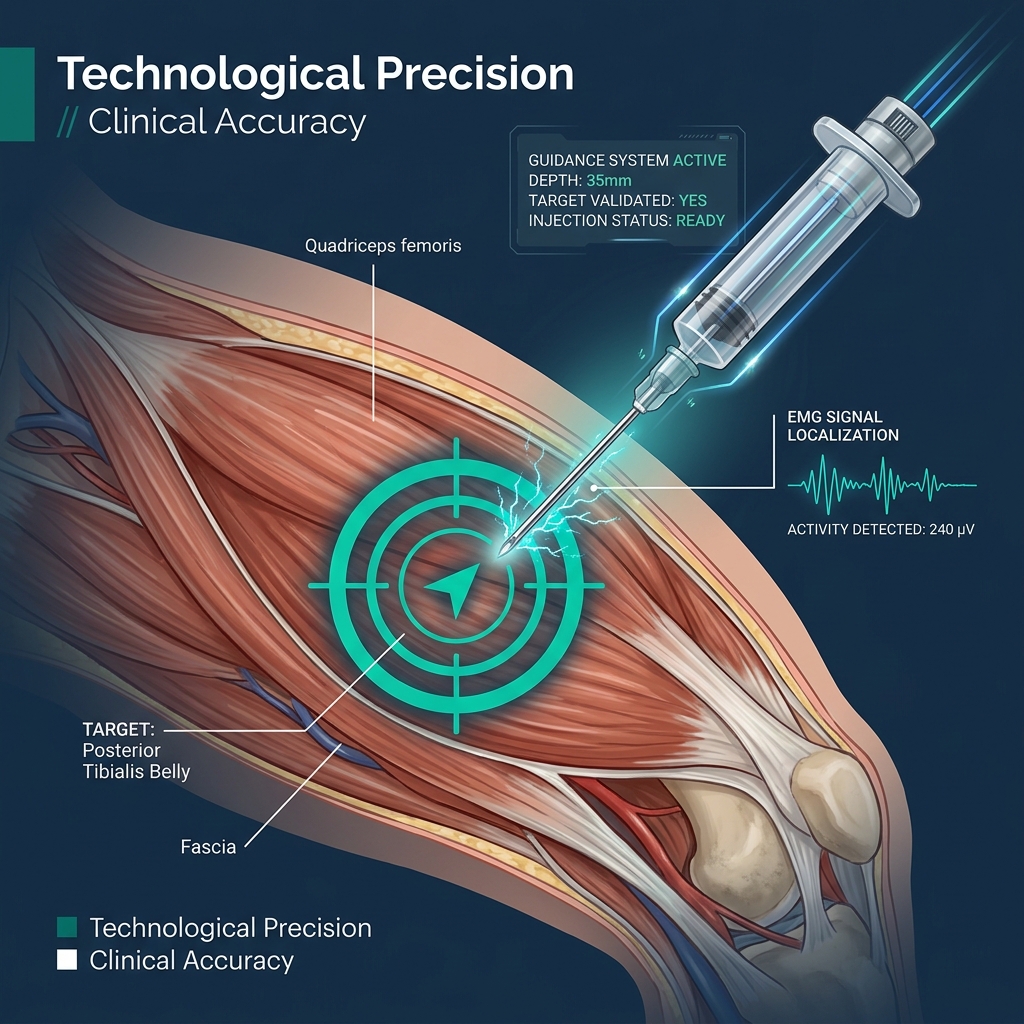
- — Electromyography (EMG) guidance allows the physician to 'hear' the muscle activity, ensuring the Botox is delivered to the exact epicenter of the spasm.
- — Guided injections (EMG or Ultrasound) significantly increase the accuracy and effectiveness of Botox compared to 'blind' or touch-based injections.
- — Precision targeting reduces the risk of 'collateral' weakness in neighboring healthy muscles, preserving more functional strength.
- — Physical therapy is most effective during the 12-week 'window' of relaxation provided by the guided Botox session.
- — For patients in Northern Luzon, accessing EMG-guided protocols locally eliminates the need for expensive and stressful travel to Metro Manila.
- — Combined precision injection and specialized rehab exercises are the clinical standard for maximizing post-stroke limb function.
When we treat a clenched fist or a stiff leg after a stroke, we are dealing with a complex map of layered muscles. Some muscles are deep, some are shallow, and many have overlapping functions. In the past, physicians relied on "anatomical landmarks"—essentially guessing the location by feeling the limb.
At TeraCare, we believe that precision botox isn't just a luxury; it's a clinical requirement. By using EMG-guided botox injection protocols, we take the guesswork out of spasticity management. We don't just look at the limb; we "listen" to the muscle's electrical activity to ensure we are targeting the exact driver of your stiffness.
What is an EMG-guided Botox injection and why is it used?
An EMG-guided botox injection uses a specialized needle that acts as a microphone to detect electrical activity in overactive muscles. This allows the physician to identify the exact 'epicenter' of a spasm before injecting. This precision ensures the medication is delivered where it's most effective, improves clinical outcomes, and minimizes unnecessary weakness in neighboring healthy muscles.
The Clinical Gap: Blind vs. Guided Injections
Research has shown that "blind" injections (based only on touch) can miss the target muscle up to 50% of the time, especially when targeting deep muscles like the flexor digitorum profundus (the muscle that clenches the fingers).
When an injection misses its mark:
- Wasted Medication: The expensive Botox doesn't reach the target, leading to poor relief.
- Collateral Weakness: The medication may spread to a nearby muscle that you actually need for movement, making you weaker without solving the stiffness.
- Slower Recovery: You lose a 3-month window of time waiting for the next treatment cycle.
By utilizing Neurology rehab doctor Northern Luzon expertise with EMG and Ultrasound, we bridge this gap, ensuring that every session moves you closer to your functional goals.
The 'Botox + PT' Synergy
Botox is a powerful tool, but it doesn't "re-teach" your brain how to move. That is the role of Spasticity physical therapy.
Think of Botox as the "grease" for a rusted hinge. The grease makes the hinge move, but you still need someone to work the door back and forth to restore smooth operation.
Our spasticity rehabilitation exercises are specifically designed to capitalize on the 12-week window of relaxation. During this time, we focus on:
- Lengthening: Stretching the relaxed muscle to prevent permanent shortening (contracture).
- Strengthening: Activating the "opposing" muscles that have been too weak to move against the stiffness.
- Functional Tasks: Re-learning how to hold a spoon, use a walker, or perform self-care tasks.
Guidance Technologies: EMG vs. Ultrasound
How we ensure 100% accuracy in every injection.
EMG (Electromyography)
- 🔊 Acoustic Feedback: We 'hear' the muscle spasm.
- ⚡ Activity Check: Confirms the muscle is alive and overactive.
- 🎯 Epicenter Hunt: Finds the absolute loudest point of tension.
Ultrasound Guidance
- 👁️ Visual Confirmation: We 'see' the needle and the muscle.
- 🛡️ Safety First: Allows us to avoid blood vessels and nerves.
- 📏 Depth Control: Ensures medication is at the correct tissue layer.
The Physiatrist's Role in Spasticity Management
As a Physiatrist (Physical Medicine & Rehabilitation specialist), I don't just look at the injection; I look at the whole person. Neurology rehab doctor Northern Luzon care involves coordinating your medications, your therapy, and your orthotics (braces).
In Vigan, we provide a centralized hub for this care. You don't have to navigate different doctors for your injections and your therapy. We manage the entire roadmap, ensuring that your spasticity physical therapy is perfectly synced with your Botox cycles.
Beyond Movement: Preventing Bone Deformity
Persistent, unguided spasticity is more than just a movement problem. Over years, the constant 'pull' of tight muscles can actually deform bones and pull joints out of their sockets (subluxation).
By using precision botox early and accurately, we protect the structural integrity of your body. This is especially critical for children with Cerebral Palsy or younger stroke survivors who have decades of life ahead of them.
World-Class Precision in Vigan City
One of the biggest hurdles for patients in Ilocos Sur and Abra has been access. Historically, EMG-guided injections were only available in major centers in Metro Manila.
At TeraCare, we've removed that barrier. We've invested in the technology and specialized training to provide the global clinical standard for EMG guided botox injection right here in Vigan.
We offer:
- In-House EMG Guidance: Real-time signal localization for every injection.
- Integrated Therapy: Immediate coordination with specialized therapists.
- Long-term Tracking: We use standardized scales (like the Modified Ashworth Scale) to prove your progress over time.
Demand Precision for Your Recovery
Don't settle for 'blind' injections. Schedule an evaluation to see how EMG-guided precision can unlock your functional potential.
Disclaimer: This page is for educational purposes and does not replace an individualized medical assessment. EMG-guided procedures are medical interventions that should only be performed by board-certified specialists in a clinical setting.
References & Clinical Evidence
- [1] Wissel, J., et al. (2020). Early Intervention with Botulinum Toxin in Post-Stroke Spasticity: A Systematic Review. Toxins.
- [2] Walker, H. W., et al. (2021). The role of ultrasound and electromyography in botulinum toxin injections for spasticity. Frontiers in Neurology.
- [3] Gracies, J. M., et al. (2020). Randomized Controlled Trial of AbobotulinumtoxinA in Upper Limb Spasticity: The IMPACT Study. Stroke.
- [4] Santamato, A., et al. (2022). Ultrasound-Guided vs. Anatomical Landmark-Guided Botulinum Toxin Injections in Post-Stroke Spasticity: A Systematic Review and Meta-Analysis. Journal of Personalized Medicine.
- [5] Pundik, S., et al. (2021). Precision Medicine in Stroke Rehabilitation: Future Directions. Neurorehabilitation and Neural Repair.
* Clinical references are provided to support the medical claims made in this article. TeraCare adheres to evidence-based practices in physical medicine and rehabilitation.

Dr. Ben Rabara
Dr. Ben Rabara is a Board-Certified Physiatrist specializing in Physical Medicine and Rehabilitation. He focuses on non-surgical, precision treatments for musculoskeletal conditions, utilizing advanced diagnostics like MSK Ultrasound.
Medical Disclaimer: The information provided in this article is for educational purposes only and does not substitute for professional medical advice, diagnosis, or treatment. Always consult a qualified physician for your specific health conditions.