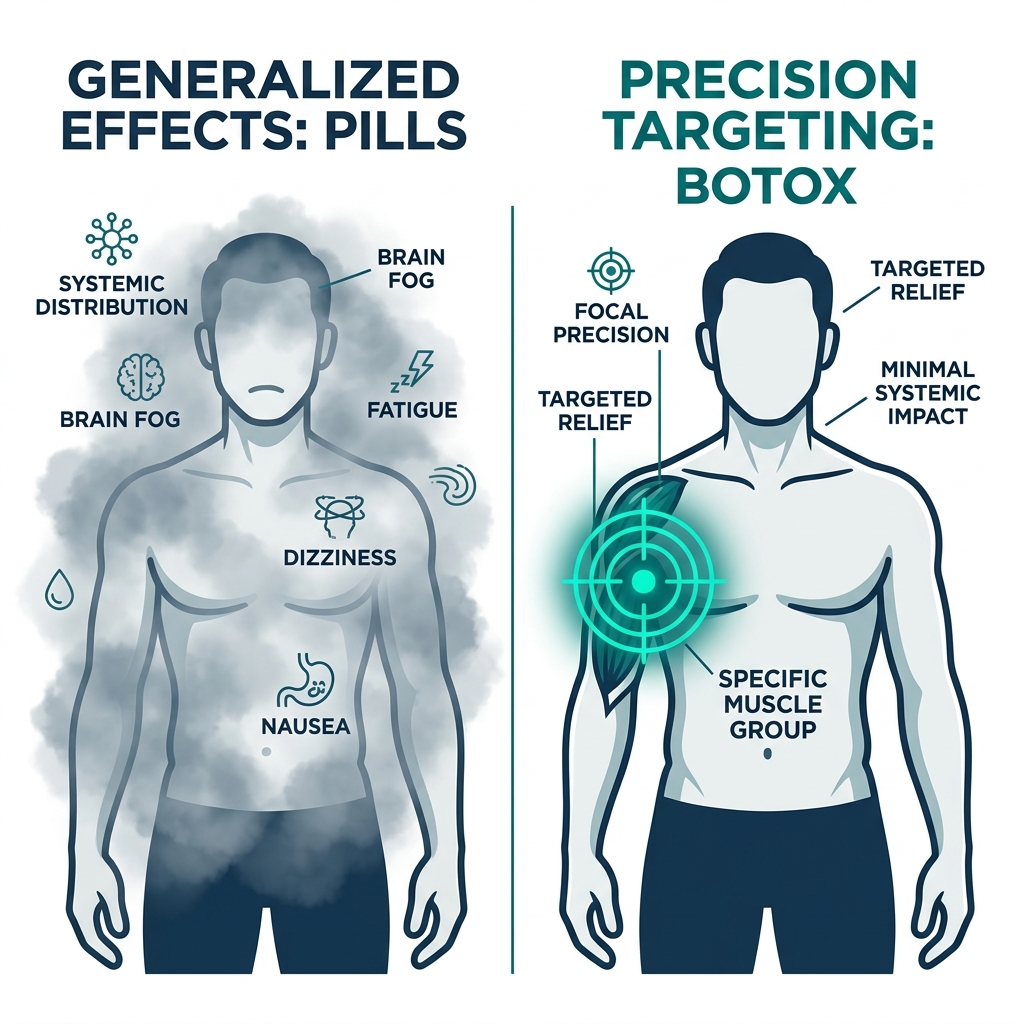
- — Oral muscle relaxants are systemic, meaning they travel through the entire bloodstream and affect the brain, causing 'zombie' side effects.
- — Medical Botox is focal and targeted, acting only on the specific muscle group injected without causing generalized weakness.
- — Common side effects of pills like Baclofen include severe drowsiness, dizziness, and cognitive impairment (brain fog).
- — Botox injections are typically performed every 12 weeks, eliminating the need for daily dosing and the 'rollercoaster' effect of oral medications.
- — For patients with localized spasticity (like a clenched fist), Botox is clinically superior because it preserves the strength of non-affected muscles.
If you are recovering from a stroke, spinal cord injury, or living with Multiple Sclerosis, you are likely familiar with the struggle of muscle spasms. For years, the standard answer has been a prescription for oral muscle relaxants like Baclofen, Tizanidine, or Diazepam.
While these pills can reduce stiffness, they often come at a heavy price. Many of my patients in Vigan describe a "zombie-like" state—a combination of profound drowsiness, dizziness, and a mental cloudiness that makes it impossible to work, drive, or even hold a conversation. This is the "Systemic Tax" of oral medication.
Medical Botox offers a different path. It is a focal intervention that provides muscle spasm relief without the systemic baggage. In this guide, we will break down the clinical differences and help you decide if it's time to clear the fog.
What is the main difference between Medical Botox and oral muscle relaxants?
The primary difference is delivery and impact. Oral muscle relaxants are systemic, affecting the entire body and the brain, which often leads to drowsiness and 'brain fog.' Medical Botox is focal; it is injected directly into the overactive muscle, providing targeted relief exactly where needed without causing generalized weakness or cognitive side effects.
The 'Zombie' Effect: Why Pills Affect Your Brain
To understand muscle relaxants side effects, you have to follow the path of the pill. When you swallow a tablet, it doesn't know you have a stiff right arm. It goes to your stomach, enters your bloodstream, and travels everywhere—including your brain and your "good" muscles.
Because these drugs work by slowing down the central nervous system, they cause:
- Cognitive Impairment: Difficulty concentrating or "feeling slow."
- Generalized Weakness: Making your healthy legs feel heavy, which significantly increases the risk of falls.
- Sedation: Many patients find themselves napping for hours, missing the critical windows for physical therapy.
Medical Botox: The Spotlight Approach
In contrast, Botox uses a localized mechanism. When I perform a precision injection at TeraCare, the medication stays within a few centimeters of the injection site.
It works by blocking the specific chemical signal (acetylcholine) at the "neuromuscular junction"—the point where the nerve meets the muscle. It never enters your central nervous system.
"Botox is like a surgical strike for your muscles. You can relax a clenched fist while keeping the patient's mind sharp and their other limbs strong for walking." — Dr. Ben Rabara
Quick Comparison: Focal vs. Systemic
Evaluating your options for spasticity management.
Oral Muscle Relaxants
- ❌ Affects the entire body and brain
- ❌ Causes drowsiness and 'brain fog'
- ❌ Must be taken multiple times a day
- ❌ Increases risk of falls and imbalance
Medical Botox Injections
- ✅ Targeted only to specific stiff muscles
- ✅ Zero effect on mental clarity
- ✅ One treatment lasts 3–4 months
- ✅ Safe for non-affected muscles
When is Botox the Right Choice?
Understanding muscle spasms causes is key to choosing the right treatment. If you have "generalized" spasticity—meaning your whole body is stiff—oral medications might be necessary.
However, most stroke and neuro patients have focal spasticity. This means the problem is limited to specific areas, such as:
- A Clenched Fist that prevents hand hygiene.
- A Stiff Elbow that makes dressing difficult.
- A Pointing Foot (Equinovarus) that causes tripping and falls.
In these cases, Botox vs muscle relaxers isn't even a contest. Botox provides the relief where you need it without the side effects you don't.
The 'Rehab Multiplier' Effect
The biggest tragedy of "zombie" medications is that they prevent patients from doing the one thing that leads to long-term recovery: Physical Therapy.
If you are too sleepy to participate in your PT session, your brain cannot relearn how to move. By switching to Medical Botox Philippines protocols, we remove the "sedation barrier." Patients are alert, motivated, and physically capable of doing the hard work of neuro-rehab, which leads to much faster functional gains.
Cost, Convenience, and the 'Rollercoaster'
Oral medications create a "rollercoaster" effect. You take the pill, you feel sleepy for 4 hours, the pill wears off, the stiffness returns, and you repeat the cycle.
Medical Botox provides a stable window of relief. One precision session at our Vigan clinic provides a consistent level of muscle relaxation for about 12 weeks. No daily pill-tracking, no mid-day crashes, and no rebound stiffness between doses.
Next Steps: Clearing the Fog
If you are currently taking oral muscle relaxants and feeling the weight of the side effects, it's time for a clinical reassessment.
During a Physiatric Evaluation at TeraCare, we will:
- Audit your current medication list and side effect profile.
- Map your specific focal muscle triggers.
- Determine if we can use Botox to "offload" your oral medications, reducing your dose and clearing your mental fog.
- Create a transition plan that prioritizes your safety and your cognitive health.
Clear the Mental Fog
Stop trading your alertness for relief. Schedule an evaluation to see if targeted Medical Botox can replace or reduce your daily pills.
Disclaimer: This page is for educational purposes and does not replace an individualized medical assessment. Never stop or change your prescribed neurological medications without direct supervision from your physician.
References & Clinical Evidence
- [1] Francisco, G. E., et al. (2013). Consensus on the use of botulinum toxin in the treatment of spasticity. Physical Medicine and Rehabilitation Clinics.
- [2] Wissel, J., et al. (2015). European ad hoc consensus on the use of botulinum toxin in adult spasticity. Journal of Rehabilitation Medicine.
- [3] Gracies, J. M. (2005). Pathophysiology of spastic paresis. II: Emergence of muscle overactivity. Muscle & Nerve.
- [4] Creutzfeldt, C. J., et al. (2011). Treatment of spasticity in patients with stroke. UpToDate.
- [5] Royal College of Physicians (2018). Spasticity in adults: management using botulinum toxin. National clinical guideline.
* Clinical references are provided to support the medical claims made in this article. TeraCare adheres to evidence-based practices in physical medicine and rehabilitation.

Dr. Ben Rabara
Dr. Ben Rabara is a Board-Certified Physiatrist specializing in Physical Medicine and Rehabilitation. He focuses on non-surgical, precision treatments for musculoskeletal conditions, utilizing advanced diagnostics like MSK Ultrasound.
Medical Disclaimer: The information provided in this article is for educational purposes only and does not substitute for professional medical advice, diagnosis, or treatment. Always consult a qualified physician for your specific health conditions.