- — Botox acts as a 'chemical key' to temporarily relax stiff, post-stroke muscles, preventing permanent joint contractures.
- — Treatment for a 'clenched fist' or 'stiff leg' is most effective when integrated with intensive physical and occupational therapy.
- — Unlike oral muscle relaxants, Medical Botox is focal and targeted, avoiding the brain fog and systemic weakness of pills.
- — Clinical success depends on precision injection techniques, such as EMG or ultrasound guidance, to identify the overactive muscle epicenters.
- — Early intervention—often within the first few months after a stroke—is critical to maximizing long-term functional independence.
Following a stroke, the brain's communication lines are often severed or disrupted. One of the most distressing results of this disruption is spasticity—a condition where your muscles remain in a state of constant, involuntary contraction. In my clinical experience, patients often describe this as a "locked hand," a "clenched fist," or a "foot that won't stop pointing down."
This stiffness isn't just uncomfortable; it is a significant barrier to recovery. A clenched fist makes it impossible to wash your palm or trim your fingernails, leading to skin infections. A stiff leg makes walking dangerous and increases the risk of falls. Traditionally, families have relied solely on stretching or oral medications, but these often fail to address the root of the problem without causing severe drowsiness.
This is where Medical Botox (Botulinum Toxin Type A) changes the trajectory of stroke recovery. By acting as a targeted "chemical key," it interrupts the faulty signals from the brain, allowing the muscle to finally relax and opening a critical window for rehabilitation.
What is Post-Stroke Spasticity? (The 'Broken Traffic Light' Analogy)
Spasticity is a clinical symptom of what we call "Upper Motor Neuron Syndrome." In a healthy body, your brain sends two types of signals to your muscles: "Go" and "Stop." After a stroke, the area of the brain responsible for sending the "Stop" or "Relax" signal is often damaged.
Imagine a traffic light that is permanently stuck on green. The muscles receive a constant, never-ending command to contract. Over time, this constant tension leads to hypertonia (increased muscle tone). If left untreated, the muscles can actually shorten and scar, leading to a "fixed contracture" where the joint can no longer be moved even by force. This is why stiff muscles after stroke require more than just massage; they require a neurological intervention.
How Botox 'Unlocks' the Stroke Recovery Hand
Many patients are surprised to learn that the same Botox used for wrinkles is the gold standard for treating a clenched fist stroke. However, the mechanism is identical: Botox blocks the release of acetylcholine, the chemical messenger that tells a muscle to contract.
When I inject Botox precisely into the overactive muscles of the forearm (the flexors), the "traffic light" is effectively turned off for 3 to 4 months.
- Stage 1 (Passive Function): Within two weeks, the hand begins to open. Caregivers can now clean the palm, dress the patient without a struggle, and prevent skin breakdown.
- Stage 2 (Active Window): With the "brakes" removed, the patient can now engage in stroke recovery hand exercises. This is when the real work of neuroplasticity—teaching the brain to find new pathways for movement—actually happens.
The Importance of EMG-Guided Precision
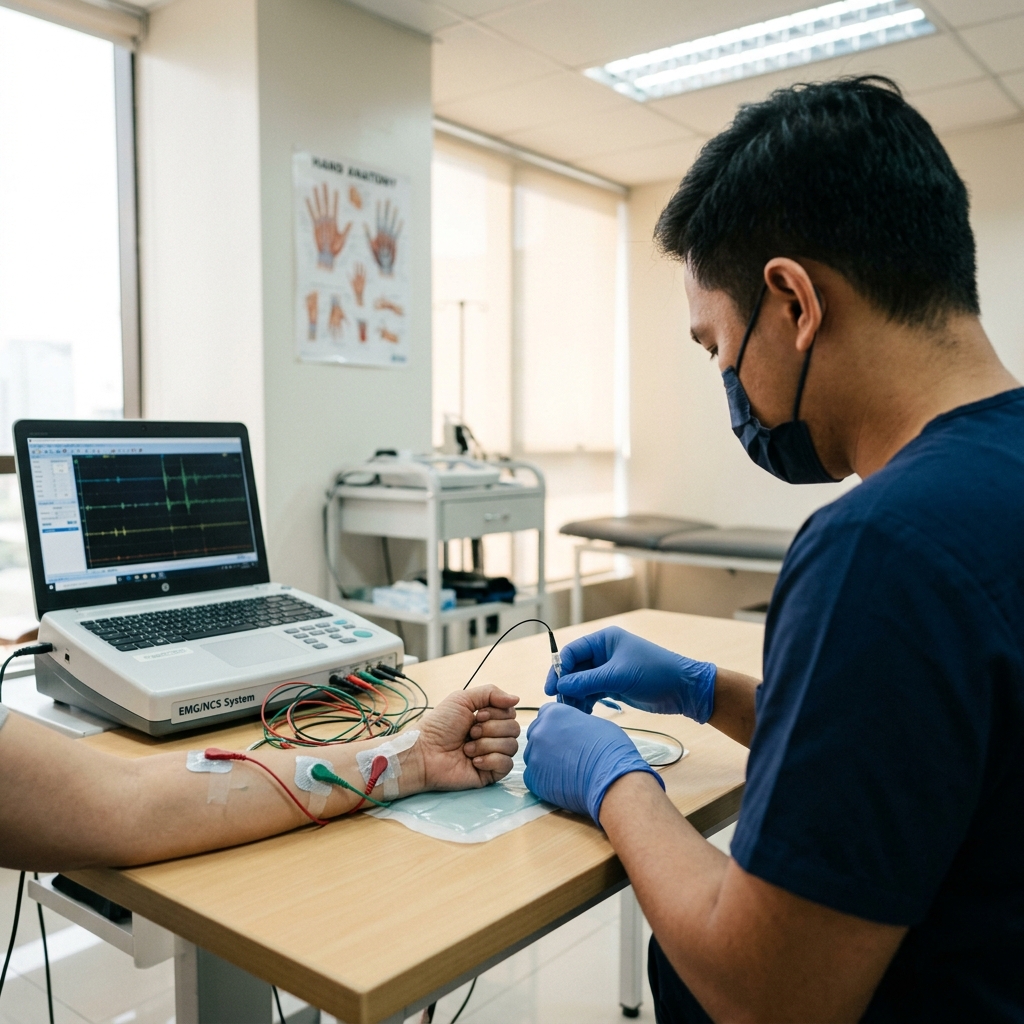
In my practice, I never inject Botox "blind" or by touch alone. When we are treating stiff muscles after stroke, the target muscles are often deep and layered beneath other tissues. Missing the target by even a few millimeters can result in injecting a muscle that doesn't need to be relaxed, leading to poor results or unnecessary weakness.
We use Electromyography (EMG) guidance. By using a specialized needle that acts as a microphone, I can "listen" to the electrical noise of the overactive muscle. When the patient tries to move or when the muscle spasms, the EMG machine produces a specific sound. This ensures that the medication is deposited exactly into the epicenter of the spasticity, maximizing the effect of every drop of medication.
Botox vs. Oral Muscle Relaxants: Why Targeted is Better
Many families are prescribed oral medications like Baclofen or Tizanidine to manage stroke spasticity treatment. While these drugs can be helpful, they have a major clinical drawback: they are systemic.
Because the pill travels through the entire bloodstream, it affects every muscle in the body and cross the blood-brain barrier. This often leads to:
- Generalized Weakness: Making the patient's "good" side weaker and increasing fall risk.
- Brain Fog: Patients often feel like "zombies," making it impossible for them to participate in active physical therapy.
Botox injection for stroke patients bypasses these issues. It works only where I put it. You can relax the hand while keeping the rest of the body—and the mind—alert and strong for rehabilitation.
The 'Golden Window' of Stroke Recovery
Understanding the timeline of your Botox treatment.
Day 1-10: Binding
The toxin is attaching to the nerve receptors. You won't see a change yet. Keep doing your baseline stretches.
Weeks 2-12: The Window
Peak muscle relaxation. This is the critical time for intensive Physical and Occupational Therapy to regain function.
Month 4+: Reassessment
The effect begins to fade. We assess your progress and decide if another session is needed to continue your gains.
Preventing Permanent Stiffness: Why Time is of the Essence
One of the biggest misconceptions in stroke recovery is that we should wait for "enough time to pass" before trying Botox. Clinically, the opposite is true.
When a muscle is stuck in a spasm for months, the muscle fibers themselves begin to change. They lose their elasticity and are replaced by fibrous scar tissue. This is called a fixed contracture. Once a contracture is fixed, Botox can no longer help because the problem is no longer neurological—it is now structural. At that point, only surgery can release the limb (Royal College of Physicians, 2018).
By using Botox early (often within 3 to 6 months post-stroke), we prevent these permanent changes, keeping the joints "supple" and ready for eventual motor recovery.
The Realities: Cost, Travel, and Expectations
I believe in absolute transparency with my patients in Vigan and across Northern Luzon. Botox for stroke patients price Philippines is a common concern because the medication itself is expensive.
However, we must weigh this against the "cost of doing nothing." A patient with severe spasticity who develops a pressure sore or pneumonia (from being unable to sit up properly) will face hospital bills exceeding ₱100,000 in a single week.
At TeraCare, we focus on:
- Local Access: You don't need to transport a fragile stroke patient to Manila. We provide world-class, EMG-guided injections right here in Vigan City.
- Financial Guidance: We provide the necessary clinical abstracts and referrals to help your family secure government assistance through the Malasakit Center or DSWD.
- Realistic Goals: Botox is not a "magic shot" that makes you walk again overnight. It is a catalyst. It clears the path so that your therapy can finally work.
Next Steps: Is Your Loved One a Candidate?
Not every stroke patient needs Botox. If the stiffness is mild or if the joints are already permanently frozen, other options like custom bracing or specialized stretching may be more appropriate.
The first step is a Physiatric Spasticity Assessment. During this visit, I will:
- Measure your muscle tone using the Modified Ashworth Scale.
- Determine if the stiffness is "dynamic" (treatable) or "fixed."
- Identify the specific muscles that are causing the most functional trouble.
- Create a combined Botox and Rehabilitation roadmap tailored to your specific goals, whether it's holding a spoon again or walking without a brace.
Schedule a Spasticity Assessment
Let's determine if Medical Botox is the key to unlocking your recovery. Visit us in Vigan City for a specialized evaluation.
Social Media Derivatives
Video Hooks: "Is your hand stuck in a fist after a stroke? Here's why stretching isn't enough.", "Stop treating stroke stiffness with just pills. Learn about the 'chemical key'.", "The secret to unlocking paralyzed limbs isn't magic—it's precision medicine.", "Don't wait for your joints to freeze. Why early Botox is a stroke recovery game-changer.", "EMG-Guided vs. Blind injections: Why where you poke matters for your recovery."
Myth Buster: "Myth: Botox is only for wrinkles. Fact: It's the gold-standard medical treatment for post-stroke locked limbs.", "Myth: Botox makes you weak. Fact: It relaxes overactive muscles so your healthy ones can finally move.", "Myth: You have to go to Manila for expert neuro-rehab. Fact: TeraCare Vigan provides EMG-guided precision care right here."
References & Clinical Evidence
- [1] Royal College of Physicians (2018). Spasticity in adults: management using botulinum toxin. National clinical guideline.
- [2] Wissel, J., et al. (2020). Early Intervention with Botulinum Toxin in Post-Stroke Spasticity: A Systematic Review. Toxins.
- [3] Simpson, D. M., et al. (2016). Practice guideline update summary: Botulinum neurotoxin for the treatment of spasticity. Neurology. (Reaffirmed 2019).
- [4] Gracies, J. M., et al. (2019). Guided Selection of Muscles for Botulinum Toxin Injection in Spastic Upper Limb. Frontiers in Neurology.
- [5] International Society of Physical and Rehabilitation Medicine (ISPRM). Core Curriculum for Post-Stroke Spasticity Management 2024.
* Clinical references are provided to support the medical claims made in this article. TeraCare adheres to evidence-based practices in physical medicine and rehabilitation.

Dr. Ben Rabara
Dr. Ben Rabara is a Board-Certified Physiatrist specializing in Physical Medicine and Rehabilitation. He focuses on non-surgical, precision treatments for musculoskeletal conditions, utilizing advanced diagnostics like MSK Ultrasound.
Medical Disclaimer: The information provided in this article is for educational purposes only and does not substitute for professional medical advice, diagnosis, or treatment. Always consult a qualified physician for your specific health conditions.