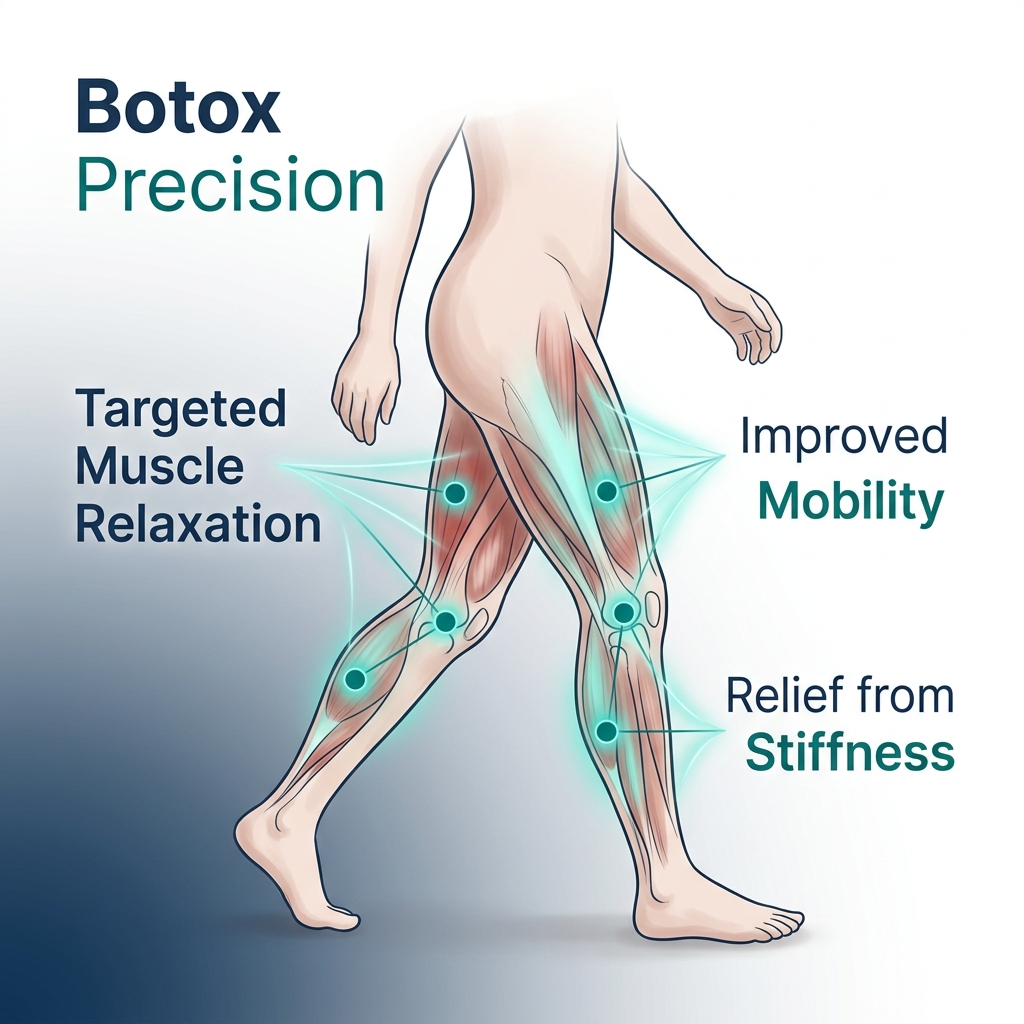
- — Medical Botox is a frontline treatment for pediatric spasticity in Cerebral Palsy, helping to improve walking patterns and prevent bone deformities.
- — In adults with Cervical Dystonia, Botox provides significant relief from involuntary neck twisting and chronic muscular pain.
- — Treatment targets 'dynamic' spasticity—stiffness that is still treatable before it becomes a fixed joint contracture.
- — Botox is highly effective for Multiple Sclerosis (MS) patients struggling with localized, painful limb spasms that don't respond to oral medications.
- — When combined with specialized pediatric or neurological physical therapy, Botox acts as a 'chemical key' to unlock a child's potential for mobility.
In the world of neurological rehabilitation, spasticity is one of the most complex challenges we face. Whether it is the 'scissoring' legs of a child with Cerebral Palsy, the painful neck twisting of Cervical Dystonia, or the sudden, violent limb spasms of Multiple Sclerosis (MS), the root problem is the same: the brain is sending too much 'noise' to the muscles.
As a Physiatrist, my goal is to filter that noise. For families in Vigan City and across Northern Luzon, Medical Botox has become a vital clinical tool. It allows us to selectively 'quiet' the overactive muscles without affecting the rest of the body, creating a window of opportunity for functional improvement that simply wasn't possible with older treatments.
How does Botox work as a spasticity treatment for CP, Dystonia, and MS?
Botox acts as a spasticity treatment by selectively blocking the chemical signals that cause involuntary muscle contractions. In Cerebral Palsy, it relaxes stiff limbs to improve walking; in Dystonia, it stops painful muscle twisting; and in MS, it quietens localized spasms. This precision allows patients to move more naturally and prevents long-term joint deformities.
Botox for Cerebral Palsy: A Growing Child's Ally
For parents, seeing their child struggle with cerebral palsy symptoms can be heart-wrenching. One of the most common issues is 'spastic diplegia,' where the muscles of the legs are so tight that the child walks on their toes or with their knees crossed (scissoring).
Cerebral palsy botox injection is not about 'fixing' the brain; it's about protecting the child's future. By relaxing these tight muscles:
- Better Gait: We can help the child's heels touch the ground, creating a more stable and efficient walking pattern.
- Bone Protection: Persistent spasticity can pull bones out of alignment as a child grows. Botox helps ensure that the hips and knees develop more normally.
- Ease of Care: Reducing stiffness makes it easier for parents to perform daily hygiene and for the child to use their braces (AFOs).
Cervical Dystonia: Ending the 'Neck Prison'
Dystonia symptoms often involve the neck (cervical dystonia), where the head is pulled involuntarily to one side, forward, or backward. This is not just a cosmetic issue; the constant muscular strain causes debilitating chronic pain and significant social anxiety.
Botox for spasticity and dystonia is highly effective here. By injecting the medication into the specific 'guilty' muscles—often identified using EMG guidance—we can restore a more neutral head position. Most patients experience a significant reduction in pain and a return to social and professional activities that they had previously abandoned.
Clinical Impact: Who Benefits Most?
How Medical Botox addresses different neurological challenges.
Cerebral Palsy
Focus: Improving walking, preventing hip dislocation, and easing the use of braces.
Cervical Dystonia
Focus: Correcting head position, reducing neck pain, and stopping involuntary tremors.
Multiple Sclerosis
Focus: Eliminating painful limb 'jumps' and allowing for better sleep and PT participation.
Multiple Sclerosis: Targeting the 'Painful Jumps'
Patients with Multiple Sclerosis often experience 'spasticity-related pain.' These are sudden, sharp contractions of the legs or arms that can occur at any time, often waking the patient from a deep sleep.
While oral muscle relaxants can help, the doses required to stop these multiple sclerosis spasms often cause so much fatigue that the patient cannot participate in their physical therapy. Botox provides a 'middle ground.' We can target the specific muscle group that is spasming (like the hamstrings or calves) while leaving the rest of the body's strength and the patient's mental clarity intact.
The Precision Advantage: EMG & Ultrasound
When treating spasticity symptoms in children or complex neuro patients, accuracy is everything. We aren't just injecting a general area; we are looking for the 'motor points' where the nerve meets the muscle.
At TeraCare, we utilize EMG (Electromyography) and Ultrasound guidance for our neuro-injections. This allows us to:
- See the Muscle: Ultrasound lets us avoid blood vessels and nerves.
- Hear the Activity: EMG lets us confirm we are in the most 'active' part of the spasm.
- Minimize Dose: By being precise, we can often use less medication to achieve the same clinical result, which is safer and more cost-effective for the family.
The 'Botox + Rehab' Roadmap
I always emphasize to my patients and their families: Botox is the key, but Physical Therapy is the door.
Injecting Botox without a follow-up rehabilitation plan is a missed opportunity. The Botox relaxes the muscle, but the therapist teaches the body how to use that new-found range of motion. For our CP patients, this might mean intensive gait training. For our Dystonia patients, it means postural retraining. We work closely with local therapists to ensure that the 'Window of Opportunity' provided by the Botox is never wasted.
Expert Neuro-Care in Vigan City
Families in Northern Luzon no longer need to endure the long, stressful journey to Manila for specialized spasticity treatment. We provide a world-class clinical environment right here in Ilocos Sur.
Our protocol for CP and Neuro-patients includes:
- Empathetic Consultation: We take the time to understand the functional goals of the patient and the family.
- Clinical Abstracts: We provide the necessary documentation for PCSO, DSWD, and PhilHealth assistance.
- Integrated Tracking: We monitor progress over months to ensure that each session builds upon the last.
Unlock Your Potential
Whether it is your child's first steps or your return to pain-free work, let's explore if Medical Botox is the right path. Schedule a neuro-evaluation today.
Disclaimer: This page is for educational purposes and does not replace an individualized medical assessment. Pediatric and neurological Botox procedures should only be performed by a qualified specialist in a controlled clinical setting.
References & Clinical Evidence
- [1] Graham, H. K., et al. (2000). Botulinum toxin A in management of spasticity in cerebral palsy. The Lancet.
- [2] Albanese, A., et al. (2013). Evidence-based review of botulinum toxin for the treatment of cervical dystonia. Movement Disorders Journal.
- [3] Heinen, F., et al. (2010). The European consensus table 2006 on botulinum toxin for children with cerebral palsy. European Journal of Paediatric Neurology.
- [4] Dressler, D. (2014). Clinical applications of botulinum toxin. Current Opinion in Neurology.
- [5] Novak, I., et al. (2013). A systematic review of interventions for children with cerebral palsy: state of the evidence. Developmental Medicine & Child Neurology.
* Clinical references are provided to support the medical claims made in this article. TeraCare adheres to evidence-based practices in physical medicine and rehabilitation.

Dr. Ben Rabara
Dr. Ben Rabara is a Board-Certified Physiatrist specializing in Physical Medicine and Rehabilitation. He focuses on non-surgical, precision treatments for musculoskeletal conditions, utilizing advanced diagnostics like MSK Ultrasound.
Medical Disclaimer: The information provided in this article is for educational purposes only and does not substitute for professional medical advice, diagnosis, or treatment. Always consult a qualified physician for your specific health conditions.