Greasing the Rusty Hinge
A healthy knee joint is surrounded by a thick, slippery liquid called synovial fluid. This fluid acts exactly like motor oil in a car engine, preventing the cartilage and bones from grinding together when you walk or climb stairs. However, if you have Knee Osteoarthritis, this fluid dries up and becomes watery. Without that essential 'oil,' your joint becomes a rusty hinge. The cartilage wears away, leading to agonizing 'bone-on-bone' friction, severe stiffness in the morning, and the inability to walk long distances.
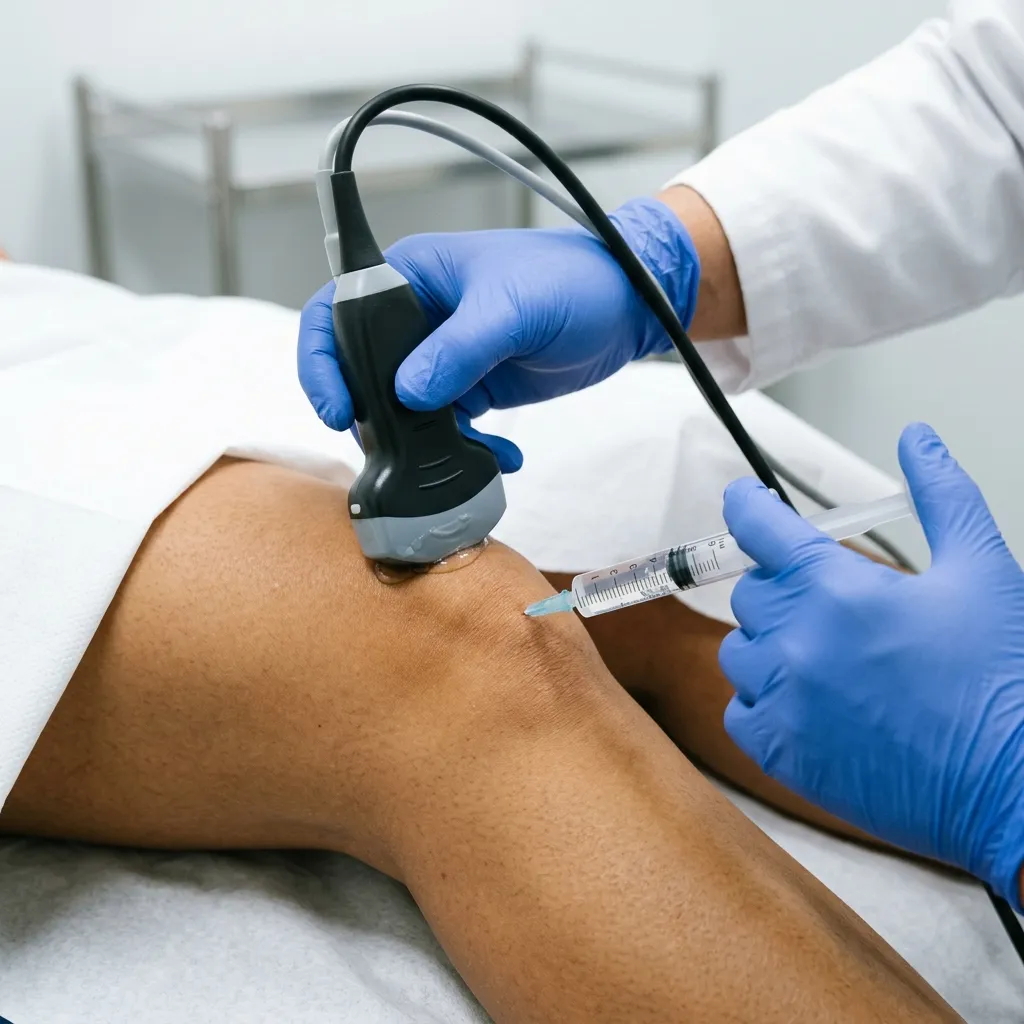
Popping daily pain pills (NSAIDs) only hides the pain; it does nothing to fix the dry, grinding joint. Viscosupplementation is the mechanical solution. Dr. Rabara injects a premium, highly concentrated Hyaluronic Acid (gel) directly into the joint capsule. This thick gel instantly replenishes your body's natural 'motor oil.' It coats the damaged cartilage, restores the shock-absorbing cushion, and allows the knee to glide smoothly again, frequently delaying the need for a total knee replacement for years.
Joint Conditions Treated with Gel Injections
Is Hyaluronic Acid Right For You?
Ideal indications
You have chronic knee OA with daily stiffness, grinding, or popping.
You have tried steroids, but the pain returned too quickly.
Your stomach cannot tolerate daily NSAIDs due to ulcers or kidney issues.
You want to delay knee replacement surgery as long as possible.
Clinical precautions
You have an active, hot, red skin infection over the knee.
You have severe avian (bird/egg) allergies (non-avian options available).
Viscosupplementation Realities
Understanding the recovery and potential reactions to joint gel injections.
Pseudoseptic Gel Flare
A small percentage (1-3%) of patients experience a severe, sterile inflammatory response causing rapid swelling and severe pain 24-48 hours post-injection.
Delayed Lubrication Effect
The hyaluronic acid takes several weeks to fully integrate into the cartilage matrix; immediate pain relief is rare.
Joint Fullness
Introducing a thick, high-viscosity gel temporarily increases joint pressure, often causing a sensation of tightness or fullness for the first few days.
Steroids vs. Gel: Which Do You Need?
Corticosteroids (Steroids)
Powerful anti-inflammatory that stops acute swelling and pain rapidly.
Hyaluronic Acid (Gel)
Thick gel that physically cushions the joint and protects remaining cartilage.
Replacement (Surgery)
Highly invasive overhaul of bone and metal hardware.
What to Expect After Your Gel Injection
The Rest Phase
Your knee will feel full and tight. Avoid heavy lifting or vigorous exercise for 48 hours to allow the gel to settle.
The Lubrication Phase
The gel coats the joint. You will notice a decrease in grinding and stiffness when using stairs.
Maximum Protection
Provides 6-12 months of relief. Pairing this with Physical Therapy extends the life of the injection even further.
Clinical Science & Technical Details
For our medical colleagues and highly analytical patients, we provide these transparent technical details on the pathophysiology and interventional protocols.
Explore the Clinical Science: Rheological Properties & Viscoelasticity (G' vs. G'') of Hyaluronic Acid
The pathophysiology of Knee Osteoarthritis (OA) involves both the mechanical degradation of articular cartilage and the severe depletion of endogenous Hyaluronic Acid (HA) within the synovial fluid. In a healthy knee joint, HA molecules provide critical elastoviscous properties: acting as a viscous lubricant under low shear forces (characterized by the viscous modulus, G''), and transforming into an elastic shock absorber under high shear forces (characterized by the elastic modulus, G').
Viscosupplementation introduces high-molecular-weight, chemically cross-linked HA directly into the joint. This restores mechanical viscoelasticity, physical cartilage coating, and triggers an analgesic effect by covering irritated nociceptor nerve endings. Additionally, it helps downregulate inflammatory cytokines and stimulates the joint lining to restart endogenous HA production over time.
Detailed Diagnostic Pathways & Kellgren-Lawrence Grading
Dr. Rabara utilizes the Kellgren-Lawrence (KL) grading system to stage OA via X-rays. High efficacy is observed in KL Grade 2 and 3. While KL Grade 4 ("bone-on-bone") still benefits from palliative pain relief, HA injections serve as a vital "bridge therapy" for these severe cases to delay surgery.
The Synovial Environment: Managing Effusion & Inflammation
Ensuring the joint environment is primed is critical. Dr. Rabara screens via Ultrasound. If severe effusion ("water on the knee") exists, the inflammatory fluid will degrade the gel. In these cases, Dr. Rabara performs a two-step intervention: aspiration and steroids first, followed by HA gel once the inflammation subsides.
Inside the Procedure: Sonographic Accuracy Rates vs. Blind Palpation
"Blind" injections have an accuracy rate of 65-80%. Missing the capsule means the expensive gel is wasted in fat tissue. At our Vigan clinic, Dr. Rabara utilizes live High-Frequency Ultrasound to guarantee 100% intra-articular delivery, ensuring maximum return on your medical investment.
Molecular Degradation: The Sorbitol Shield and Repeat Intervention Timelines
While the injected gel is metabolized over several months, modern formulations have advanced to resist degradation. For example, premium HA gels containing Sorbitol (such as Synolis VA) utilize this powerful antioxidant to act as a free-radical scavenger, shielding the hyaluronic acid molecules from premature enzymatic and oxidative breakdown. HA injections can be safely repeated every 6-12 months to defer knee replacement surgery indefinitely.
Don't Waste Expensive Medicine: The Ultrasound Advantage
The MSK Ultrasound Diagnosis
Dr. Rabara uses live Diagnostic Ultrasound to look inside your knee first, ensuring the joint capsule is accurately identified before the injection.
Precision Image-Guided Injection
While watching the ultrasound screen in real-time, Dr. Rabara guides the needle precisely into the joint space, ensuring 100% medication delivery.
Joint Mobilization & Protection
Immediately after, we gently move the knee to evenly distribute the gel throughout the joint capsule, allowing you to walk out the same day.
Clinical decision support
A candid view of hyaluronic acid injections
Hyaluronic acid injections are offered for knee osteoarthritis in some settings, but major guidelines do not agree that they should be used routinely. Average benefit in trials is modest and variable, and an individual response cannot be predicted with certainty. This is not a cartilage-regrowth treatment. A decision should consider symptom severity, examination and imaging, prior exercise and weight-management efforts, medication tolerance, cost, preferences, and reasonable alternatives.
Possible harms include a post-injection flare, swelling, bleeding, infection, and rare severe inflammatory reaction. Treatment should be deferred when joint or overlying skin infection is suspected. If used, the plan should define what improvement would count as meaningful and when to stop rather than scheduling indefinite repeat injections.
How this evidence is applied at TeraCare
Dr. Rabara discusses the conflicting evidence openly, checks whether the knee diagnosis and treatment history fit a trial, and links any injection to rehabilitation and a documented follow-up decision.
Medical review: Dr. Ben Rabara, Physiatrist · Evidence reviewed August 22, 2026. This information supports shared decision-making and does not replace an individual examination or emergency care.
Clinical sources: AAOS Clinical Practice Guideline: Management of Osteoarthritis of the Knee; ACR/Arthritis Foundation Guideline for Osteoarthritis Management.
How this treatment fits your care plan
MSK, Joint & Tendon Care
Diagnosis, symptom control, tissue repair, and return to movement for joint, muscle, and tendon problems.
Your exact sequence depends on the diagnosis, safety screening, and response to treatment. A physiatrist will recommend only the steps that fit your case.
Where this treatment is available
Availability is generated from each active branch’s service record.
Common Questions
Will the gel injection hurt?
Is this a single shot, or do I need a series of injections?
Is Viscosupplementation covered by PhilHealth or my HMO?
Can I walk out of the clinic after the injection?
Can I get a gel injection in other joints besides my knee?
I've already had a steroid shot. Can I still get the gel?
References & Clinical Evidence
- [1] Bannuru, R. R., et al. (2019). OARSI guidelines for the non-surgical management of knee osteoarthritis. Osteoarthritis and Cartilage, 27(11), 1578-1589.
- [2] Altman, R. D., et al. (2015). Efficacy and safety of a single intra-articular injection of non-cross-linked hyaluronic acid... Seminars in Arthritis and Rheumatism, 45(2), 133-139.
- [3] Legré-Boyer, V. (2015). Viscosupplementation: techniques, indications, results. Orthopaedics & Traumatology: Surgery & Research, 101(1), S101-S108.
* Clinical references are provided to support the medical claims made in this article. TeraCare adheres to evidence-based practices in physical medicine and rehabilitation.

Dr. Ben Rabara
Dr. Ben Rabara is a Physiatrist in Vigan City specializing in Physical Medicine and Rehabilitation. He focuses on non-surgical, precision treatments for musculoskeletal conditions, utilizing advanced diagnostics like MSK Ultrasound.
Medical Disclaimer: The information provided in this article is for educational purposes only and does not substitute for professional medical advice, diagnosis, or treatment. Always consult a qualified physician for your specific health conditions.
Comprehensive Knee Lubrication & Gel Guides
Expert-led clinical resources for non-surgical knee osteoarthritis management.