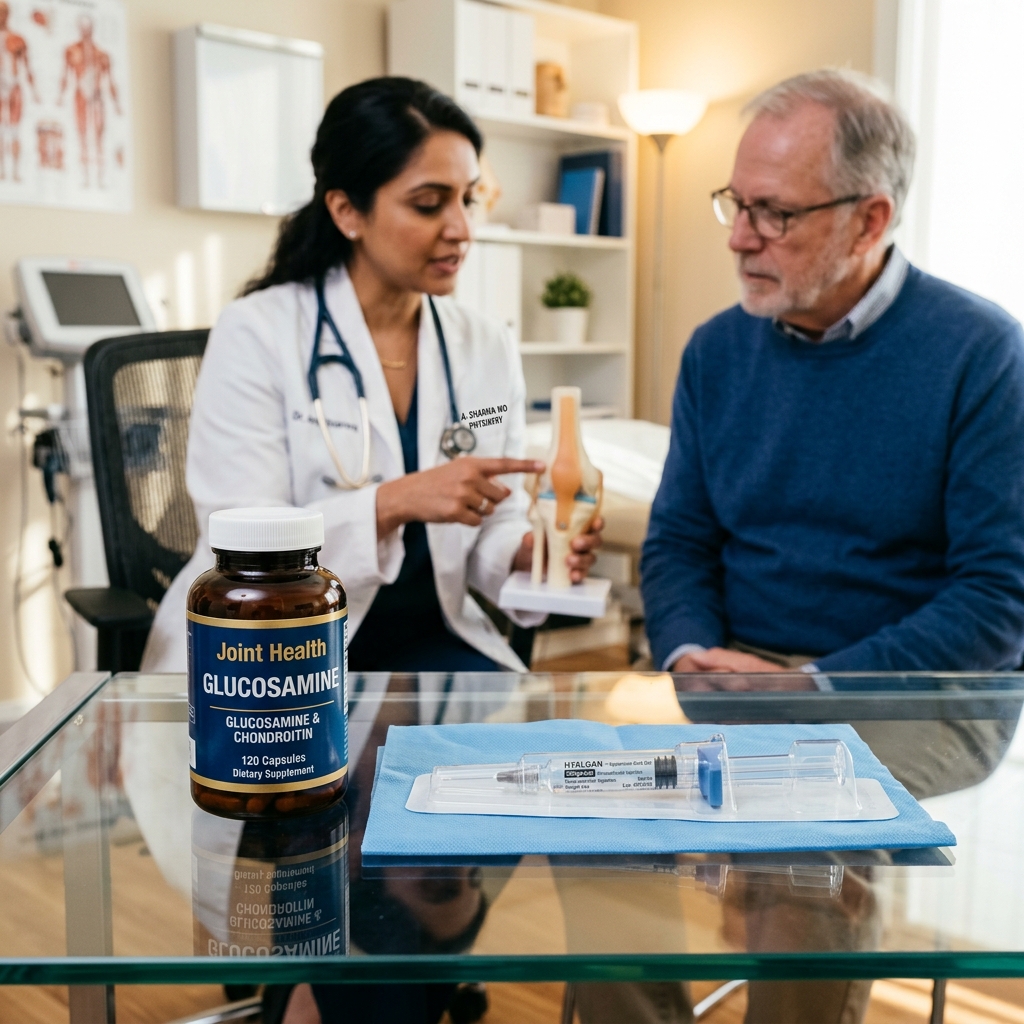
- — Oral joint supplements like glucosamine and chondroitin are largely broken down during digestion, meaning only a microscopic fraction ever reaches the knee joint.
- — Adult knee cartilage is avascular, meaning it has no direct blood supply to transport nutrients or pills to the areas of active bone-on-bone friction.
- — Viscosupplementation bypasses the digestive tract completely, injecting thick, cushioning Hyaluronic Acid gel directly into the joint capsule.
- — Taking daily joint vitamins often functions as an expensive delaying tactic, allowing osteoarthritis to worsen while delaying effective mechanical treatment.
- — At TeraCare, we combine ultrasound-guided gel injections with targeted rehabilitation to lubricate the joint and strengthen the supporting muscles.
Every week in my clinic, I meet patients who are taking a handful of expensive daily pills in the hope of saving their joints. They have bought into the heavy marketing surrounding glucosamine, chondroitin, and collagen supplements, believing these products will naturally regrow their worn knee cartilage. Many have spent thousands of pesos over several years, only to find their knees are clicking, grinding, and hurting just as much as before.
In this guide, we will explore the hard scientific truth about the best vitamins for knee joints, explain the physiological reasons why oral supplements struggle to reach your knee cartilage, and contrast these limitations with the direct structural benefits of ultrasound-guided viscosupplementation.
Do oral supplements actually build knee cartilage?
Oral joint supplements such as glucosamine, chondroitin, and hydrolyzed collagen cannot rebuild or regrow worn knee cartilage in patients with active osteoarthritis. While these molecules serve as structural building blocks in healthy cartilage, the digestive system breaks them down into basic amino acids and sugars before they ever reach your bloodstream.
When you swallow a glucosamine pill, your stomach acids and digestive enzymes instantly begin to disassemble it. By the time it passes through your liver, the complex compound has been completely dismantled. The body treats it like any other digested nutrient, distributing it systemically.
Hoping an oral pill will travel through your entire digestive tract, enter your bloodstream, and selectively reassemble itself into smooth knee cartilage is the biological equivalent of eating a leather jacket in the hope of fixing a tear in your leather shoes. The physiological pathway simply does not work that way.
The anatomical barrier: Why pills struggle to reach the joint
The primary reason oral vitamins fail to repair grinding knees is the unique avascular anatomy of adult articular cartilage, which lacks blood vessels to transport digested nutrients directly to the joint space. Unlike muscles or bones, which have rich capillary networks, cartilage relies entirely on the slow diffusion of joint fluid for its survival.
Articular cartilage is a highly specialized tissue that is completely "isolated" from the body's main circulatory system. It has no nerves, no lymphatics, and crucially, no blood supply.
Because there are no blood vessels flowing through the cartilage caps on your knee bones, any minuscule amount of glucosamine that survives digestion and enters your bloodstream still cannot flow directly into the cartilage. Instead, it must slowly leak from surrounding blood vessels into the synovial fluid, and then passively diffuse into the dense cartilage matrix. Under loading conditions like walking with osteoarthritis, the rate of cartilage wear vastly outpaces this sluggish, indirect diffusion process, making cartilage regeneration via oral supplements practically impossible.
Glucosamine and chondroitin benefits: What the science really says
Extensive, high-quality clinical research, including large-scale randomized controlled trials, has consistently shown that oral glucosamine and chondroitin provide no meaningful structural benefits for knee osteoarthritis. Leading international medical organizations, including the American Academy of Orthopaedic Surgeons (AAOS), do not recommend these supplements for active joint pain.
The most famous scientific study on this topic was the Glucosamine/Chondroitin Arthritis Intervention Trial (GAIT), a massive multi-center study funded by the National Institutes of Health. The researchers tracked hundreds of patients over several years and found no significant difference in pain relief or cartilage thickness between patients taking joint supplements and those taking a completely harmless placebo pill.
While a very small subset of patients with mild pain reported minor relief, this was largely attributed to the "placebo effect" or the mild, general anti-inflammatory properties of the supplements, rather than any actual structural repair of the knee joint.
Viscosupplementation vs. supplements: A mechanical comparison
Viscosupplementation gel injections solve the anatomical barrier by delivering a concentrated dose of premium Hyaluronic Acid directly into the knee joint capsule, bypassing the digestive tract completely. This direct administration instantly replenishes the joint's thinned synovial fluid, providing immediate mechanical lubrication that pills cannot achieve.
Rather than hoping a digested pill will somehow find its way into your knee, viscosupplementation functions as a direct mechanical intervention. Dr. Rabara uses high-resolution ultrasound to look inside your knee, placing the needle precisely into the open joint capsule.
We then introduce a thick, highly viscoelastic Hyaluronic Acid gel. This gel coats the rough, grinding bone endings, restoring the missing "shock absorber" and physically protecting the remaining cartilage from friction. It is a direct, immediate, and mathematically precise mechanical solution to a physical wear-and-tear problem.
| Oral Joint Supplements | Precision Viscosupplementation (HA Gel) |
|---|---|
| Route: Swallowed, digested in stomach, metabolized by liver. | Route: Injected directly into the joint capsule under ultrasound. |
| Target Accuracy: Extremely low; scatters systemically. | Target Accuracy: 100% precise intra-articular delivery. |
| Mechanism: Sluggish chemical diffusion (no friction reduction). | Mechanism: Immediate physical lubrication and shock absorption. |
| Clinical Guidelines: Not recommended by AAOS and OARSI. | Clinical Guidelines: Recommended as a safe non-surgical option. |
Combining PRP and hyaluronic acid together vs. joint vitamins
Combining PRP and hyaluronic acid together represents an elite, multi-layered biological restoration protocol that stands in stark contrast to oral joint vitamins. While oral glucosamine pills cannot reach adult cartilage due to digestive barriers, injecting PRP regenerative therapy and hyaluronic acid together delivers mechanical lubrication and localized healing growth factors directly into the joint capsule, forming a synergistic bio-scaffold.
For patients seeking maximum joint preservation, the combined HA + PRP (Cellular Matrix) therapy solves the anatomical limitations of cartilage healing. Hyaluronic acid gel forms a physical shock-absorbing cushion, separating the grinding bones. Simultaneously, it serves as a porous three-dimensional matrix that traps the PRP's platelets, keeping them from being washed away by synovial circulation.
This allows the platelets to remain localized inside the knee capsule, continuously releasing concentrated cytokines and growth factors to calm chronic synovial inflammation and stimulate cellular repair over several weeks. While the cellular matrix injection cost is higher than standard vitamins, it delivers targeted mechanical and biological results that swallowed pills simply cannot replicate.
Evidence says vs. In practice: Translating research for Filipino patients
While international guidelines emphasize the absolute clinical superiority of viscosupplementation over joint pills, practicing in the Philippines requires balancing these ideal medical protocols with local economic and logistical realities. In our Vigan clinic, we tailor our joint protection programs to ensure patients receive highly effective, practical care that fits their budget.
Evidence says:
Clinical evidence dictates that patients with moderate knee osteoarthritis should receive ultrasound-guided viscosupplementation paired with structured, progressive physical therapy, while avoiding unproven over-the-counter joint supplements entirely. This combination yields the highest rate of long-term joint preservation and delays surgery most effectively.
In practice:
In the Philippines, many families face significant budget constraints. Premium Hyaluronic Acid gels are imported consumables that represent an out-of-pocket cash expense not fully covered by basic insurance or PhilHealth. As a result, patients often resort to buying cheap, heavily advertised glucosamine pills online or in pharmacies, thinking they are taking a sensible, budget-friendly step.
Why I may adapt:
If a patient cannot immediately afford a premium single-shot viscosupplementation gel, I do not simply tell them to keep buying useless glucosamine pills. Instead, we adapt the plan. We may use a highly cost-effective multi-shot gel series spaced a week apart, or focus intensively on dynamic offloading techniques—such as prescribing custom unloader knee bracing and designing a home-based muscle-strengthening program. This approach reduces joint friction mechanically without requiring immediate high-cost procedures.
What I watch for:
I monitor the patient closely for signs of progressive muscle weakness in the quadriceps, worsening morning stiffness, or a decrease in their walking distance. If their knee pain begins to wake them up at night, it indicates that the chemical inflammation is outrunning their muscle support.
When I escalate:
We escalate to viscosupplementation when the patient's walking mobility declines, when they develop an active joint flare, or when pain prevents them from performing their physical therapy exercises safely. At this stage, the gel injection becomes an essential investment to restore their function and prevent rapid joint collapse.
The danger of delaying care with unproven vitamins
Relying exclusively on oral joint vitamins to manage grinding knee pain carries a significant hidden danger: it functions as an expensive delaying tactic that allows osteoarthritis to progress unchecked. While patients wait for a pill to regrow their cartilage, the chronic friction causes cumulative, irreversible wear to the joint structures.
When patients consume joint pills daily, they often develop a false sense of security. They assume they are "treating" the underlying problem. Meanwhile, the actual mechanical cause of their osteoarthritis—whether it is a thinned synovial fluid layer, weak quadriceps, or poor kneecap alignment—continues to damage the joint.
By the time the patient finally seeks medical help because the pain has become unbearable, the cartilage has often worn away completely, leaving them with severe bone-on-bone friction that is much harder to treat conservatively. The thousands of pesos wasted on vitamins over the years would have been infinitely better spent on a precise medical assessment and a targeted rehabilitation plan.
How a physiatrist guides your joint restoration plan
A board-certified Physical Medicine & Rehabilitation physician (physiatrist) does not look at your knee in isolation; we assess your entire kinetic chain to design a comprehensive, individualized joint restoration program. We combine targeted mechanical interventions with structural offloading to protect your joint from every angle.
When you consult with Dr. Rabara, we perform a thorough functional evaluation:
- Joint Space Mapping: We use diagnostic MSK ultrasound imaging to check the exact physical space left in your knee and evaluate the quality of your joint fluid.
- Quad Strength Balancing: The quadriceps muscle is the primary shock absorber for your knee. We identify specific muscle imbalances that cause your kneecap to grind.
- Mechanical Offloading: If one side of your joint is worn down, we may prescribe specialized lateral wedge insoles or an unloader knee brace to shift your weight onto the healthy side.
- Precision Lubrication: If viscosupplementation is appropriate, we perform the injection under 100% ultrasound guidance, ensuring the gel is placed perfectly inside the joint space to maximize cushioning.
Safety profiles: Are joint pills safer than injections?
While many patients assume oral joint pills are safer because they do not involve a needle, viscosupplementation actually carries a much safer clinical profile because it is a localized treatment that avoids systemic side effects. Daily reliance on oral pain relievers or unproven supplements carries severe cumulative risks for your stomach, kidneys, and heart.
Oral medications must travel through your entire body, exposing your vital organs to chemical side effects. For example:
- NSAID Damage: Frequent use of pain relievers (like Ibuprofen, Mefenamic Acid, or Naproxen) is a leading cause of severe stomach ulcers, gastrointestinal bleeding, and kidney dysfunction in older adults.
- Supplement Contamination: Over-the-counter joint vitamins are often poorly regulated, meaning they may contain hidden ingredients, high sodium levels, or lack the actual dosage listed on the bottle.
- Injection Safety: Because viscosupplementation is injected directly into the knee capsule, the Hyaluronic Acid does not enter your general circulation. It stays exactly where it is needed, meaning it will not spike your blood pressure, upset your stomach, or strain your kidneys. Under sterile, ultrasound-guided conditions, the risk of infection is extremely low (less than 1 in 10,000 cases).
Make the Smart Choice for Your Knees
Schedule an expert, physician-led PM&R evaluation with Dr. Rabara to stop wasting money on joint pills and discover the direct benefits of precision viscosupplementation.
References & Clinical Evidence
- [1] American Academy of Orthopaedic Surgeons (AAOS). (2021). Treatment of Osteoarthritis of the Knee: Evidence-Based Clinical Practice Guideline.
- [2] Bannuru, R. R., et al. (2019). OARSI guidelines for the non-surgical management of knee osteoarthritis. Osteoarthritis and Cartilage, 27(11), 1578-1589.
- [3] McAlindon, T. E., et al. (2020). Effect of intra-articular triamcinolone vs hyaluronic acid on knee pain and cartilage volume: A randomized clinical trial. JAMA, 323(14), 1361-1370.
- [4] Runhaar, J., et al. (2017). Efficacy and safety of oral glucosamine sulfate in the treatment of knee osteoarthritis: A systematic review. Joint Bone Spine, 84(6), 681-689.
- [5] Towheed, T. E., et al. (2005). Glucosamine therapy for treating osteoarthritis. Cochrane Database of Systematic Reviews, (3), CD002946.
* Clinical references are provided to support the medical claims made in this article. TeraCare adheres to evidence-based practices in physical medicine and rehabilitation.

Dr. Ben Rabara
Dr. Ben Rabara is a Board-Certified Physiatrist specializing in Physical Medicine and Rehabilitation. He focuses on non-surgical, precision treatments for musculoskeletal conditions, utilizing advanced diagnostics like MSK Ultrasound.
Medical Disclaimer: The information provided in this article is for educational purposes only and does not substitute for professional medical advice, diagnosis, or treatment. Always consult a qualified physician for your specific health conditions.