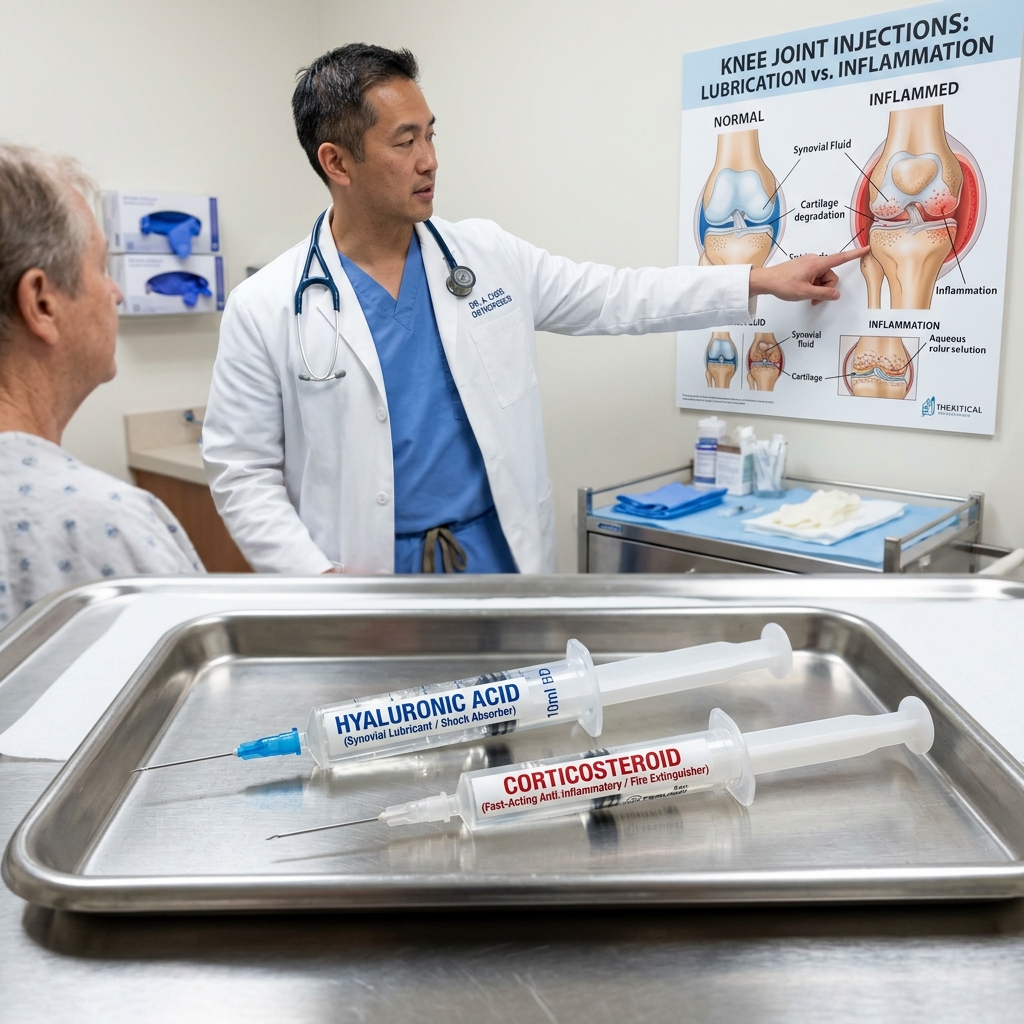
- — Corticosteroid injections act as a localized 'fire extinguisher,' rapidly shutting down acute chemical inflammation and swelling.
- — Hyaluronic Acid (HA) gel injections act as a mechanical 'shock absorber,' physically coating the bones and lubricating the joint spaces.
- — Repeated cortisone shots can accelerate joint degradation by softening remaining cartilage and weakening tendon structures.
- — Viscosupplementation gel is structurally safe for long-term use and can be repeated every six to twelve months to preserve joint spaces.
- — Physiatrists often sequence the two treatments: utilizing a steroid shot first to put out an inflammatory flare, followed by HA gel once the joint is quiet.
When joint pain and stiffness begin to restrict your daily walks, interfere with your sleep, or make climbing stairs agonizing, you are faced with a critical decision. You know you want to avoid major surgery like a total knee replacement, but you are confused by the injection options your doctors have mentioned. Many of my patients come into the TeraCare clinic wondering whether they should get a "steroid shot" or a "gel injection" for their arthritic knees.
In this guide, we will explore the fundamental differences between steroid vs hyaluronic acid injection knee treatments. We will look at the science, the mechanisms of action, and how we clinically sequence these options to protect your knee cartilage and restore smooth, quiet mobility.
What is the difference between steroid and gel injections for knee pain?
The primary difference between steroid and gel injections is their mechanism of action: corticosteroid injections serve as localized chemical agents that rapidly suppress inflammation and swelling, whereas Hyaluronic Acid gel injections act as physical mechanical devices that lubricate and cushion the joint surfaces. Steroids target chemical pain networks, while viscosupplementation directly targets structural friction and wear.
To understand this difference, it is highly useful to use the **"Fire Extinguisher vs. Shock Absorber"** analogy.
When your knee is hot, swollen, throbbing, and filled with fluid, the joint is experiencing a massive chemical fire. In this emergency scenario, a steroid shot is the ultimate fire extinguisher. It enters the joint, instantly halts the inflammatory cascade, and dampens the hyper-sensitive pain receptors within 24 to 48 hours.
However, once the fire is out, you are still left with a dry, squeaky joint. The steroid does nothing to physically protect the cartilage or reduce friction when you walk. That is where a **hyaluronic acid injection knee** acts as the shock absorber—replenishing the joint's missing "motor oil" and physically cushioning the bones so they can glide smoothly.
Corticosteroids: The rapid fire extinguisher for acute joint swelling
Corticosteroids (commonly referred to as cortisone or steroid shots) are powerful synthetic hormones that mimic cortisol to suppress the body's overactive local immune response and shut down acute chemical joint swelling. This localized treatment is highly effective at providing rapid, short-term relief during intense, painful osteoarthritis flare-ups.
When a knee arthritic joint experiences a severe flare-up, it becomes flooded with inflammatory chemicals called cytokines and enzymes that actively degrade the cartilage tissue. A steroid injection delivered directly into the joint capsule works at the cellular level.
It stabilizes the cell membranes, stops the production of these destructive enzymes, and constricts local blood vessels to rapidly drain the swelling. It does not "rebuild" anything; it is a powerful biological reset that breaks a chronic pain cycle, typically providing relief within days that lasts between 6 weeks and 3 months.
Hyaluronic Acid: The mechanical shock absorber and lubricant
Hyaluronic Acid (known as a gel injection or viscosupplementation) is a dense, viscoelastic gel designed to restore the mechanical lubricating and shock-absorbing properties of healthy synovial fluid. By physically coating the damaged cartilage surfaces and cushioning the bone endings, this structural treatment directly eliminates friction and slows down mechanical joint wear.
In a healthy knee, the synovial fluid contains a high concentration of natural Hyaluronic Acid, which acts as a viscous lubricant during slow, low-impact movements and transforms into an elastic shock absorber during rapid impact. In osteoarthritis, this fluid degrades and becomes thin and watery, leaving the cartilage unprotected.
When we administer a **gel injection for knee osteoarthritis**, we are physically replacing this missing oil. The dense gel coats the rough cartilage caps, cushions the sensitive bone endings, and absorbs vertical load. Because it is a natural component of your joint, it has virtually no systemic side effects and can safely protect your knee for 6 to 12 months.
Steroid vs. Hyaluronic Acid injection knee: A detailed comparison
Comparing cortisone and Hyaluronic Acid requires analyzing how their speed of relief, longevity, safety profiles, and mechanisms match your specific stage of knee osteoarthritis. While cortisone is superior for rapid relief of severe, swollen flares, Hyaluronic Acid is the preferred option for long-term joint space preservation and cartilage protection.
| Feature | Corticosteroid Injections (Steroids) | Hyaluronic Acid Gels (Viscosupplementation) |
|---|---|---|
| Primary Goal | Rapid chemical anti-inflammation & swelling control. | Mechanical joint lubrication & shock absorption. |
| Onset of Relief | Very fast (typically 24 to 48 hours). | Gradual (peaks over 2 to 4 weeks). |
| Duration of Efficacy | Short-term (typically 4 to 12 weeks). | Long-term (typically 6 to 12 months). |
| Cartilage Impact | Softening Risk: May accelerate wear if repeated often. | Preservation: Physically protects cartilage from wear. |
| Systemic Risks | Can spike blood sugar in diabetic patients. | Virtually none; localized within the joint capsule. |
Why steroids degrade joint cartilage over time
Repeated corticosteroid injections carry a well-documented risk of accelerating joint degradation by softening remaining articular cartilage and weakening the surrounding supportive tendon structures. While a single shot is highly effective for an inflammatory crisis, relying on steroids as a recurring "crutch" ultimately worsens mechanical bone-on-bone friction.
High-level clinical evidence, including a landmark randomized clinical trial published in *JAMA*, tracked patients receiving repeated cortisone shots over two years. The researchers discovered that patients who received steroid injections every three months showed significant, accelerated loss of cartilage volume compared to those receiving a saline placebo, with no long-term difference in their pain scores.
This is because steroids, while stopping pain, also inhibit the cells (chondrocytes) that maintain the cartilage matrix. If we keep "putting out the fire" with steroids without addressing the underlying lack of lubrication, we are ultimately leaving the joint dry, brittle, and highly vulnerable to rapid structural collapse.
How long does a gel injection in the knee last?
A premium viscosupplementation gel injection typically provides effective pain relief and physical joint protection for 6 to 12 months, depending on the severity of your arthritis, the brand of Hyaluronic Acid used, and your quad muscle strength. Because Hyaluronic Acid is structurally safe, the procedure can be repeated every 6 months indefinitely.
In my clinical experience, the longevity of **how long does gel injection in knee last** depends heavily on how the joint is managed after the procedure. If a patient gets the injection and immediately returns to heavy, unbraced loading or avoids physical therapy, the mechanical forces will degrade the gel much faster.
However, if we pair the injection with targeted lower-extremity strengthening exercises, the strong muscles absorb the impact, allowing the imported gel to remain intact within the cartilage matrix for a much longer period. Additionally, modern high-molecular-weight gels (like Synolis) are engineered to resist enzymatic breakdown, frequently providing a full year of smooth, quiet movement.
Evidence-based ideal sequencing: Combining the two treatments safely
Rather than viewing steroids and Hyaluronic Acid as competitors, modern interventional physiatry sequences the two treatments systematically to safely manage both acute chemical inflammation and chronic mechanical wear. This coordinated pathway maximizes the lifespan of your joint and avoids the risks of excessive steroid exposure.
If you come to the clinic with a highly swollen, hot, and painful knee, the joint is filled with inflammatory fluid. If I inject a premium gel immediately, this watery fluid will dilute and chemically degrade the expensive gel within days, wasting your medical investment.
Instead, our clinical sequence is:
- Chemical Rescue (Day 1): We perform a therapeutic joint aspiration (arthrocentesis) to remove the excess inflammatory fluid, followed by a targeted corticosteroid injection to completely extinguish the acute synovial fire.
- The Rest Phase (Week 1-3): You wear supportive unloader knee bracing or compression orthotics and perform light isometric quadriceps exercises at home while the joint settles.
- Mechanical Lubrication (Week 3-4): Once the joint is quiet, dry, and cool, we perform an ultrasound-guided viscosupplementation injection. The thick gel now coats the cartilage without being diluted, providing maximum shock absorption and a long-lasting rehab window.
A physiatrist's guide to choosing the best knee injection for you
Choosing between steroids and gel injections requires an individualized medical assessment that analyzes your diagnostic MSK ultrasound findings, your stage of arthritis (Kellgren-Lawrence grading), your systemic medical risks (like diabetes), and your functional lifestyle goals. At TeraCare, we focus on matching the right mechanical solution to your actual pain driver.
If you are a diabetic patient, we must be exceptionally cautious with steroids because they can cause severe spikes in your blood sugar for 3 to 5 days, whereas Hyaluronic Acid is completely safe and carries no glycemic risks.
If your primary symptom is morning stiffness, grinding noises, and an ache that gets worse the longer you stand, your pain is primarily driven by mechanical friction—making viscosupplementation the absolute best choice.
At TeraCare, we use live ultrasound to check inside your joint space, analyze your Quad muscle strength, and help you select the safest, most cost-effective path to restore your mobility without relying on chronic pain pills or premature surgery.
Choose the Safe, Mechanical Path for Your Knees
Schedule an expert, ultrasound-guided assessment with Dr. Rabara to compare your options and design a customized, joint-preserving injection sequence.
References & Clinical Evidence
- [1] Bannuru, R. R., et al. (2019). OARSI guidelines for the non-surgical management of knee osteoarthritis. Osteoarthritis and Cartilage, 27(11), 1578-1589.
- [2] Concoff, A. L., et al. (2021). Hyaluronic acid injections for knee osteoarthritis: Systematic review and meta-analysis of randomized controlled trials. Cartilage, 13(1_suppl), 1228S-1240S.
- [3] McAlindon, T. E., et al. (2017). Effect of intra-articular triamcinolone vs saline on knee cartilage volume and pain in patients with knee osteoarthritis: A randomized clinical trial. JAMA, 317(19), 1967–1975.
- [4] Jevsevar, D. S., et al. (2015). The American Academy of Orthopaedic Surgeons evidence-based clinical practice guideline on: Treatment of osteoarthritis of the knee. Journal of Bone and Joint Surgery, 97(24), 2092-2093.
* Clinical references are provided to support the medical claims made in this article. TeraCare adheres to evidence-based practices in physical medicine and rehabilitation.

Dr. Ben Rabara
Dr. Ben Rabara is a Board-Certified Physiatrist specializing in Physical Medicine and Rehabilitation. He focuses on non-surgical, precision treatments for musculoskeletal conditions, utilizing advanced diagnostics like MSK Ultrasound.
Medical Disclaimer: The information provided in this article is for educational purposes only and does not substitute for professional medical advice, diagnosis, or treatment. Always consult a qualified physician for your specific health conditions.