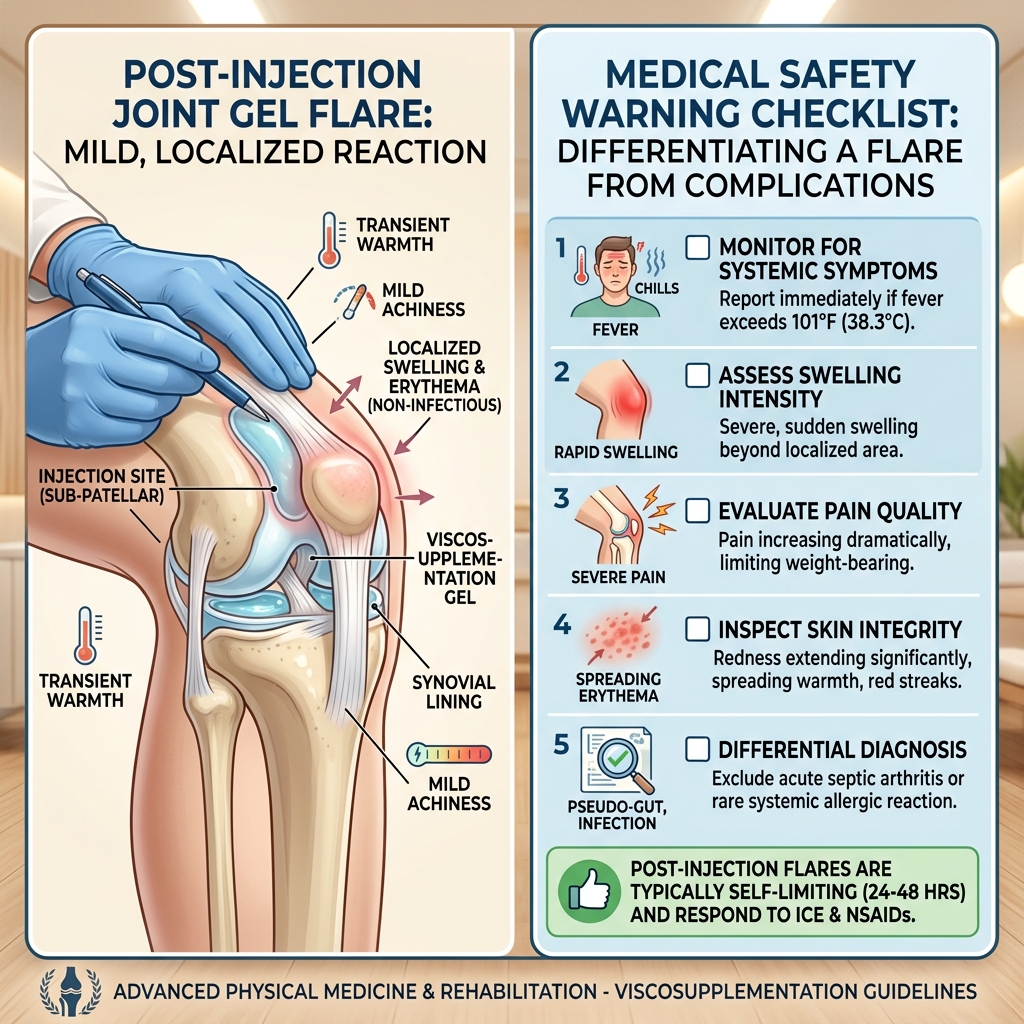
- — Mild soreness, stiffness, or localized warmth is normal for 24 to 48 hours after a hyaluronic acid gel injection as the fluid distributes inside the joint.
- — A pseudoseptic flare (SALR) is a rare, sterile inflammatory immune reaction to cross-linked gels that mimics an infection but lacks systemic fever.
- — Septic arthritis is a rare but life-threatening bacterial joint infection that requires immediate emergency room evaluation and surgical drainage.
- — Blind (landmark-guided) injections miss the joint capsule up to 30% of the time, leaking gel into surrounding tissues and causing intense pain.
- — At TeraCare Vigan, Dr. Rabara uses live musculoskeletal ultrasound to ensure 100% injection accuracy, eliminating extra-articular leakage and preventing tissue irritation.
Receiving a viscosupplementation injection is one of the most effective non-surgical decisions a patient can make to manage knee osteoarthritis. However, when a patient experiences sudden, throbbing pain or swelling shortly after leaving the clinic, it can trigger intense anxiety. The immediate question they ask is: "Why does my knee hurt more after a gel shot? Is this normal, or is something seriously wrong?"
In this comprehensive safety guide, we will break down the physiological reasons behind post-injection knee discomfort, explain the rare immunological reaction known as a pseudoseptic gel flare, provide a clear triage checklist to rule out surgical infections, and detail how high-precision ultrasound guidance prevents these painful side effects.
Is sudden knee pain after hyaluronic acid injection normal?
Mild joint stiffness, a localized dull ache, or minor puffiness is completely normal for 24 to 48 hours after a hyaluronic acid gel injection as the fluid distributes inside the joint capsule. Because the knee joint is a sealed, high-pressure chamber, introducing a thick, high-viscosity viscosupplement temporarily increases hydraulic pressure, which can stimulate surrounding nerve endings until the gel coats the cartilage evenly.
When a viscosupplement like Durolane, Synvisc-One, or Synolis VA is injected, it does not instantly behave like thinned motor oil. Instead, it occupies a concentrated space within the joint recesses. As you walk, stand, and move your knee during normal daily activities, the sheer forces of your joints help spread the gel across the tibiofemoral and patellofemoral cartilage caps.
During this initial 24-to-48-hour distribution phase, it is very common to feel a sense of fullness, mild warmth, or localized soreness at the injection site. This is a standard mechanical tissue response. Applying cold compression (ice) for 15 minutes at a time and resting the joint from strenuous physical activities (like heavy lifting or long-distance walking) is highly effective at cooling this temporary mechanical stretch response.
Differentiating a benign gel flare from a pseudoseptic reaction (SALR)
A pseudoseptic reaction, clinically classified as a Severe Acute Localized Reaction (SALR) or "gel flare," is a sterile, non-infectious acute inflammatory response that occurs in approximately 1% to 3% of viscosupplementation injections. Unlike normal mild soreness, a pseudoseptic flare triggers sudden, massive joint swelling, severe throbbing pain, and localized heat within 24 to 72 hours, but it does not cause a systemic fever.
Understanding why a pseudoseptic flare occurs requires looking at the molecular structure and chemical origins of the injected gel. Hyaluronic acid viscosupplements are manufactured using two primary methods:
- Avian-Derived Gels (Rooster Combs): Older generations of cross-linked gels (such as traditional hylan G-F 20) are purified from rooster combs. These products contain microscopic traces of avian (bird) protein impurities. In some patients, these foreign proteins trigger a localized immune system sensitization. This explains why a pseudoseptic flare typically occurs 24 to 72 hours after the second or third injection in a multi-shot series—the body's immune cells have built a memory of the avian protein and launch an intense, sterile inflammatory response upon re-exposure.
- Synthetic Bio-Fermentation Gels: Modern viscosupplements are manufactured using advanced bacterial bio-fermentation. Because they are synthesized in sterile laboratory environments without animal tissue, they contain zero avian protein impurities. At TeraCare, we prioritize synthetic, high-molecular-weight bio-fermented gels because they exhibit a clinical safety profile that reduces the incidence of sterile flares to nearly zero.
Septic arthritis vs. pseudoseptic flare: The emergency triage guide
Septic arthritis is a bacterial infection of the joint space that represents a critical, limb-threatening medical emergency requiring immediate surgical wash-out. Patients can easily distinguish septic arthritis from a sterile pseudoseptic gel flare by checking for systemic symptoms: a bacterial infection causes a rapid high fever (above 38.3°C / 101°F), violent shaking chills, cold sweats, and an excruciating, throbbing pain that makes bearing any weight completely impossible.
While both a sterile pseudoseptic flare and a bacterial infection cause swelling, redness, and pain, they are managed in completely opposite ways. A sterile gel flare is a benign, self-limiting reaction that resolves with rest, ice, and anti-inflammatories. Septic arthritis, on the other hand, is caused by bacteria introduced during the injection (occurring in less than 1 in 10,000 sterile procedures) and will rapidly destroy joint cartilage within hours if not treated with emergency intravenous antibiotics and surgical drainage.
To protect our patients, we provide this clear, actionable clinical triage matrix:
| Symptom Profile | Benign Recovery | Pseudoseptic Flare (SALR) | Septic Joint Infection (Emergency) |
|---|---|---|---|
| Onset Timeline | Within 12 to 24 hours post-shot. | 24 to 72 hours after injection. | 24 hours to 7 days post-injection. |
| Pain Severity | Mild ache; easily managed. | Moderate to severe throb. | Excruciating; cannot touch or move. |
| Swelling & Heat | Minimal puffiness; mild warmth. | Moderate to severe; fluid buildup. | Extreme; bulging, hot to touch. |
| Weight-Bearing | Able to walk normally. | Difficult to walk; stiff joint. | **Zero weight-bearing possible.** |
| Systemic Fever | None. | None (strictly localized). | **High fever, chills, sweating.** |
| Required Action | Ice compress, rest, mild activity. | Contact clinic; resting & ice. | **Go to Emergency Room immediately.** |
Why does joint gel leak? The impact of ultrasound guidance
Gel leaking outside the joint capsule—known as extra-articular deposition—occurs when a physician performs the injection "blind" using manual feeling and landmarks alone. Wasting a dense viscosupplement into the surrounding sensitive infrapatellar fat pad or synovial lining triggers an intense, painful local inflammatory reaction and leads to immediate therapeutic failure.
The knee joint is surrounded by highly sensitive structures, including the Hoffa's fat pad (a densely innervated pad of fat behind the kneecap ligament) and the vascular synovial lining. Hyaluronic acid gel is designed specifically to reside within the synovial fluid cavity where cartilage can absorb its viscoelastic cushioning.
Published medical studies demonstrate that traditional "blind" (landmark-guided) knee injections miss the joint capsule up to 20% to 30% of the time, even when performed by highly experienced orthopedic surgeons. When the thick gel is accidentally injected into the extra-articular fat pad or capsule walls, the tissue reacts to the dense foreign volume, resulting in severe pain, persistent swelling, and zero functional lubrication.
At TeraCare Vigan, Dr. Rabara eliminates this risk by using high-resolution musculoskeletal ultrasound. By tracking the needle tip live on a digital screen, we guide it precisely past the fat pads and place it directly into the open joint recess. This guarantees that 100% of your imported premium gel is deposited exactly where it belongs, maximizing your therapeutic benefit and preventing painful leakage.
Home care and medical treatments for knee gel flares
Managing a sterile, post-injection knee gel flare focuses on cooling the localized inflammatory response. If you experience massive swelling, Dr. Rabara can perform a rapid, painless ultrasound-guided joint aspiration to drain the excess fluid, which instantly relieves the internal hydraulic pressure and resolves up to 80% of the throbbing pain.
If you suspect you are experiencing a sterile gel flare, follow these conservative, doctor-approved protocols:
- Cryotherapy (Ice): Apply a cold gel pack wrapped in a thin towel to your swollen knee for 15 to 20 minutes every 2 hours. Never apply bare ice directly to the skin. Cold constricts the blood vessels, reducing swelling and numbing local pain receptors.
- Strict Joint Rest: Avoid standing or walking for extended periods during the first 24 hours of a flare. Keep your leg elevated on a pillow above the level of your heart to facilitate fluid drainage.
- Oral Anti-Inflammatories (NSAIDs): Under physician guidance, taking a short course of over-the-counter NSAIDs (such as Ibuprofen or Naproxen) can block the inflammatory cytokines triggering the swelling.
- Clinical Aspiration & Cortisone Triage: If the swelling is severe and does not improve after 24 hours of rest, visit our clinic. Dr. Rabara will use ultrasound to visualize the fluid buildup, gently extract it with a sterile needle, and may inject a micro-dose of steroid to instantly quiet the localized immune response.
Our preventative safety standards at TeraCare Vigan
A board-certified Physical Medicine & Rehabilitation physician (physiatrist) prioritizes joint safety and procedural precision above all else. At TeraCare, we have engineered a strict safety protocol to protect our viscosupplementation patients from flares, leakage, and infections, ensuring the highest standard of interventional care in Northern Luzon.
Our non-surgical joint safety program includes:
- Exclusive Use of Bio-Fermented Gels: We refuse to use cheap, avian-derived generic gels that carry high rates of bird protein impurities. We only source premium, FDA-approved, bio-fermented hyaluronic acid to eliminate allergic flare risks.
- 100% Ultrasound Guidance: Every viscosupplementation injection at TeraCare is performed under live ultrasound visualization. We never perform blind, landmark-guided joint injections.
- Triple-Sterile Field Preparation: To prevent septic joint infections, we prepare the injection site using a rigid surgical sterilization protocol, utilizing chlorhexidine or betadine and maintaining a strict aseptic field.
- Post-Procedure Monitoring: We provide every patient with a written care plan, including a direct clinic hotline, so they can immediately contact Dr. Rabara if they have any questions about post-injection recovery.
Experience Safe, Precision Joint Relief
Schedule an expert, ultrasound-guided viscosupplementation evaluation with Dr. Rabara at TeraCare Vigan to ensure your joint injections are performed with absolute precision and maximum safety.
References & Clinical Evidence
- [1] Goldberg, V. M., & Coutts, R. D. (2004). Pseudoseptic reactions to hylan G-F 20 (Synvisc) in the treatment of osteoarthritis of the knee. Clinical Orthopaedics and Related Research, (419), 130-137.
- [2] Bannuru, R. R., et al. (2015). Therapeutic trajectory of hyaluronic acid versus placing joint injections for knee osteoarthritis: A systematic review. Annals of Internal Medicine, 163(12), 911-919.
- [3] Rutjes, A. W., et al. (2012). Viscosupplementation for osteoarthritis of the knee: A systematic review and meta-analysis. Annals of Internal Medicine, 157(3), 180-191.
- [4] Berkoff, D. J., et al. (2012). Accuracy of joint injections: A systematic review comparing landmark-guided vs. image-guided procedures. AJR. American Journal of Roentgenology, 198(2), 375-381.
- [5] Kane, D., et al. (2003). A prospective, double-blind, randomized, controlled trial comparing landmark-guided versus ultrasound-guided intra-articular injection of the knee joint. Rheumatology, 42(12), 1439-1444.
* Clinical references are provided to support the medical claims made in this article. TeraCare adheres to evidence-based practices in physical medicine and rehabilitation.

Dr. Ben Rabara
Dr. Ben Rabara is a Board-Certified Physiatrist specializing in Physical Medicine and Rehabilitation. He focuses on non-surgical, precision treatments for musculoskeletal conditions, utilizing advanced diagnostics like MSK Ultrasound.
Medical Disclaimer: The information provided in this article is for educational purposes only and does not substitute for professional medical advice, diagnosis, or treatment. Always consult a qualified physician for your specific health conditions.