- — Knee cracking and grinding (crepitus) is a mechanical sound indicating friction between the cartilage surfaces, often aggravated by the loss of synovial fluid.
- — Crepitus without pain is frequently benign, but noisy knees accompanied by aching, stiffness, or swelling indicate active joint degeneration.
- — Popping pills masks chemical pain but does nothing to stop the physical, mechanical wear-and-tear of bone-on-bone contact.
- — Viscosupplementation works like motor oil in a dry engine, injecting premium Hyaluronic Acid gel directly into the joint capsule to restore lubrication.
- — TeraCare utilizes high-resolution musculoskeletal ultrasound to guarantee 100% accurate, painless delivery of the cushioning gel.
Few sounds are as unsettling as hearing a loud pop, click, or grating grind coming from your knees when you stand up from a low chair or walk down a flight of stairs. Many of my patients come into the TeraCare clinic expressing deep anxiety that their joints are "collapsing," "breaking," or instantly wearing down to bone-on-bone contact. These fears are highly understandable, as the physical sensation of joint grinding can feel like a mechanical failure.
In this comprehensive guide, we will break down the medical reality of cracking knees meaning, explore the precise biomechanical reasons why your joints make these noises, and discuss how we use advanced, non-surgical viscosupplementation to lubricate, protect, and restore smooth, quiet movement to your knees.
What does cracking and popping in the knee actually mean?
Knee cracking and popping, known medically as joint crepitus, refers to the acoustic noises generated by the movement of cartilage, ligaments, or fluid within the joint capsule during motion. While pain-free clicking is often harmless and caused by shifting gas bubbles, persistent grinding or cracking accompanied by discomfort signifies increased friction between rough, worn cartilage surfaces.
When you bend or straighten your leg, the patella (kneecap) must glide smoothly through a groove at the end of the femur (thigh bone). In a perfectly healthy joint, this movement is silent because both bones are capped with a thick, slippery layer of articular cartilage and bathed in lubricating joint fluid. However, if the smooth surface of the cartilage becomes frayed, or if the protective fluid layer thins, the opposing bones begin to generate physical vibrations as they rub against each other. This friction is what translates into the pops, grinds, and clicks that you hear and feel.
The dry joint mechanism: Why knees grind and pop
The physiological mechanism behind noisy, grinding knees is primarily driven by the progressive loss of synovial fluid viscosity and the subsequent thinning of the joint's protective shock absorbers. Under normal conditions, specialized cells in the joint lining produce Hyaluronic Acid, a thick substance that acts as motor oil to prevent direct bone-on-bone friction during mechanical loading.
To understand this dry joint mechanism, it is highly useful to compare your knee to a car engine. A healthy engine is filled with clean, slippery motor oil that coats every moving piston, ensuring they glide without touching. If you never change the oil, or if the engine develops a leak, the oil becomes thin, watery, and dirty. Without that protective barrier, the metallic pistons begin to grind directly against each other, generating intense heat, alarming noises, and rapid structural damage.
In knee osteoarthritis, a very similar process occurs. The natural Hyaluronic Acid inside your synovial fluid degrades, transforming from a rich, protective gel into a watery, ineffective liquid. Without this cushioning barrier:
- Articular Cartilage Fraying: The protective cartilage caps on your bones lose their slick surface, developing rough, fibrous edges like a frayed rope.
- Patellar Tracking Friction: The underside of your kneecap grinds directly against the femur instead of sliding smoothly.
- Nociceptor Irritation: The friction stimulates microscopic pain fibers (nociceptors) embedded in the surrounding bone and joint lining, translating mechanical grinding into chronic, aching pain.
Bone-on-bone knee pain: What patients commonly misunderstand
Many patients mistakenly believe that a diagnosis of "bone-on-bone" knee pain means their joints are entirely devoid of cartilage and that joint replacement surgery is their only immediate option. In clinical practice, true bone-on-bone pain is highly variable and often responds exceptionally well to non-surgical structural interventions that restore joint lubrication and improve lower-extremity biomechanics.
In my clinical experience, the phrase "bone-on-bone" is frequently used as a scare tactic or an oversimplification of a complex condition. When patients are told they have bone-on-bone knees, they often picture two flat, dry blocks of wood scraping together. They assume that physical therapy is impossible and that they must restrict all movement until they can schedule surgery.
This is a profound misunderstanding. The pain associated with advanced knee friction is not just a structural problem; it is a chemical and functional issue. The bone tissue under the worn cartilage contains millions of tiny nerve endings that become highly sensitive when exposed to increased pressure and inflammatory chemicals. By injecting a protective gel cushion and strengthening the surrounding muscles to offload the joint, we can frequently eliminate the pain and restore quiet function, even if the X-ray still shows narrow joint spaces.
How to distinguish between benign knee noises and serious damage
Distinguishing between harmless joint acoustics and pathological crepitus requires analyzing whether the noises are accompanied by symptoms like persistent aching, morning stiffness, knee swelling, or mechanical instability. While occasional popping caused by gas bubble release (cavitation) is entirely benign, constant grinding that feels like sand in the joint indicates active cartilage wear.
| Benign Joint Popping | Concerning Crepitus (Seek Assessment) |
|---|---|
| Occurs occasionally and randomly during movement. | Happens consistently with every single bend or step. |
| Entirely painless; does not leave an after-ache. | Accompanied by a dull, deep ache or sharp pain. |
| No joint stiffness, warmth, or physical swelling. | Knee feels tight, stiff in the morning, or looks swollen. |
| Feels like a clean, crisp bubble popping. | Feels like sand, gravel, or coarse sandpaper grinding. |
If your knees pop when you squat but feel perfectly fine afterward, you likely have nothing to worry about. The sound is simply the release of nitrogen gas from the synovial fluid, much like cracking your knuckles. However, if you find yourself avoiding stairs, limiting your walks, or waking up with a stiff, heavy knee because of the grinding sensation, your joint is actively calling out for structural lubrication.
How we clinically assess knee crepitus at TeraCare
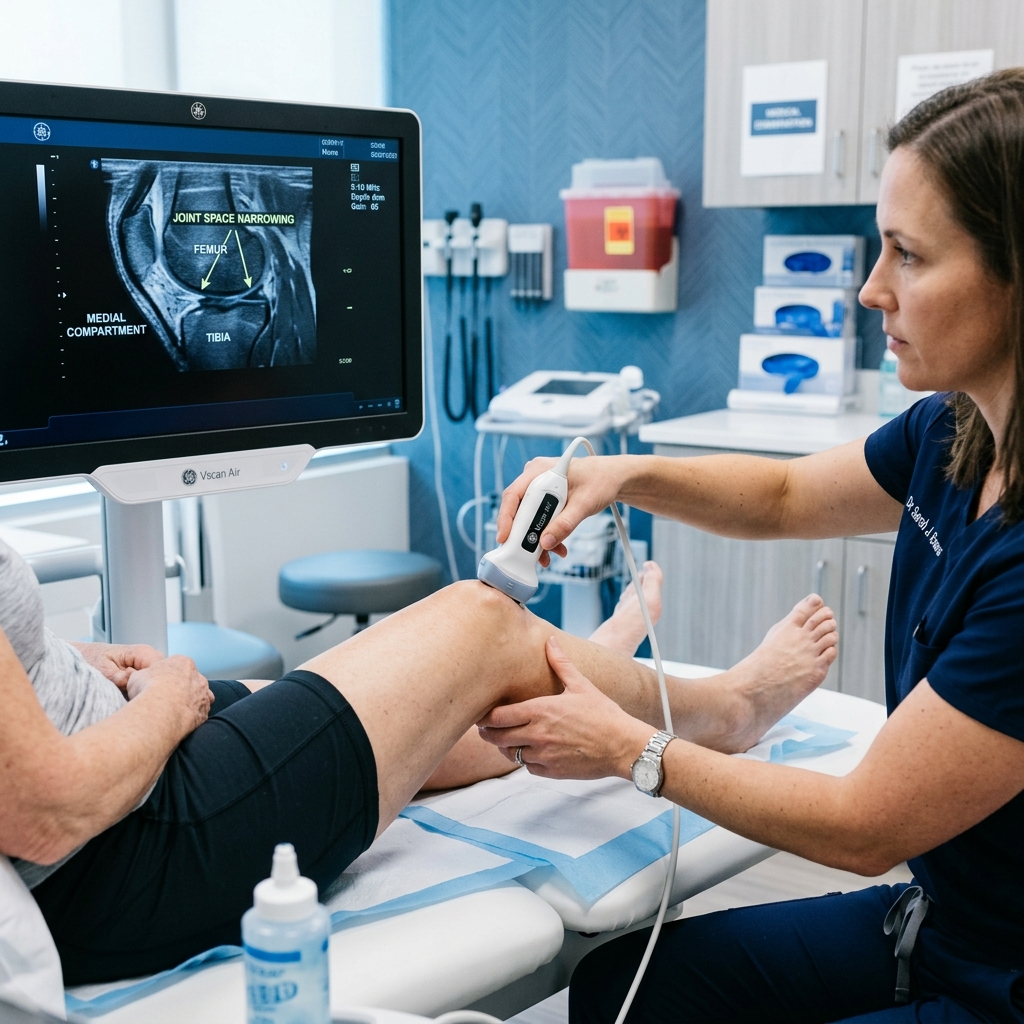
At TeraCare, our diagnostic pathway for knee crepitus combines a comprehensive biomechanical examination with live, high-resolution Musculoskeletal (MSK) Ultrasound to visualize the cartilage surfaces and assess synovial fluid levels in real time. This dynamic approach allows us to pinpoint the exact source of joint friction and determine if viscosupplementation is the most appropriate treatment.
During a standard clinical evaluation, I perform several targeted diagnostic steps:
- Mechanical Palpation: I place my hands directly over your kneecap while you slowly bend and straighten your knee, feeling the quality and intensity of the grinding vibrations.
- Dynamic Ultrasound Scan: We use ultrasound to look inside the joint while you move. We can physically see if your patella is tracking off-center, check for hidden pockets of inflammatory fluid (effusion), and measure the thickness of the remaining cartilage.
- Kinetic Chain Screening: We examine your hips, ankles, and foot arches. Frequently, weak hip muscles or flat feet cause the knee to collapse inward, twisting the joint and accelerating the grinding wear on one side.
Viscosupplementation: The physical lubricant and cushion for grinding joints
Viscosupplementation is an advanced, non-surgical treatment that injects a highly concentrated, bio-engineered Hyaluronic Acid gel directly into the knee joint to replenish the degraded synovial fluid and restore mechanical cushioning. By coating the rough cartilage surfaces and cushioning the bone endings, this gel physically eliminates grinding and stops the wear-and-tear cycle.
When we perform viscosupplementation Vigan, we are not injecting a drug that merely masks pain. We are delivering a physical, structural material. Hyaluronic Acid is a natural molecule that your body already produces, but in osteoarthritic knees, the production has slowed down. By introducing a premium, high-molecular-weight gel, we achieve several critical therapeutic goals:
- Immediate Lubrication: The gel instantly coats the rough cartilage, allowing the joint surfaces to glide smoothly over each other without generating heat or friction.
- Shock Absorption: The thick, elastic properties of the gel absorb the heavy vertical forces generated when you walk, jump, or climb stairs, protecting the underlying bone.
- Anti-Inflammatory Shield: The gel coats the highly sensitive nerve endings inside the joint capsule, blocking inflammatory chemicals and cooling down joint irritation.
- Endogenous Stimulation: Over the following weeks, the presence of the injected gel triggers your joint lining to restart its own production of healthy, natural lubricating fluid.
| Oral Glucosamine Pills | Precision Viscosupplementation Gel |
|---|---|
| Must be digested, broken down by liver, and enter bloodstream. | Delivered directly into the joint capsule; 100% targeted. |
| Less than 1% of the active ingredient ever reaches the knee. | Replenishes 100% of the joint's missing "motor oil" instantly. |
| Requires months of daily use with highly questionable results. | Provides immediate structural support and lasting relief. |
| Wastes thousands of pesos on over-the-counter supplements. | A highly cost-effective medical procedure with clinical evidence. |
What to expect before, during, and after a knee gel injection
A viscosupplementation procedure is a rapid, highly comfortable, and sterile outpatient treatment performed directly in our Vigan clinic under 100% live ultrasound guidance. Patients can walk out of the clinic immediately after the injection and return to their light daily activities the very same day.
Many of my patients are anxious about having a needle placed into their knee. I want to reassure you that we have designed our injection protocol to be as painless as possible:
- Skin Numbing: We clean the skin thoroughly and apply a highly effective local anesthetic to completely freeze the area, ensuring you only feel a tiny pinch.
- Ultrasound Guidance: Unlike standard clinics that perform "blind" injections by feeling the bones, we use live ultrasound. This allows us to see the needle in real-time, guiding it precisely into the open joint capsule without touching any sensitive bones, nerves, or blood vessels.
- Gel Delivery: The Hyaluronic Acid gel is slowly introduced. You may feel a mild sensation of fullness or pressure inside your knee, but no sharp pain.
- Immediate Movement: We gently bend and straighten your leg a few times to spread the gel evenly across the cartilage surfaces. You will then stand up and walk out of the clinic immediately.
We advise patients to rest their knee and avoid heavy lifting, running, or high-impact workouts for 48 hours following the procedure to allow the gel to fully settle into the cartilage matrix.
Safety boundaries and who should avoid viscosupplementation
Viscosupplementation is exceptionally safe and carries a much lower side-effect profile than steroid shots or daily pain medications, but it requires careful screening to identify patients with active joint infections, severe inflammatory flares, or rare brand-specific allergies. The safety and effectiveness of the gel depend entirely on injecting it into a clean, stable joint environment.
Specifically, we will modify or delay the treatment if:
- Active Skin or Joint Infection: If there is any rash, scrape, or infection near the knee, we must wait until it is fully healed to prevent introducing bacteria into the joint.
- Severe Joint Effusion ("Water on the Knee"): If your knee is hot, swollen, and filled with inflammatory fluid, this fluid will quickly degrade and wash away the expensive gel. In these cases, we perform a dynamic two-step approach: we aspirate the excess fluid and resolve the active inflammation first, then inject the lubricating gel once the environment has stabilized.
- Severe Avian Allergies: Some older formulations of Hyaluronic Acid are derived from rooster combs. If you have a severe allergy to feathers or eggs, we simply select modern, bio-fermented synthetic gels that are 100% safe and allergy-free.
By respecting these clinical safety boundaries, we ensure that every viscosupplementation procedure performed at TeraCare is safe, comfortable, and highly successful.
Stop the Grinding. Protect Your Knees.
Schedule a comprehensive musculoskeletal ultrasound assessment with Dr. Rabara to determine if viscosupplementation can restore your joint cushion.
References & Clinical Evidence
- [1] Bannuru, R. R., et al. (2019). OARSI guidelines for the non-surgical management of knee osteoarthritis. Osteoarthritis and Cartilage, 27(11), 1578-1589.
- [2] Concoff, A. L., et al. (2021). Hyaluronic acid injections for knee osteoarthritis: Systematic review and meta-analysis of randomized controlled trials. Cartilage, 13(1_suppl), 1228S-1240S.
- [3] Hunter, D. J., & Bierma-Zeinstra, S. (2019). Osteoarthritis. The Lancet, 393(10182), 1745-1759.
- [4] Maheu, E., et al. (2020). Efficacy and safety of intra-articular hyaluronic acid in the treatment of knee osteoarthritis: A systematic review. Clinical Rheumatology, 39(12), 3467-3475.
- [5] McAlindon, T. E., et al. (2020). Effect of intra-articular triamcinolone vs hyaluronic acid on knee pain and cartilage volume: A randomized clinical trial. JAMA, 323(14), 1361-1370.
* Clinical references are provided to support the medical claims made in this article. TeraCare adheres to evidence-based practices in physical medicine and rehabilitation.

Dr. Ben Rabara
Dr. Ben Rabara is a Board-Certified Physiatrist specializing in Physical Medicine and Rehabilitation. He focuses on non-surgical, precision treatments for musculoskeletal conditions, utilizing advanced diagnostics like MSK Ultrasound.
Medical Disclaimer: The information provided in this article is for educational purposes only and does not substitute for professional medical advice, diagnosis, or treatment. Always consult a qualified physician for your specific health conditions.