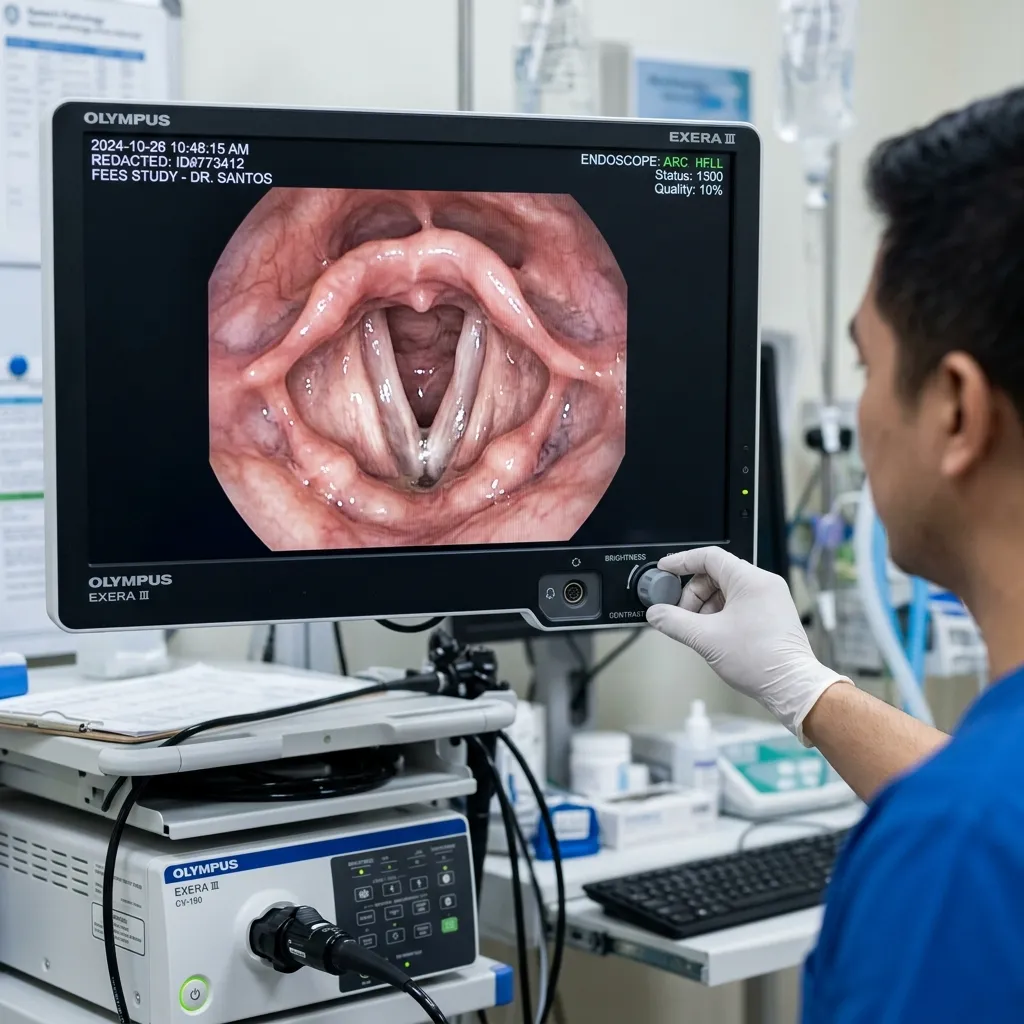
- — Bedside assessment helps identify risk, but instrumental testing may be needed when silent aspiration or pharyngeal impairment cannot be judged safely from observation alone.
- — FEES uses a flexible endoscope through the nose to assess the pharynx, laryngeal sensation and secretion management without radiation; it does not show every part of the oral or esophageal phase.
- — VFSS, also called MBSS, is a moving X-ray of swallowing with contrast. A routine esophagram or barium swallow is a different study and may be chosen for a different referral question.
- — Testing is selected and supervised according to medical status, alertness, positioning, airway risk, and the question being asked; duration and comfort vary.
- — Results should lead to a documented safety plan and referral or follow-up with the appropriate physician, speech-language pathologist, radiology, or gastroenterology team.
If your doctor has recommended a swallow test for yourself or a loved one, it is natural to feel a bit of apprehension. You might be wondering: "Is it going to hurt? Will they put a tube down my throat? What if they tell me I can't eat anymore?"
As a Physiatrist specializing in swallowing disorders, my goal is to turn that apprehension into empowerment. A swallow test is not an interrogation; it is a diagnostic conversation between your brain, your throat, and the clinical team. Instrumental testing can answer questions that bedside observation cannot, while the final safety plan still depends on the whole clinical picture.
In this guide, we distinguish FEES, VFSS/MBSS, and a routine barium swallow or esophagram. They are not interchangeable: the right study depends on whether the concern is the mouth and throat, airway protection, or the esophagus.
Why Do We Need an Instrumental Test?
A bedside swallow exam (where a trained clinician watches eating, drinking, voice, breathing, and alertness) is an important starting point, but it cannot directly visualize every pharyngeal event or reliably exclude silent aspiration in every patient.
When bedside findings or the clinical history leave important safety questions unanswered, instrumental diagnostics—cameras or X-rays—can show internal swallowing events and help guide the plan.
Option 1: FEES (Fiberoptic Endoscopic Evaluation of Swallowing)
FEES may be useful when the question involves pharyngeal swallowing, secretion management, laryngeal sensation, airway protection, fatigue, or repeated bedside assessment. It uses no radiation, but the scope can be uncomfortable and the view is briefly obscured during the swallow (the "white-out"). It does not fully assess oral transit or the esophagus.
The Procedure:
- The Camera: A very thin, flexible tube with a high-definition camera at the tip (an endoscope) is gently passed through the nose.
- The View: The camera sits just above the vocal cords, providing a "bird's eye view" of the entrance to the lungs and the esophagus.
- The Meal: We may provide selected foods and liquids, sometimes with food coloring for visibility. We observe secretions, residue, airway protection, and the response to tested strategies; the scope view is briefly obscured during the swallow.
The Advantage:
FEES shows pharyngeal anatomy and physiology before and after the swallow, including secretions, residue, laryngeal function, and signs consistent with airway invasion. It can support an aspiration-safety plan, but a normal or reassuring observation does not establish safety for every meal or setting.
"FEES can make important pharyngeal findings visible, but it is one part of dysphagia assessment and cannot establish safety in every situation."
Option 2: VFSS/MBSS and the Routine Barium Swallow
A Videofluoroscopic Swallow Study (VFSS), also called an MBSS when a modified barium protocol is used, is a moving X-ray study of swallowing with contrast. It is not the same as every test called a "barium swallow" or esophagram, which may focus more on the esophagus and require a different referral.
The Procedure:
- The Contrast: The patient drinks a white, chalky liquid called Barium. Barium shows up clearly on X-ray.
- The Video: As the patient swallows, the radiology and swallowing team records contrast moving through the mouth and pharynx; the protocol and views determine how much of the esophagus is assessed.
The Advantage:
VFSS/MBSS can show oral and pharyngeal timing, bolus flow, airway invasion, and the effect of compensatory strategies during recorded swallows. It uses radiation and may not answer a suspected esophageal problem by itself; a routine esophagram or gastroenterology referral may be needed.
Comparing the Two: Which One Is Right for You?
Neither test is "better" than the other; they simply provide different types of information.
- Consider FEES when: the main question concerns pharyngeal safety, secretions, laryngeal sensation, fatigue, or bedside/portable assessment.
- Consider VFSS/MBSS when: the team needs dynamic information about oral and pharyngeal bolus movement, timing, or tested strategies and the patient can be positioned for fluoroscopy.
- Consider an esophagram or gastroenterology referral when: symptoms suggest an esophageal obstruction, stricture, reflux-related problem, pouch, or food sticking after the swallow.
At TeraCare Vigan, Dr. Ben Rabara can help clarify the clinical question and coordinate the appropriate test or referral. FEES may not replace radiology or gastroenterology assessment when the suspected problem lies outside its field of view.
| Diagnostic Feature | FEES (Endoscopic) | VFSS/MBSS (X-Ray) |
|---|---|---|
| Equipment Used | Flexible camera (Endoscope). | Video Fluoroscopy (X-Ray). |
| Radiation Exposure | None. | Minimal (X-Ray exposure). |
| Best For Seeing... | Airway protection & silent aspiration. | Dynamic oral and pharyngeal swallowing with contrast; esophageal referral may be separate. |
| Location | Clinic office or bedside. | Hospital Radiology department. |
How to "Pass" a Swallow Test?
One of the most common things patients ask is how they can "pass" the test. It is important to shift your perspective. You don't "pass" a swallow test; you inform it.
Do not deliberately test yourself with unsafe textures or hide symptoms before or after testing. The team may identify aspiration on one texture and safer performance on another, but no single maneuver or thickened liquid removes all pneumonia risk. Follow the written plan and seek urgent care for breathing difficulty, choking that does not resolve, or suspected aspiration with distress.
What Happens After the Test?
Once the diagnostic is complete, the team documents a Swallowing Roadmap. Depending on the findings, this may include:
- Diet Modification: A specific list of safe food textures and liquid thicknesses.
- Postural Strategies: Learning techniques like the "Chin Tuck" or "Head Turn" that mechanically protect the airway during a swallow.
- Rehabilitation Plan: Specific exercises to strengthen the throat muscles or re-train the neurological reflex.
- Referral or tube-feeding review: Feeding-tube changes require a coordinated medical and swallowing assessment; a test result alone does not authorize tube removal.
Conclusion: Knowledge is Safety
A swallow test is the bridge between fear and function. It takes the "Silent Threat" of dysphagia and makes it visible and manageable. If you or your loved one are struggling with eating, drinking, or recurrent pneumonia, don't wait.
At TeraCare Vigan, we provide FEES assessment when appropriate and coordinate diagnostic care. If symptoms point to VFSS/MBSS, radiology, ENT, or gastroenterology, referral is part of safe care—not a failure of the bedside assessment.
See What's Happening Inside
Book a high-definition FEES Swallowing Assessment in Vigan City. Stop guessing and start protecting your lungs.
Physician's Note: Diagnostic accuracy is the foundation of patient safety. A FEES assessment provides the immediate, visual evidence needed to make critical decisions about a patient's nutrition and rehabilitation pathway.
References & Clinical Evidence
- [1] Langmore, S. E. (2001). Endoscopic Evaluation and Treatment of Swallowing Disorders. Thieme.
- [2] Logemann, J. A. (1998). Evaluation and Treatment of Swallowing Disorders. Pro-Ed.
- [3] Bastian, R. W. (1991). The videoendoscopic swallowing study: an alternative and partner to the videofluoroscopic swallowing study. Dysphagia Journal.
- [4] Martin-Harris, B., et al. (2008). MBS Measurement Tool for Swallow Impairment—MBSImP: A Standardized Approach. Dysphagia Journal.
* Clinical references are provided to support the medical claims made in this article. TeraCare adheres to evidence-based practices in physical medicine and rehabilitation.

Dr. Ben Rabara
Dr. Ben Rabara is a Board-Certified Physiatrist specializing in Physical Medicine and Rehabilitation. He focuses on non-surgical, precision treatments for musculoskeletal conditions, utilizing advanced diagnostics like MSK Ultrasound.
Medical Disclaimer: The information provided in this article is for educational purposes only and does not substitute for professional medical advice, diagnosis, or treatment. Always consult a qualified physician for your specific health conditions.