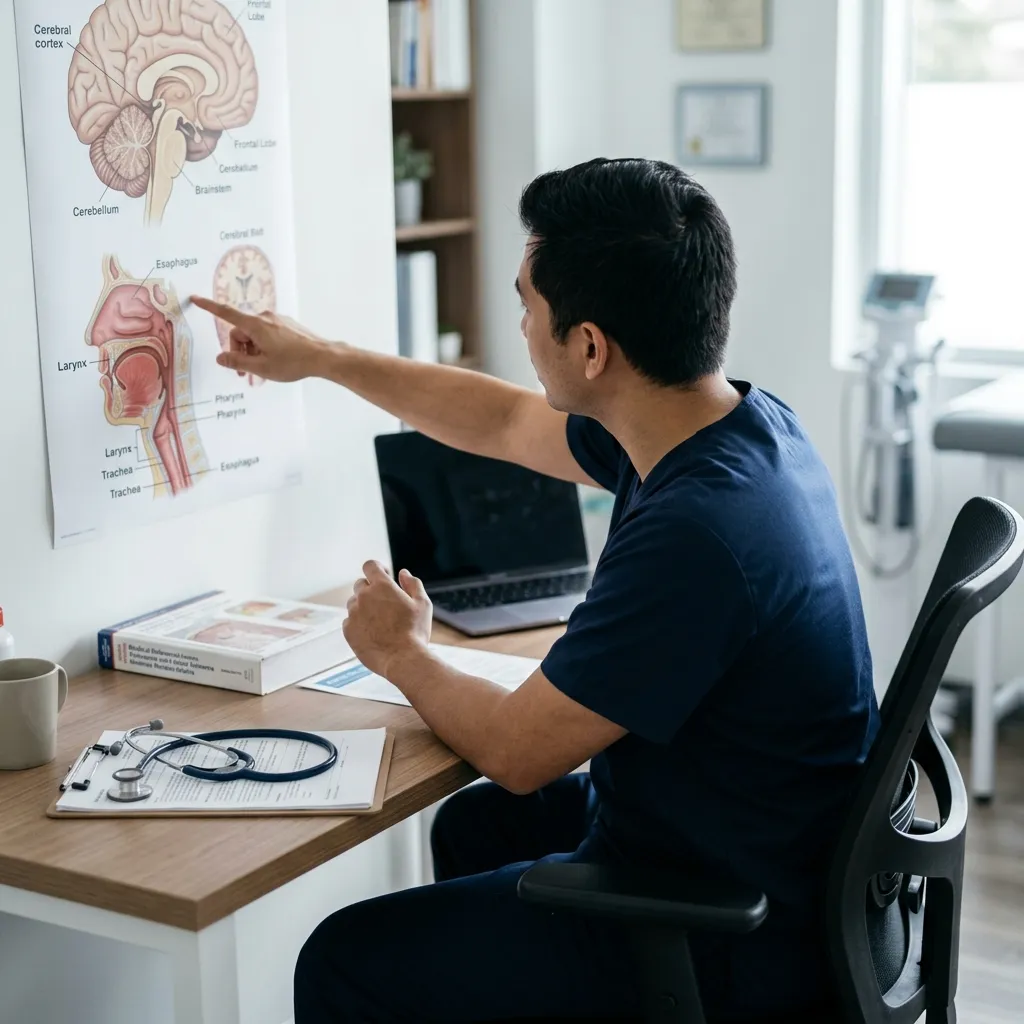
- — Neurological dysphagia is a mechanical failure caused by a 'broken signal' from the brain to the swallowing muscles.
- — Stroke survivors often experience delayed oropharyngeal transit, leaving the airway open for too long during a swallow.
- — Parkinson's patients frequently suffer from 'tongue pumping' and poor airway protection, increasing the risk of aspiration.
- — Dementia can lead to sensory dysphagia, where the patient 'forgets' the presence of food in the mouth or loses the reflex to trigger a swallow.
- — Clinical intervention focuses on re-training the brain and strengthening the throat mechanics to restore safety.
For a patient recovering from a stroke or living with Parkinson’s Disease, one of the most frustrating and terrifying experiences is the loss of a basic human function: swallowing. Families often describe it as a sudden "disconnection." One day, eating was an unconscious joy; the next, every bite feels like a dangerous hurdle.
As a Physiatrist, I often hear caregivers express confusion: "His jaw is strong, he can still chew, so why is he choking?" The answer lies deep within the brain's wiring. In the world of Oropharyngeal Dysphagia, we aren't just dealing with weak muscles—we are dealing with a Neurological Breakdown. The brain has lost its ability to choreograph the complex dance of the swallow.
The Broken Traffic Light: A Neurological Analogy
To understand neurological dysphagia, imagine your throat as a high-speed intersection. On one side, you have the path to your lungs (the airway); on the other, the path to your stomach (the esophagus).
In a healthy person, your brain acts as a perfect traffic controller. The moment food hits the back of your throat, the brain sends an instantaneous signal: "Close the airway! Open the stomach!" This happens in less than a second.
In a stroke or Parkinson’s patient, that "traffic light" is broken. The signal is either delayed, weak, or completely absent. The food arrives at the intersection, but the airway is still open. The result is a mechanical "collision"—food or liquid enters the lungs instead of the stomach. This is the physiological reality of aspiration.
Post-Stroke Dysphagia: The Sudden Disruption
A stroke is a sudden interruption of blood flow to the brain. If the stroke affects the brainstem or the parts of the cortex responsible for motor control, the swallowing reflex is often the first casualty.
The Delayed Swallow: The most common issue I see in stroke survivors is a delayed pharyngeal trigger. The patient can chew and move food to the back of the mouth, but the "automatic" part of the swallow doesn't start fast enough. While the brain is "deciding" when to swallow, gravity is pulling the liquid down into an unprotected airway.
Muscle Weakness vs. Coordination: While there may be physical weakness in the tongue or throat muscles, the bigger problem is often sequencing. The muscles aren't working in the right order. It’s like a rowing team where everyone is strong, but they aren't rowing at the same time. The boat—your food—goes nowhere, or worse, capsizes into the lungs.
"A stroke doesn't just weaken the throat; it erases the 'software' the brain uses to operate the swallowing mechanism."
Parkinson's Disease: The Slow Breakdown
Unlike the sudden impact of a stroke, Parkinson's Disease causes a gradual decline in swallowing safety. Because Parkinson's affects movement across the entire body, the throat is no exception.
Tongue Pumping and Hesitation: Many Parkinson's patients experience "tongue pumping"—repetitive, rocking motions of the tongue that struggle to push food backward. This can happen for several seconds before a swallow is finally triggered, leading to fatigue and a higher risk of choking.
Silent Danger: Because Parkinson's also affects sensory perception, these patients are at a very high risk for silent aspiration. They may be inhaling food into their lungs without feeling it and without coughing. This is why we emphasize that a "lack of coughing" does NOT mean the patient is safe.
Dementia and the Sensory Connection
In patients with Dementia or Alzheimer’s, the breakdown is often sensory. The patient may "pocket" food in their cheeks, simply forgetting it is there. Or, they may lose the ability to recognize food as something that needs to be swallowed.
In these cases, we focus on Sensory Re-education. We use temperature (cold liquids) or strong flavors (sour/tart) to "shock" the brain into recognizing that something is in the throat and needs to be cleared. It is a neurological override designed to trigger the reflex when the voluntary mind has failed.
The Importance of Clinical Mapping
Because every neurological injury is unique, we cannot treat dysphagia with a "one size fits all" approach. We must map the breakdown.
At TeraCare Vigan, we use FEES (Fiberoptic Endoscopic Evaluation of Swallowing) to see the "Broken Traffic Light" in real-time. By placing a small camera in the throat, we can see exactly which neurological signal is failing.
- Is the tongue failing to push the food?
- Is the epiglottis failing to close?
- Is there "residue" sitting in the throat after the swallow?
Once we have this map, we can design a Neurological Rehabilitation Plan.
Re-Wiring the Swallow: Neuroplasticity in Action
The good news is that the brain is plastic. Through Swallowing Rehabilitation, we can often help the brain find new pathways to control the throat muscles.
Neuromuscular Electrical Stimulation (NMES): We use tools like VitalStim to provide small electrical pulses to the throat muscles while the patient practices swallowing. This "jump-starts" the neurological connection, helping the brain recognize and strengthen the muscles that are failing.
Targeted Exercises: Exercises like the Mendelsohn Maneuver or Masako Maneuver are not just about strength; they are about timing. We are teaching the brain to hold the airway closed for a fraction of a second longer, or to pull the esophagus open wider, to ensure a safe passage for food.
| Neurological Condition | Primary Swallowing Failure | Clinical Goal |
|---|---|---|
| Post-Stroke | Delayed trigger; unilateral (one-sided) weakness. | Re-mapping the reflex; compensating for weak side. |
| Parkinson's | Slowness (bradykinesia); poor airway protection. | Improving speed and coordination of the trigger. |
| Advanced Dementia | Sensory neglect; "forgetting" to trigger a swallow. | Sensory stimulation and environment modification. |
Conclusion: Expert Intervention is Mandatory
Neurological dysphagia is not something that gets better with "careful eating" alone. It is a complex mechanical failure that requires a physician’s diagnosis and a therapist’s intervention.
If your loved one is struggling to eat after a stroke or is experiencing changes in their swallowing due to Parkinson's or Dementia, don't wait for a choking event or a hospital admission. A clinical assessment at TeraCare Vigan can identify exactly where the "Broken Traffic Light" is and provide a clear, evidence-based plan to restore safety and dignity to their mealtimes.
Master the Swallowing Connection
Don't let a neurological condition lead to aspiration pneumonia. Schedule a Clinical Swallowing Assessment in Vigan City today.
Physician's Note: In neurological rehabilitation, timing is everything. The sooner we identify the specific failure in the swallowing sequence, the more effectively we can apply neuroplasticity principles to restore safety and prevent the need for long-term feeding tubes.
References & Clinical Evidence
- [1] Hamdy, S., et al. (1996). The cortical topography of human swallowing musculature. Gastroenterology.
- [2] Logemann, J. A. (1998). Evaluation and Treatment of Swallowing Disorders. Pro-Ed.
- [3] Cichero, J. A., & Murdoch, B. E. (2006). Dysphagia: Foundation, Theory and Practice. John Wiley & Sons.
- [4] Smithard, D. G., et al. (1997). The natural history of dysphagia following a stroke. Dysphagia Journal.
* Clinical references are provided to support the medical claims made in this article. TeraCare adheres to evidence-based practices in physical medicine and rehabilitation.
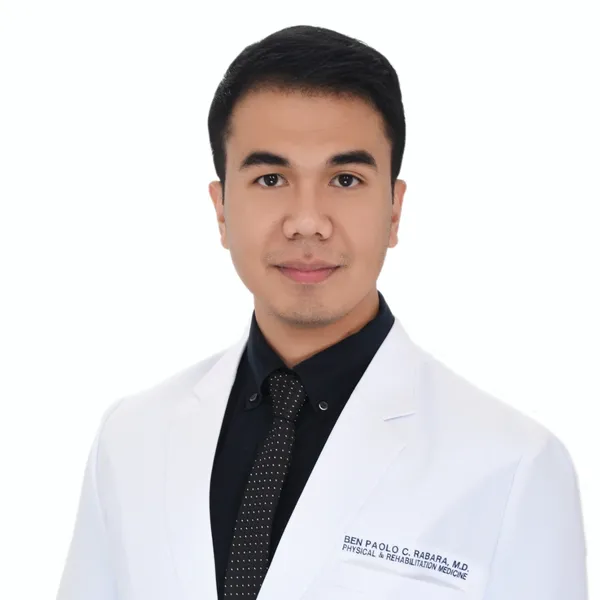
Dr. Ben Rabara
Dr. Ben Rabara is a Board-Certified Physiatrist specializing in Physical Medicine and Rehabilitation. He focuses on non-surgical, precision treatments for musculoskeletal conditions, utilizing advanced diagnostics like MSK Ultrasound.
Medical Disclaimer: The information provided in this article is for educational purposes only and does not substitute for professional medical advice, diagnosis, or treatment. Always consult a qualified physician for your specific health conditions.