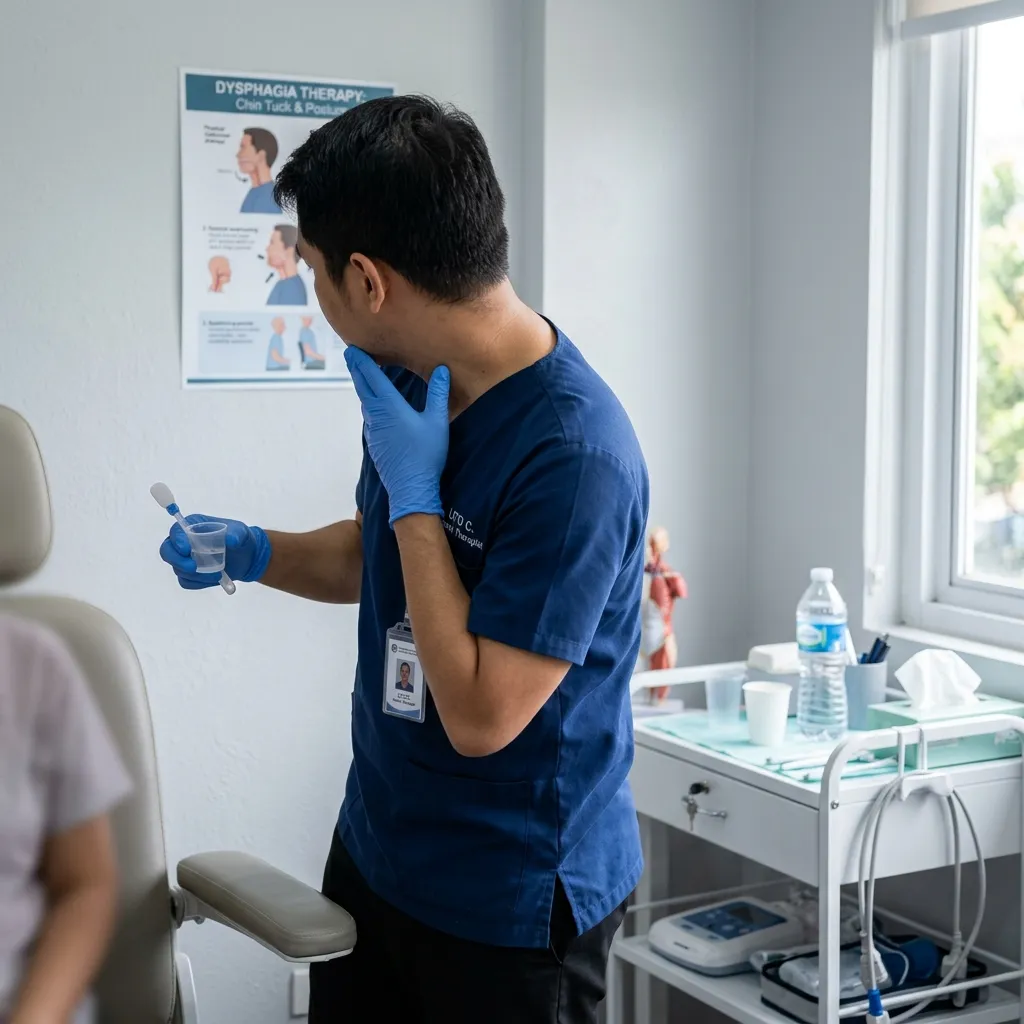
- — Speech-Language Pathologists (SLPs) are specialized 'throat mechanics' trained to rebuild the complex muscles used in swallowing.
- — Dysphagia rehabilitation is not just about 'waiting' to get better; it requires active, targeted exercises to trigger neuroplasticity.
- — VitalStim Therapy uses mild electrical stimulation to re-train the brain-to-throat signal, accelerating the recovery of the swallowing reflex.
- — Postural strategies (like the chin tuck or head turn) are mechanical tools used to immediately improve swallowing safety during therapy.
- — The goal of therapy is to move patients toward the least restrictive diet possible, restoring both nutrition and quality of life.
When a patient is referred to "Speech Therapy" for a swallowing problem, the reaction is often one of confusion. "But Doctor, my speech is fine. Why am I seeing a speech therapist for my choking?"
The term "Speech Therapy" is actually a bit of a historical misnomer in the clinical world. A Speech-Language Pathologist (SLP) is, in reality, a highly specialized throat mechanic. They are the experts in the oropharyngeal complex—the intricate network of muscles and nerves that allow you to speak, breathe, and, most importantly, swallow safely.
In this guide, we will demystify the role of therapy in dysphagia recovery and explain the advanced tools, like VitalStim, that we use at TeraCare Vigan to help patients return to the joy of eating.
The Science of Re-Training the Swallow
Swallowing is not a single movement; it is a sequence of events that must happen in a specific order within a fraction of a second. When a stroke or neurological disease occurs, that sequence is broken.
Dysphagia Rehabilitation is based on the principle of Neuroplasticity. Your brain has the ability to find new pathways and "re-wire" its control over the throat muscles. However, this doesn't happen through rest. It happens through targeted, high-repetition exercise. Just as a physical therapist helps a patient walk again by strengthening the legs, an SLP helps a patient eat again by strengthening the throat.
VitalStim Therapy: Electrical Stimulation for the Throat
At TeraCare, we are proud to offer VitalStim Therapy, a gold-standard treatment in dysphagia rehabilitation.
How it works: Small, specialized electrodes are placed on the skin of the neck. A gentle electrical current is sent to the swallowing muscles. This stimulation does not "force" a swallow; rather, it provides a "wake-up call" to the nerves.
When the patient attempts to swallow while receiving the stimulation, the brain receives a much stronger sensory signal. This accelerates the re-learning process. In clinical studies, patients receiving VitalStim along with traditional exercises often regain their swallowing function significantly faster than those doing exercises alone.
"VitalStim isn't a shortcut; it's an amplifier. it makes every swallow exercise twice as effective by strengthening the brain-to-muscle connection."
Targeted Swallowing Exercises: The Core of Rehab
An SLP will prescribe specific maneuvers designed to fix your unique failure point. These are not general "throat clearings"; they are biomechanical interventions.
- The Mendelsohn Maneuver: This involves "holding" the larynx (voice box) at its highest point during a swallow for several seconds. This manually keeps the esophagus open longer, allowing food to pass through before the airway re-opens.
- The Masako Maneuver: The patient holds their tongue between their teeth while swallowing. This forces the back wall of the throat (the pharyngeal wall) to work harder to meet the tongue, strengthening the "squeeze" of the swallow.
- Effortful Swallow: The patient is coached to "swallow as hard as they can" with all their throat muscles. This increases the pressure needed to clear food residue that might otherwise fall into the lungs.
Postural Strategies: Immediate Safety Tools
While exercises build long-term strength, postural strategies provide immediate safety. During a therapy session, an SLP may use a FEES camera to determine if a specific head position protects your airway.
The Chin Tuck: By tucking the chin toward the chest during a swallow, the patient manually narrows the entrance to the airway and widens the "valley" at the base of the tongue (the vallecula). This provides a physical barrier that helps prevent food from slipping into the lungs.
The Head Turn: If a patient has one-sided weakness (common in stroke), turning the head toward the weak side closes off that side of the throat, forcing the food to travel down the stronger, safer side.
The Goal: Progression to the Least Restrictive Diet
The ultimate goal of dysphagia rehabilitation is what we call "Restoring Oral Independence." We want to move you through the dysphagia diet levels:
- From NPO (Nothing by Mouth) to Purees.
- From Thickened Liquids to Thin Liquids (Water).
- From Soft Foods to Regular Textures.
Every time we "promote" a patient to a higher diet level, it is a clinical victory. It means the therapy is working, the muscles are stronger, and the risk of pneumonia has decreased.
| Therapy Component | How It Rebuilds the Swallow | Who Needs It Most? |
|---|---|---|
| VitalStim (NMES) | Electrical 'jump-start' for swallowing nerves and muscles. | Post-stroke and chronic dysphagia patients. |
| Maneuvers (Exercises) | Active muscle strengthening and coordination drills. | Patients with mechanical throat weakness. |
| Postural Training | Using body positioning to 'steer' food away from the lungs. | Patients with one-sided stroke weakness or delayed reflexes. |
Why Choose TeraCare Vigan for Dysphagia Rehab?
In many hospitals, "swallowing therapy" is a generic recommendation. At TeraCare Vigan, it is a precision medical intervention.
Because Dr. Ben Rabara is a Physiatrist, we integrate medical supervision with SLP expertise. We don't just give you a list of exercises; we use diagnostic evidence (FEES) to prove which exercises are working and when it is truly safe to advance your diet. We specialize in complex cases, including geriatric dysphagia and NGT-to-oral transitions.
Conclusion: Don't Settle for a Feeding Tube
A feeding tube is a temporary solution for a permanent problem. If your loved one has been told they "just have to live with it," we invite you to seek a second opinion. Swallowing is a skill that can often be rebuilt.
With the right therapy, the right technology (VitalStim), and the right "throat mechanics," the path back to regular meals is possible.
Start Your Swallowing Rehab
Unlock your potential to eat safely again. Schedule a consultation with our Dysphagia Rehabilitation team in Vigan City.
Physician's Note: Rehabilitation is an active process. We don't just treat the throat; we treat the person. Restoring the ability to eat safely is one of the most powerful ways to improve a patient's overall health and psychological well-being.
References & Clinical Evidence
- [1] Logemann, J. A. (1998). Evaluation and Treatment of Swallowing Disorders. Pro-Ed.
- [2] Carnaby-Mann, G. D., & Crary, M. A. (2007). Adjunctive neuromuscular electrical stimulation for treatment-refractory oropharyngeal dysphagia. Annals of Otology, Rhinology & Laryngology.
- [3] Speyer, R., et al. (2010). Effects of therapy in oropharyngeal dysphagia by speech and language therapists: a systematic review. Dysphagia Journal.
- [4] Huckabee, M. L., & Pelletier, C. A. (1999). Management of Adult Neurogenic Dysphagia. Singular Publishing Group.
* Clinical references are provided to support the medical claims made in this article. TeraCare adheres to evidence-based practices in physical medicine and rehabilitation.
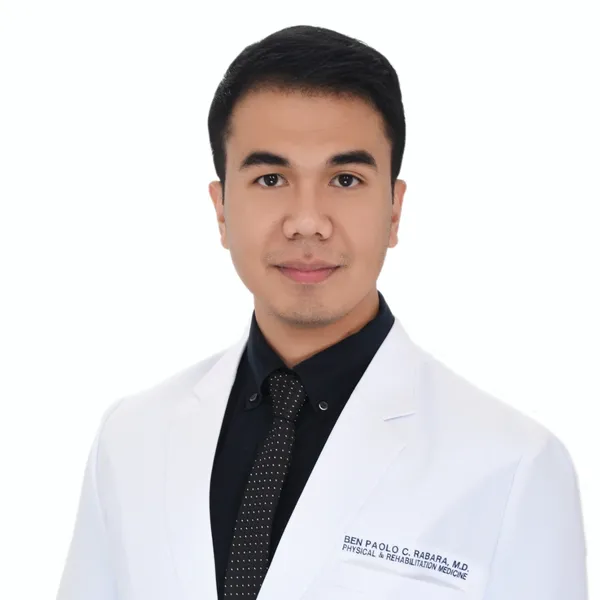
Dr. Ben Rabara
Dr. Ben Rabara is a Board-Certified Physiatrist specializing in Physical Medicine and Rehabilitation. He focuses on non-surgical, precision treatments for musculoskeletal conditions, utilizing advanced diagnostics like MSK Ultrasound.
Medical Disclaimer: The information provided in this article is for educational purposes only and does not substitute for professional medical advice, diagnosis, or treatment. Always consult a qualified physician for your specific health conditions.