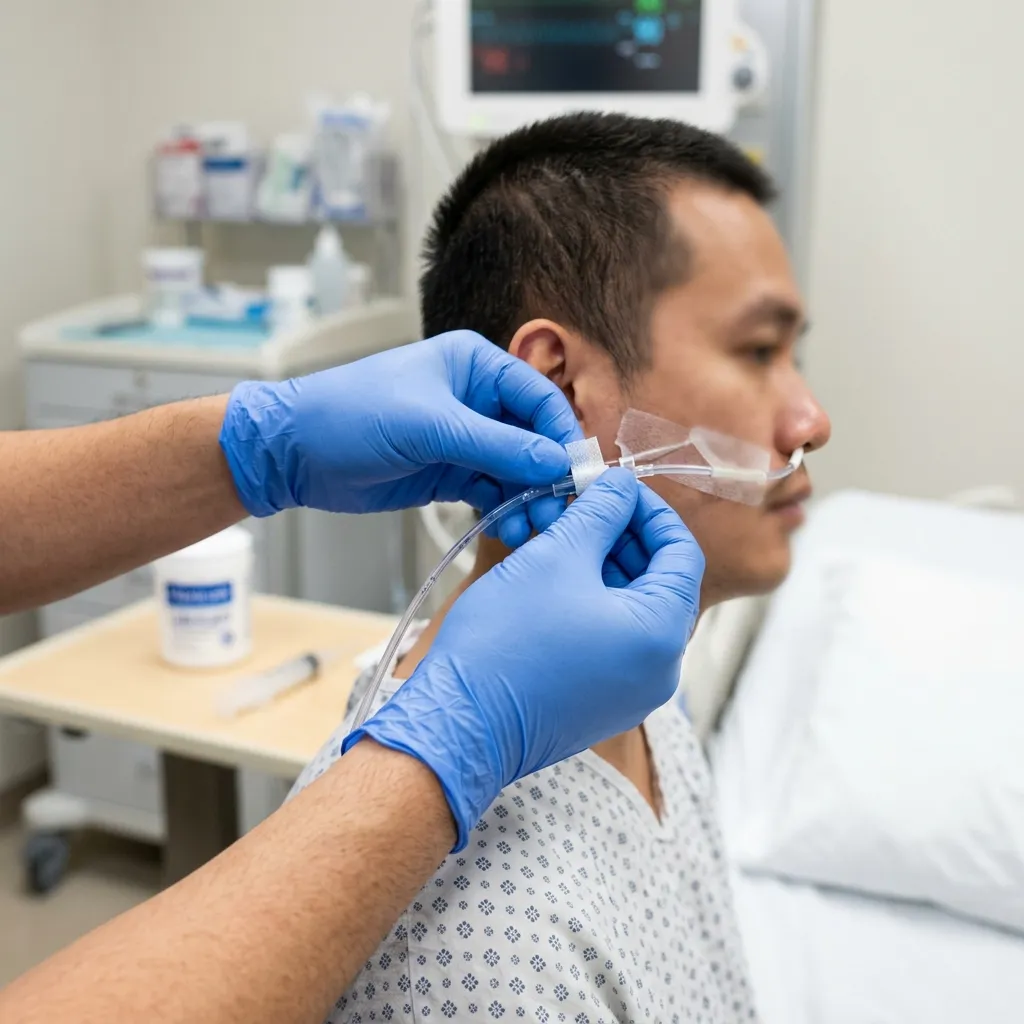
- — An Nasogastric (NGT) tube is a life-saving but temporary measure to prevent malnutrition and aspiration in the early stages of stroke recovery.
- — NGT removal is not based on a timeline, but on clinical diagnostic clearance (usually through a FEES assessment).
- — The transition off a feeding tube involves 'graduating' through various dysphagia diet levels, starting with thickened liquids and pureed foods.
- — Psychological readiness is as important as physiological readiness; the return to eating is a significant emotional milestone.
- — Physician-supervised swallowing therapy is the 'bridge' that allows for the safe removal of the feeding tube.
In the first few days following a stroke, life is often defined by medical interventions. For many families, the placement of a Nasogastric (NGT) feeding tube is a moment of profound emotional grief. It is a visible sign that their loved one can no longer perform the most basic human act: nourishing themselves.
However, it is important to view the NGT tube not as a permanent failure, but as a life-saving bridge. It exists to ensure the patient receives the hydration and nutrition needed to heal their brain while preventing the catastrophic complication of aspiration pneumonia.
The most frequent question I receive from families is: "Doctor, when can we finally take the tube out?" The answer is not found on a calendar; it is found through a precise clinical pathway. In this guide, we will outline the steps required to transition from a feeding tube back to the dinner table.
The Emotional Journey of Tube Feeding
We must first acknowledge the psychological toll. Eating is more than just biological fuel; it is a social and cultural cornerstone. For a patient, losing the ability to eat is a loss of autonomy and dignity. For the caregiver, it feels like a heavy burden of medical maintenance.
It is normal to feel frustrated, saddened, or even scared of the tube. But remember: the tube is currently doing the "work" that the throat is temporarily unable to do. Our goal at TeraCare Vigan is to guide you through the rehabilitation process so that the tube can be removed as soon as—and only when—it is medically safe.
Step 1: The Clinical Swallowing Assessment
The journey off the NGT begins with a Diagnostic Swallow Test. We cannot remove the tube based on a "trial and error" approach at home. The risk of silent aspiration (where food enters the lungs without a cough) is simply too high.
We typically use FEES (Fiberoptic Endoscopic Evaluation of Swallowing). During this procedure, we use a tiny camera to watch the throat mechanics from the inside while we offer the patient tiny amounts of liquid or food.
What we are looking for:
- Is the patient awake and alert enough to swallow?
- Can they clear their own saliva without choking?
- Do the throat muscles close the airway completely during a swallow?
- Is there any "residue" left in the throat that could fall into the lungs later?
"Removing an NGT without a clinical assessment is like driving with your eyes closed. You might make it, but the risk of a catastrophic crash—aspiration pneumonia—is immense."
Step 2: Graduating to Thickened Liquids
For many stroke survivors, the first "graduation" is not to solid food, but to thickened liquids.
This often confuses families. "Why can't he just have a sip of plain water?" Paradoxically, thin water is the hardest and most dangerous thing for a dysphagia patient to swallow. Water moves extremely fast. If the brain’s signal to close the airway is delayed by even a fraction of a second, the water has already entered the lungs.
By adding a thickening agent (to reach a "nectar-like" or "honey-like" consistency), we slow the liquid down. This gives the patient's damaged neurological system more time to react and seal off the airway. It is a critical safety step on the pathway back to regular hydration.
Step 3: The Dysphagia Diet Levels
Once a patient passes the liquid test, we introduce specific food textures. We follow international standards (IDDSI) to ensure consistency.
- Level 4 (Pureed): Foods that are smooth, like yogurt or mashed potatoes, with no lumps. This requires the least amount of chewing and oral control.
- Level 5 (Minced & Moist): Foods that are finely chopped and very soft. This requires some tongue movement but minimal chewing.
- Level 6 (Soft & Bite-Sized): Foods that can be mashed with a fork. This is the final step before returning to a regular diet.
A patient often stays on a specific level for several weeks while undergoing Swallowing Therapy. We monitor their progress and only "promote" them to the next level when their mechanics prove stable.
Step 4: The "Trial Removal" and Nutritional Monitoring
Before we physically pull the NGT out, we often perform a "trial" where the tube remains in place but is not used for several days. During this time, the patient must meet two criteria:
- Safety: No signs of aspiration (fever, coughing, wet voice).
- Caloric Intake: The patient must be able to eat and drink enough volume to maintain their weight and hydration entirely by mouth.
If the patient is only eating three spoonfuls of puree and then getting tired, they are not ready for NGT removal. They still need the tube for supplemental nutrition. We only remove the tube when the patient’s "oral intake" meets 100% of their daily needs.
The Role of Swallowing Therapy
You cannot simply "wait" for the swallowing to get better. Swallowing is a muscle-driven act that requires exercise. Our team uses targeted speech therapy and swallowing rehabilitation exercises to build the bridge off the feeding tube:
- Pharyngeal Strengthening: Exercises to increase the force of the swallow.
- Laryngeal Elevation: Training the throat to pull the airway "up and out of the way" during a swallow.
- VitalStim Therapy: Using mild electrical stimulation to re-train the brain to recognize the swallowing reflex.
| Stage of Recovery | Dietary Status | Clinical Goal |
|---|---|---|
| Acute Stage (Early Stroke) | Full NGT Feeding; NPO (Nothing by Mouth). | Prevent aspiration and stabilize vitals. |
| Transitional Stage | Supplemental NGT + Thickened Liquids/Purees. | Increase oral endurance and safety. |
| Final Clearance | Oral Intake > 75% of Needs; Tube Removed. | Return to full independence and dignity. |
Conclusion: Hope and Patience
Removing an NGT tube is one of the most celebrated moments in a stroke survivor's journey, closely aligned with functional milestones in our stroke recovery timeline guide. It symbolizes a return to "normalcy" and the end of the acute medical phase.
However, the path to removal must be paved with clinical evidence. At TeraCare Vigan, we are committed to helping your family navigate this emotional and medical challenge. We provide the diagnostics (FEES), the therapy, and the medical supervision needed to ensure that when that tube finally comes out, it stays out for good.
Ready to Transition Off the NGT?
Book a comprehensive swallowing assessment and NGT removal clearance consultation in Vigan City.
Physician's Note: The goal is never just 'removing the tube'; the goal is 'safe nutrition.' We prioritize the patient's lung health above all else, ensuring that the return to oral eating is a triumph, not a tragedy.
References & Clinical Evidence
- [1] Logemann, J. A. (1998). Evaluation and Treatment of Swallowing Disorders. Pro-Ed.
- [2] Cichero, J. A., & Murdoch, B. E. (2006). Dysphagia: Foundation, Theory and Practice. John Wiley & Sons.
- [3] SURA, J., et al. (2012). Guidelines for the use of nasogastric tubes in stroke patients. Stroke Research and Treatment.
- [4] Crary, M. A., et al. (2013). The Dysphagia Outcome and Severity Scale (DOSS): a 3-year study of its reliability and validity. Dysphagia Journal.
* Clinical references are provided to support the medical claims made in this article. TeraCare adheres to evidence-based practices in physical medicine and rehabilitation.

Dr. Ben Rabara
Dr. Ben Rabara is a Board-Certified Physiatrist specializing in Physical Medicine and Rehabilitation. He focuses on non-surgical, precision treatments for musculoskeletal conditions, utilizing advanced diagnostics like MSK Ultrasound.
Medical Disclaimer: The information provided in this article is for educational purposes only and does not substitute for professional medical advice, diagnosis, or treatment. Always consult a qualified physician for your specific health conditions.