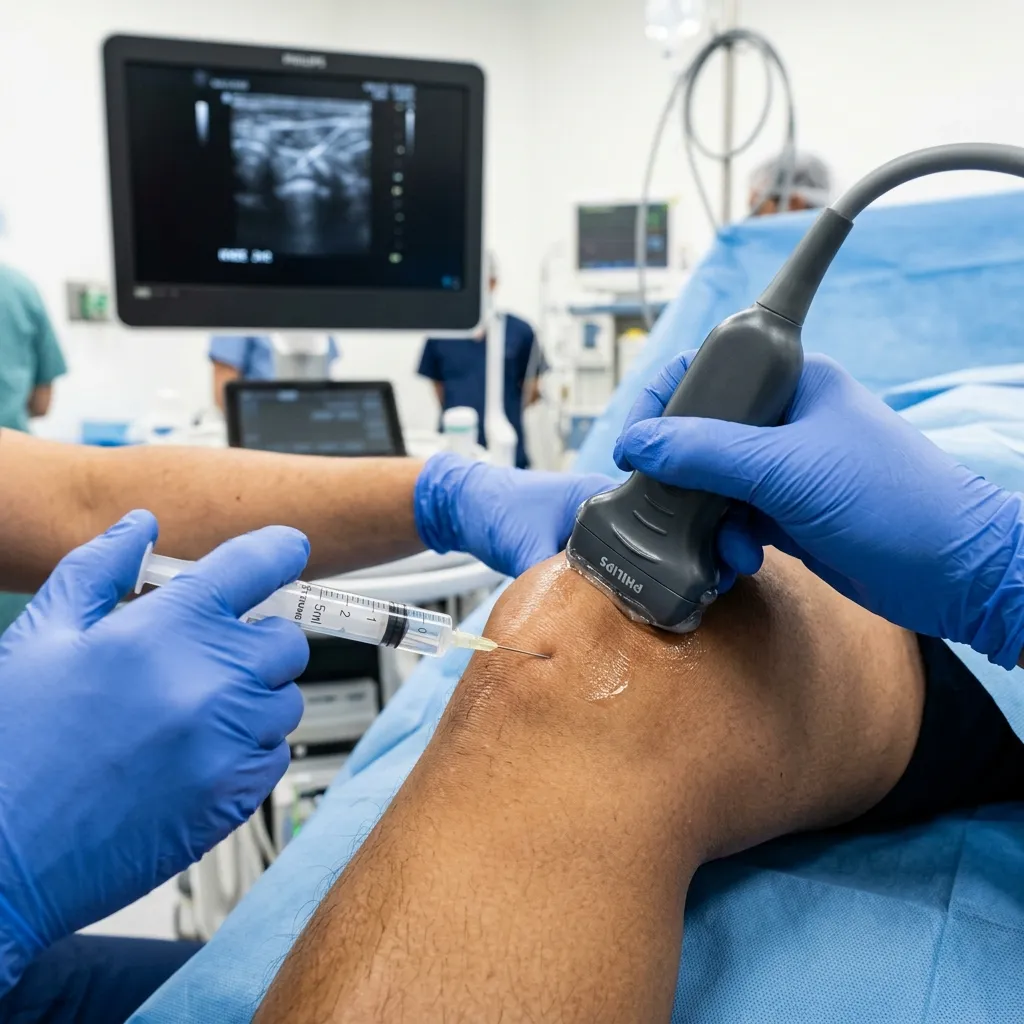
- — A hot, swollen joint must be assessed for septic arthritis before injection.
- — Aspiration and testing may need to come first; crystals and culture answer different questions.
- — Injection is one possible route for an assessed, limited-joint flare, not an automatic treatment.
- — Acute flare control does not replace long-term urate management.
Is a Steroid Injection Safe for an Acute Gout Flare?
A gout steroid injection may be considered only after a clinician assesses the hot, swollen joint and determines that injection is a reasonable route. The first safety question is whether septic arthritis, an infection inside the joint, could be present. Infection must be excluded before injection when the presentation or risk factors make it a concern.
The urgency is understandable. Patient discussions repeatedly describe burning or sharp joint pain, a foot too stiff for a shoe, broken sleep, and difficulty standing through a workday. That functional loss deserves timely care, but severe pain alone cannot identify gout or prove that the joint is safe to inject. A careful assessment protects the patient while treatment options are considered.
When a Hot, Swollen Joint Needs Urgent Medical Assessment
Gout and septic arthritis can both produce sudden severe pain, warmth, redness, swelling, and restricted movement. They can also coexist. Because untreated joint infection can damage a joint and affect the whole body, suspected septic arthritis needs urgent evaluation and a different care pathway; it should not be masked with a routine steroid injection.
A previous gout diagnosis makes another flare plausible, but it does not make every future hot joint gout. A high serum urate result also does not settle the diagnosis by itself: many people with elevated urate do not have gout, and urate can change during an acute flare. The clinician combines the history, examination, pattern of joints involved, medical risks, and selected tests.
I look for how the pain feels and behaves without treating any one description as a diagnosis. Burning or sharp pain can fit acute inflammation, while dull or heavy pain, radiating or tingling symptoms, and catching or grinding may suggest overlapping nerve, tendon, or mechanical joint problems that change the assessment. These descriptions do not exclude gout or infection, so they remain part of—not a substitute for—the full safety evaluation.
Red Flags for Possible Joint Infection
- Fever or systemic illness: chills, confusion, marked weakness, or feeling much more unwell than with a familiar flare.
- Rapid progression: pain, swelling, redness, or loss of movement that is worsening quickly.
- Skin barrier problems: broken skin, an infected wound, drainage, or cellulitis over or near the planned needle path.
- Immune suppression: medicines or illnesses that reduce the body's ability to contain infection.
- Recent procedure: recent surgery, joint injection, or another invasive procedure that changes the infection assessment.
- Prosthetic joint: new pain and swelling in a replaced joint requires specialist evaluation rather than routine injection.
None of these findings independently confirms septic arthritis, and their absence does not provide absolute certainty. They guide urgency and testing. If infection is suspected, the priority is prompt diagnostic evaluation, synovial-fluid sampling when appropriate, and treatment through the suitable medical or surgical pathway—not proceeding with corticosteroid simply because the symptoms resemble a previous gout attack.
When Joint Aspiration and Synovial-Fluid Testing Come First
Joint aspiration may come before an injection when the diagnosis is uncertain, the presentation is atypical, a substantial effusion (fluid buildup inside the joint) is present, or infection is possible. Aspiration means using a needle to remove synovial fluid, the lubricating fluid inside a joint, so its appearance and laboratory findings can inform the next clinical decision (Abhishek et al., 2017; PMID: 28148582).
The decision is not “aspirate every gout flare” or “never aspirate a familiar flare.” In my assessment, I lower the threshold for fluid testing when this is a first episode, an unusual joint, a prolonged or treatment-resistant course, or a presentation with systemic symptoms or a competing diagnosis. A classic big-toe presentation in a person with established gout may sometimes be diagnosed clinically when aspiration is not feasible, but the consequences of missing infection matter more than procedural convenience.
Aspiration may also reduce pressure when a joint contains a sizable effusion, but diagnosis and safety remain central here. For a detailed explanation of preparation and technique, see the guide to ultrasound-guided joint aspiration and synovial-fluid analysis. That procedure guide complements, rather than replaces, an individualized assessment of the acute hot joint.
Why Crystals and Culture Answer Different Questions
Synovial-fluid tests do not all answer the same question. Crystal analysis looks for material that supports crystal arthritis, while Gram stain and culture investigate bacterial infection. The results must be interpreted with the history and examination because gout and septic arthritis can occur together; one positive finding does not automatically cancel the other possibility.
- Crystal analysis: needle-shaped monosodium urate crystals support gout; other crystal patterns can point toward a different crystal arthritis.
- Gram stain and fluid culture: Gram stain looks for visible bacteria, while culture attempts to grow and identify organisms causing infection.
Finding urate crystals does not by itself exclude infection. Conversely, a negative early Gram stain cannot independently establish that no infection exists. Cell counts, culture, blood tests, clinical stability, antibiotics already received, and the overall presentation can influence interpretation. When the concern remains significant, treatment and escalation should follow the suspected-infection pathway while results are reviewed.
This distinction is why pain response cannot be used as a diagnostic test. If symptoms improve after anti-inflammatory treatment, that does not prove the original episode was only gout. A safe plan establishes reasonable diagnostic confidence before injection and gives the patient clear instructions about what worsening symptoms require reassessment.
Who May Be a Candidate for a Joint Injection?
A possible candidate has an assessed, limited-joint flare in which gout is sufficiently likely, infection is not suspected, and local treatment fits the person's health context and preferences. Candidacy is a decision made after evaluation—not a promise based on pain severity, a high urate result, a booking request, or failure of one home remedy.
When a Local Injection May Be Considered
A clinician may discuss intra-articular corticosteroid when one or a small number of accessible joints drive the current disability. In my assessment, I consider whether aspiration is needed, whether the joint can be approached safely, and whether the patient understands the evidence limits and potential adverse effects before discussing injection as one possible route. Guidelines particularly recognize that route when common oral flare medicines are contraindicated, not tolerated, or ineffective.
“Local” does not mean risk-free or completely confined to the joint. Steroid can have systemic effects, and the needle procedure has local risks. The goal is to choose a proportionate route for this presentation while preserving diagnostic safety. Image guidance may be selected for certain joints or anatomy, but it does not replace sterile technique, clinical judgment, or infection exclusion.
When Another Treatment Route May Fit Better
When several joints are active, a systemic medicine may address the distribution more logically than multiple local procedures. Oral anti-inflammatory medicines, colchicine, an oral corticosteroid course, or an intramuscular route may be considered according to comorbidities, co-prescriptions, prior response, timing, and patient preference. No route is universally superior, and this page does not prescribe an individual medicine or dose.
Kidney disease, gastrointestinal or cardiovascular risk, diabetes, uncontrolled hypertension, infection risk, and medication interactions can make one option less suitable and another more reasonable. If the diagnosis is uncertain, testing or specialist input may come before any steroid route. Shared decision-making should explain what the treatment is intended to do, what it cannot establish, and what the fallback plan is if the flare does not improve.
Not Every Hot Joint Should Be Injected
Book a physician assessment to clarify infection risk, the likely diagnosis, and the safest treatment route for your situation. The appropriate next step may or may not be an injection.
What Health Factors Can Change the Plan?
Injection planning extends beyond the painful joint. Medical conditions, current medicines, allergies, skin integrity, and prior procedures can change the balance of benefit and harm. Diabetes or anticoagulant use is not an automatic prohibition, but each requires specific review rather than a generic assurance that a local injection has no meaningful systemic or bleeding risk.
- Diabetes: corticosteroid can temporarily raise blood glucose, so current control, monitoring, and a response plan should be discussed.
- Kidney disease: renal function can limit common oral flare medicines and may influence whether a local or other route is considered.
- Hypertension: blood-pressure control and possible fluid or systemic steroid effects belong in the risk discussion.
- Immune suppression: underlying illness or immunosuppressive medicines can increase concern for infection and alter presentation.
- Skin infection: broken or infected skin near the needle path is a reason not to inject through that area and to address infection first.
- Anticoagulants or bleeding risk: the specific blood thinner, reason for treatment, procedure site, and bleeding history need review. Patients should not stop prescribed therapy without coordinated advice.
- Allergy history: reactions to corticosteroid, local anesthetic, antiseptic, adhesives, or other planned materials should be identified before consent.
- Prosthetic joint: a painful replaced joint requires specialist evaluation because infection and procedural consequences differ from those of a native joint.
Bring an accurate medicine list and describe recent antibiotics, infections, injections, surgery, glucose readings when relevant, and previous reactions. These details are not administrative obstacles; they help the clinician choose among aspiration, injection, systemic treatment, urgent referral, or further diagnostic work. EULAR guidance supports individualized attention to diabetes, bleeding risk, and anticoagulant use around intra-articular therapy (Uson et al., 2021; PMID: 34035002).
For broader corticosteroid effects, review the guide to cortisone-shot duration and side effects.
What to Expect During Assessment and Aftercare
Assessment starts by confirming the pattern, screening for infection, reviewing medicines and health conditions, and deciding whether fluid testing is needed. If a procedure remains appropriate, consent should cover the intended route, alternatives, likely sensations, sterile preparation, possible post-injection flare, systemic effects, uncertainty of benefit, and specific instructions for seeking help afterward.
Before and During a Procedure
The clinician examines the skin and joint, identifies the planned approach, and may use imaging when it adds useful anatomical information. Ultrasound guidance can help visualize selected joints and needle placement, but it cannot ensure a particular outcome or make an infected joint safe to inject. The comparison guide on ultrasound-guided and landmark-guided injections explains this procedural question separately.
An inflamed joint can be very tender. Sensations may include antiseptic on the skin, pressure, a brief needle sensation, or fullness as fluid is removed or medicine is introduced. Comfort measures vary by joint and patient.
Tell me if pain is unexpected, if you feel faint, or if you need the explanation paused. Consent remains an ongoing conversation, not a signature that removes your choices.
Aftercare and When to Seek Help
Recovery instructions depend on the joint, the procedure performed, the patient's work demands, and medical risks. Improvement varies and has no universal schedule. A temporary post-injection flare can occur, while infection or bleeding can also cause worsening symptoms; the safety plan should help distinguish ordinary monitoring from signs that need prompt reassessment.
- Follow the clinician's individualized guidance about activity, loading the joint, dressings, bathing, and return to work or driving.
- Keep the puncture area clean and avoid handling it unnecessarily; use only the pain plan discussed for your medical circumstances.
- Monitor pain, swelling, redness, wound changes, and general wellness. If you have diabetes, follow the agreed glucose-monitoring and escalation plan.
- Contact the treating service if pain or swelling is severe, progressive, or not following the expected course, even without fever.
- Seek urgent assessment for fever, chills, confusion, spreading redness, drainage, marked weakness, rapidly worsening joint symptoms, or another concerning systemic change.
Do not use temporary improvement to cancel needed follow-up or assume the diagnosis is proven. Likewise, do not dismiss deterioration as “just a steroid flare.” If the course changes, reassessment can revisit infection, bleeding, another crystal disease, tendon or soft-tissue pathology, and whether the original treatment plan still fits.
What the Evidence Supports—and Does Not Prove
Clinical guidelines recognize intra-articular corticosteroid as one possible treatment route for selected acute gout flares, especially when common oral options are unsuitable or ineffective. That recognition should not be confused with strong direct trial proof: the evidence specific to injecting an acutely gouty joint remains limited, and recommendations incorporate indirect evidence and expert judgment.
The 2020 American College of Rheumatology guideline includes glucocorticoids given orally, intra-articularly, or intramuscularly among recommended flare therapies (FitzGerald et al., 2020; PMID: 32390306). NICE similarly advises considering an intra-articular or intramuscular injection when nonsteroidal anti-inflammatory medicines and colchicine are contraindicated, not tolerated, or ineffective. These recommendations support considering a route; they do not say every flare should be injected.
The direct controlled-trial limitation is important: a Cochrane review found no eligible randomized or controlled trials directly testing intra-articular glucocorticoids for acute gout (Wechalekar et al., 2013; PMID: 23633379). Small uncontrolled reports and experience from other inflamed joints may be informative, but they cannot establish comparative superiority, a universal onset of relief, or a predictable outcome for an individual patient.
Evidence-informed care therefore combines guideline options with diagnostic confidence, patient-specific risks, route feasibility, preferences, and transparent uncertainty. I explain why an injection is or is not being considered and what alternatives remain available. Good consent includes the limits of what research can promise, not only a list of possible benefits.
Acute Flare Control Is Not Long-Term Urate Management
A local corticosteroid addresses inflammation in the current joint; it does not remove the underlying urate burden or provide long-term urate control. Follow-up with the prescribing clinician, primary care physician, or rheumatology service is needed to review urate-lowering therapy, treatment goals, adherence, comorbidities, and a plan for future flares.
Acute and preventive care have different jobs. Flare treatment aims to reduce current inflammation safely. Long-term management aims to keep serum urate at an individualized target so crystals can gradually dissolve and future risk can fall.
Medicines such as allopurinol or febuxostat require clinician-guided selection and monitoring; an injection neither substitutes for them nor determines whether they are indicated.
Follow-up is also the time to revisit whether the diagnosis is secure, whether flares are becoming more frequent, whether tophi or kidney disease are present, and whether the treatment plan is practical. Lifestyle factors can support care, but gout should not be reduced to blame about food. A durable plan coordinates medical therapy, comorbidity management, education, and timely access when another flare begins.
Assessment-First Gout Care in Vigan and Ilocos Sur
For patients in Vigan and Ilocos Sur, the next useful step is an assessment that answers three questions: could this hot joint be infected, is gout the most likely explanation, and which treatment route fits the number of joints and the patient's health risks? The correct result of that visit may be injection, aspiration, medicine, testing, or urgent referral.
TeraCare's steroid joint-injection service guide explains the broader treatment category. Patients whose main question is fluid removal and diagnosis can review the joint aspiration guide for severe inflammatory swelling. These resources prepare you to ask better questions; they do not replace examination of the current joint.
Bring your medicine list, allergy history, relevant glucose information, prior gout records, recent infections or procedures, and a clear account of when symptoms began. Explain whether you can walk, wear a shoe, sleep, or work. Functional impact matters, but safety remains first: the purpose of assessment is to choose the safest defensible next step, not to justify a predetermined injection.
Steroid Joint Injection Realities
Important effects and warning signs to discuss before and after a procedure.
Post-Injection Flare
Pain and swelling can temporarily increase after an injection. Severe, progressive, or otherwise concerning symptoms need reassessment rather than assumption that this is a routine flare.
Blood Glucose and Systemic Effects
A local corticosteroid can still cause temporary blood-glucose elevation and other systemic effects. Diabetes and other health factors should be included in planning and monitoring.
Escalate Worsening Symptoms
Fever, feeling systemically unwell, spreading redness, drainage, or worsening joint pain after a procedure requires prompt medical assessment for infection or another complication.
References & Clinical Evidence
- [1] FitzGerald JD, Dalbeth N, Mikuls T, Brignardello-Petersen R, Guyatt G, Abeles AM, et al. 2020 American College of Rheumatology Guideline for the Management of Gout. Arthritis Rheumatol. 2020 Jun;72(6):879-895. doi: 10.1002/art.41247. PMID: 32390306.
- [2] Wechalekar MD, Vinik O, Schlesinger N, Buchbinder R. Intra-articular glucocorticoids for acute gout. Cochrane Database Syst Rev. 2013 Apr 30;2013(4):CD009920. doi: 10.1002/14651858.CD009920.pub2. PMID: 23633379.
- [3] Uson J, Rodriguez-García SC, Castellanos-Moreira R, O'Neill TW, Doherty M, Boesen M, et al. EULAR recommendations for intra-articular therapies. Ann Rheum Dis. 2021 Oct;80(10):1299-1305. doi: 10.1136/annrheumdis-2021-220266. PMID: 34035002.
- [4] Abhishek A, Roddy E, Doherty M. Gout - a guide for the general and acute physicians. Clin Med (Lond). 2017 Feb;17(1):54-59. doi: 10.7861/clinmedicine.17-1-54. PMID: 28148582.
- [5] National Institute for Health and Care Excellence. Gout: diagnosis and management. NICE guideline NG219. Published June 2022.
* Clinical references are provided to support the medical claims made in this article. TeraCare adheres to evidence-based practices in physical medicine and rehabilitation.

Dr. Ben Rabara
Dr. Ben Rabara is a Board-Certified Physiatrist specializing in Physical Medicine and Rehabilitation. He focuses on non-surgical, precision treatments for musculoskeletal conditions, utilizing advanced diagnostics like MSK Ultrasound.
Medical Disclaimer: The information provided in this article is for educational purposes only and does not substitute for professional medical advice, diagnosis, or treatment. Always consult a qualified physician for your specific health conditions.